In January 1889, in the Piazza Carlo Alberto in Turin, a man saw a cabman beating a horse, ran across the square, threw his arms around the animal’s neck, and collapsed. He was forty-four. He never wrote another sentence he intended for publication, and he lived another eleven years in the care of his mother and then his sister, largely silent.
The story may not be true. It appears in no contemporary account, and its whole weight rests on one newspaper interview given eleven years later by the man who rented him his room. It has attached itself to him permanently even so, and it is worth noticing why. It shows the man who spent a decade attacking pity, undone by pity, at the precise moment his mind gave way. The tradition wanted that irony badly enough to preserve it whether or not it happened.
His productive life was about fifteen years. The part that matters is about ten. In that decade he produced a body of work that made it substantially harder for educated Europeans to believe that their moral convictions were self-evident, and then he was silent for eleven years while his sister rearranged what he had left.
The pastor’s son
He was born on 15 October 1844 in Röcken, in Prussian Saxony, into a family of Lutheran clergy on both sides. His father Carl Ludwig, a pastor, died in 1849 of what the doctors called softening of the brain, when Friedrich was four. His younger brother died six months later. The household that raised him afterwards consisted of his mother, his sister Elisabeth, his grandmother and two aunts.
He was a devout and unnervingly serious child, nicknamed “the little pastor” for the seriousness with which he recited scripture. At fourteen he entered Schulpforta, the most demanding classical boarding school in Germany, and received the training that shaped everything he later did: philology - the technical discipline of establishing what an ancient text actually said, and what its words actually meant to the people who used them.
This matters more than any influence. Nietzsche’s method for the rest of his life is a philologist’s method applied to morality. The method takes a word, good, evil, guilt, duty, and asks not what it means but where it came from, who was using it, and what they wanted when they did.
At Bonn and then Leipzig he abandoned theology, which produced a lasting rupture with his mother. In a Leipzig second-hand bookshop in 1865 he found Schopenhauer’s The World as Will and Representation and read it, by his own account, in a kind of fever. Schopenhauer gave him the will as the underlying reality and the world as fundamentally without purpose. Nietzsche kept the diagnosis for life and eventually rejected the prescription: where Schopenhauer concluded that the only decent response was to renounce the will, Nietzsche came to think that conclusion was itself the sickness.
There was one year of soldiering in between, and it went badly. He served with a Prussian artillery regiment at Naumburg from the autumn of 1867, and in March 1868, mounting his horse, he struck his chest against the pommel and tore two muscles in his side. He was unable to walk for months. It is the first entry in a medical history that never afterwards closed.
In 1869, on the strength of his published philological articles and Ritschl’s extraordinary recommendation, Basel appointed him professor of classical philology. He was twenty-four, had not completed a doctorate, and was awarded one by Leipzig without examination. Taking a Swiss chair meant giving up his Prussian nationality; the revocation is dated 17 April 1869, he never took another, and he remained officially stateless for the rest of his life. The man who wrote most severely about German nationalism held no passport of any country.
He did go back to the war. In August 1870 he left Basel to serve as a medical orderly in the Franco-Prussian campaign, spent weeks with the wounded and the dying, and came back with diphtheria and dysentery. He was twenty-five, and from that point the gaps in his health are never longer than a few months.
Wagner, and the first break
At Leipzig he had met Richard Wagner, thirty-one years older and at that point the most commanding artistic personality in Europe. For three years Nietzsche was effectively a member of the Wagner household at Tribschen, on the lake above Lucerne, and it was the closest thing to a home he had as an adult. He had his own room there, spent Christmases there, and ran errands for the household of a kind that a young professor might have thought beneath him.
The Birth of Tragedy (1872) came out of that circle. It argues that Greek tragedy arose from the collision of two forces - the Apollonian, which is form, individuation and the beautiful dream, and the Dionysian, which is intoxication, dissolution and the terrible truth underneath - and that the Greeks did not achieve serenity by avoiding the horror of existence but by facing it and transfiguring it into art. Then Socrates arrived, made reason the highest value, and killed tragedy by insisting that the world be explicable.
The book has no footnotes and reads like a manifesto. It ends by proposing Wagner’s music-drama as the rebirth of the tragic. The philological establishment destroyed it. Ulrich von Wilamowitz-Moellendorff, then a young scholar and later the greatest classicist of the age, published a pamphlet called Zukunftsphilologie! which took the book apart line by line on the evidence, and Nietzsche’s academic career effectively ended at twenty-seven. Erwin Rohde defended him, Wagner wrote an open letter in his support, and neither helped. Students stopped enrolling.
The friendship came apart in stages rather than in one scene. In 1877, with Nietzsche’s health collapsing, Wagner wrote privately to his doctor, Otto Eiser, proposing that the trouble was excessive masturbation. Eiser told Nietzsche what his friend had written. Nietzsche’s fury at that betrayal is documented, and Eiser himself later dated the breach to the moment he handed over the letter.
By 1876, at the first Bayreuth Festival, he had had enough of the crowds, the German nationalism, the patrons, and Wagner himself. In 1878 the two men exchanged books, the Parsifal libretto going one way and Human, All Too Human going the other, and they never wrote to each other again. Human, All Too Human is dedicated to the memory of Voltaire on the hundredth anniversary of his death, which was as clear a declaration of allegiance as an aphorism could make. Parsifal, Wagner’s Christian opera, Nietzsche read as a capitulation to everything they had jointly despised.
He never entirely recovered from the loss. Wagner died in February 1883, while Nietzsche was finishing the first part of Zarathustra, and is present, usually under attack, in nearly every book he wrote afterwards. Two of the last four are about him: The Case of Wagner and Nietzsche contra Wagner, the second assembled almost entirely out of passages he had already published, as if to prove that he had never changed his mind and had only stopped being polite.
Ten years without an address
In 1879, at thirty-four, the illness forced him out of Basel. He resigned in June and the university granted him a pension of three thousand Swiss francs a year for six years. He had migraines that blinded him for days, vomiting that lasted a week at a time, and eyesight so poor he could sometimes not read or write at all. He described years in which he was capable of work on perhaps a third of the days.
With that pension he became, for the next decade, a man with no fixed home: Sils-Maria in the Engadine in summer, where the light was bearable and the walks were long, and Genoa, Rapallo, Nice, Turin in winter. He wrote in notebooks while walking. In 1882 he bought a Malling-Hansen writing ball, one of the first commercial typewriters, hoping to work with his eyes shut, and it was broken within months. Much of the aphoristic form is a direct consequence of a body that could not sustain a paragraph.
In 1882 he met Lou Salomé, a twenty-one-year-old Russian intellectual, in Rome, through Malwida von Meysenbug and his friend Paul Rée. He asked Rée to propose marriage on his behalf and was refused; he proposed himself in Lucerne some weeks later and was refused again. He had imagined a philosophical household of three, the three of them reading and arguing through a winter in Vienna or Paris. What survives of that plan is a photograph taken in Jules Bonnet’s studio in Lucerne on 13 May 1882: Salomé kneeling in a small cart with a whip, Rée and Nietzsche in the traces. Nietzsche staged it and insisted on it over Rée’s objection.
What followed was a humiliation, made permanent by Elisabeth, who loathed Salomé and worked to destroy the connection, writing to her mother and to Salomé’s family until the friendship with Rée was gone too. In the aftermath, in a state that he described as close to suicidal, he wrote the first part of Thus Spoke Zarathustra in ten days.
The books came fast after that, most of them at his own expense, most of them selling in the dozens. The fourth part of Zarathustra was privately printed in forty copies and he gave away only a handful, because he could not think of enough people who would understand it. Of the six hundred copies of Beyond Good and Evil, one hundred and fourteen had sold a year after publication and sixty-six had been given away to newspapers. He was, for practical purposes, an unread author until the year he lost his mind.
The recognition arrived just too late to register. In the spring of 1888 the Danish critic Georg Brandes gave a lecture course at the University of Copenhagen titled “The German Philosopher Friedrich Nietzsche”, the first university teaching anywhere on a living author almost nobody had read, and it drew an audience of three hundred. Nietzsche, in Turin, wrote to his correspondents about it with the pleasure of a man who has waited fifteen years for one review.
The argument
The death of God
The famous passage is The Gay Science §125, and almost everything about the usual reading is wrong.
A madman lights a lantern in the bright morning and runs into the marketplace crying that he seeks God. The people there, who do not believe in God, laugh at him. He turns on them, tells them that they are the ones who killed God, and then asks how they managed it:
But how have we done it? How were we able to drink up the sea? Who gave us the sponge to wipe away the whole horizon? What did we do when we loosened this earth from its sun? Whither does it now move? Whither do we move? Away from all suns? Do we not dash on unceasingly? Backwards, sideways, forwards, in all directions? Is there still an above and below? Do we not stray, as through infinite nothingness? Does not empty space breathe upon us? Has it not become colder? The Gay Science, §125, trans. Thomas Common
Then the madman looks at them, throws the lantern to the ground, and says he has come too early: the deed is done but the news has not yet reached anyone. He goes on to sing a requiem in the churches, and when he is asked what he thinks he is doing, he answers that the churches are now the tombs and monuments of God.
Three things follow from reading it properly. It is not triumphant: the imagery is of vertigo, coldness and murder. It is addressed to atheists, not believers, and the joke is that the people who have stopped believing have not begun to reckon with it. And the problem is not the loss of a deity but the loss of a foundation: European morality was built on the assumption of a cosmic order that guaranteed it, that assumption has quietly gone, and the morality is still standing there like a building whose foundations have been removed but which has not fallen yet.
The same book states the point twice more, in flatter language. At §108 he writes that God is dead but that, human beings being what they are, there will perhaps be caves for millennia yet in which his shadow will be shown. At §343, opening the fifth book added in 1887, he calls it the most important of recent events: that “God is dead,” that the belief in the Christian God has become unworthy of belief, and says the event is too large for most people to have received the news, including those who would understand at once what must collapse with it, because so much had been built on it, for example, our entire European morality.
His name for the coming condition is nihilism: the highest values devalue themselves. He predicted two centuries of it and regarded himself as a physician announcing a diagnosis, not a partisan celebrating a victory.
The genealogy of morality
On the Genealogy of Morality (1887) is his most disciplined book, and it does with moral concepts what he had been trained to do with texts. It opens by saying that we knowers are unknown to ourselves, and the three essays are an attempt to establish, by evidence, where our most confident feelings came from.
The first essay separates two ways of using moral language. In the older, master mode, the strong and flourishing call themselves good, meaning noble, capable, fortunate, and call what is unlike them bad, meaning common, without much interest. It is a self-affirmation, and the contrast is an afterthought.
The slave mode inverts this, and it begins from ressentiment: the resentment of those who cannot act on their hostility and therefore act it out imaginatively. Here the starting point is the enemy, who is declared evil, and good is defined afterwards as whatever the evil one is not. Nietzsche’s claim is that this inversion was a genuine achievement: a slave revolt in morality, carried out by priests, that succeeded so completely that its categories now look self-evident.
He locates the decisive turn in one place, and it is the passage every hostile reader has since quarried:
It was the Jews who, in opposition to the aristocratic equation (good = aristocratic = beautiful = happy = loved by the gods), dared with a terrifying logic to suggest the contrary equation, and indeed to maintain with the teeth of the most profound hatred (the hatred of weakness) this contrary equation, namely, “the wretched are alone the good; the poor, the weak, the lowly, are alone the good; the suffering, the needy, the sick, the loathsome, are the only ones who are pious, the only ones who are blessed, for them alone is salvation”. On the Genealogy of Morals, first essay §7, trans. Horace B. Samuel
What that passage is doing has to be read against what the same book does with the aristocrats. Four sections later he describes them as a blond beast of prey at the core of every noble race, on the loose after murder and arson, and says that one may be perfectly justified in being permanently afraid of it. The blond beast is a lion before it is a German, and the adjective belongs to the animal, though a few paragraphs later he writes of the blond Germanic beast and the qualification has to be made rather than assumed. And the revaluation he credits to the priests is, on his own account, the thing that made human beings interesting, because before it we were merely a well-adapted animal, and the whole of our depth, our inwardness, our capacity for self-questioning, is its by-product.
He is careful in other ways his popularisers are not. He is describing two mechanisms of valuation, not two races or two classes of person, and he says explicitly that both operate within a single individual.
The second essay derives guilt and bad conscience from debt, since the German Schuld means both, and describes what happens when an animal built for roaming is enclosed inside a society: the instincts that cannot discharge outward turn inward, and the result is a soul.
The third essay asks what ascetic ideals mean, and arrives at the most far-reaching claim in the book: that the ascetic priest gave suffering a meaning, and that this was an enormous relief, because human beings can bear suffering, and what they cannot bear is meaningless suffering. Even the modern scientific commitment to truth at any cost, he argues, is the ascetic ideal in its latest costume, and it is now dismantling the God that produced it. The essay ends on the sentence the whole book has been walking towards: the human will needs a goal, and will wish Nothingness rather than not wish at all.
Will to power and perspectivism
The will to power is offered as a hypothesis about what living things are fundamentally doing: not preserving themselves and not pursuing pleasure, but extending, discharging, and overcoming resistance. In Beyond Good and Evil §13 he puts it as a correction to biology: a living thing seeks above all to discharge its strength, and life itself is will to power; self-preservation is only one of the indirect and most frequent results thereof.
Nietzsche is more tentative about it than his reputation suggests. Where he states it most ambitiously, in §36 of the same book, he builds it out of a chain of conditionals: supposing nothing were given as real except our world of desires, supposing thinking were only a relation of the drives to each other, then one would have the right to define all active force as will to power. It reads as a philosopher setting out what a hypothesis would have to look like, not as a man announcing the structure of the universe. It works best not as a metaphysics but as a question one puts to any value, doctrine or institution: what is this doing for whoever holds it?
Perspectivism follows. There is no view from nowhere; every act of knowing is done from a position, with interests. His formulation in the Genealogy is precise and is not the relativism it gets flattened into:
There is only a seeing from a perspective, only a “knowing” from a perspective, and the more emotions we express over a thing, the more eyes, different eyes, we train on the same thing, the more complete will be our “idea” of that thing, our “objectivity.” On the Genealogy of Morals, third essay §12, trans. Horace B. Samuel
Objectivity is not the absence of perspective but the discipline of holding many. The sentence immediately before it attacks the idea of a pure, will-less, painless, timeless subject of knowledge as an eye that is required to see while facing in no direction, which is not scepticism about knowing but a demand that knowing be described honestly.
Eternal recurrence
The Gay Science §341, which Common titles “The Heaviest Burden”. A demon steals into the loneliest loneliness of a man and says this:
This life, as thou livest it at present, and hast lived it, thou must live it once more, and also innumerable times; and there will be nothing new in it, but every pain and every joy and every thought and every sigh, and all the unspeakably small and great in thy life must come to thee again, and all in the same series and sequence The Gay Science, §341, trans. Thomas Common
The passage goes on to name the spider and the moonlight among the trees, and this moment, and the demon itself, all returning unchanged. Then it puts the question. Would the hearer throw himself down and gnash his teeth and curse the demon, or had there been one tremendous moment in his life at which he would have called the demon a god and said he had never heard anything more divine.
Whether he believed it cosmologically is disputed. There are notebook attempts at a proof from finite energy in infinite time, and he never published one of them, which is itself evidence about how much weight he wanted the physics to carry. As a test it is unambiguous, and it is the sharpest thing he ever devised. The question it puts is not whether a life has been good. It is whether the life is owned, and whether it would be taken again.
Amor fati
The counterpart arrives first, at the head of the fourth book of The Gay Science, in a section written in Genoa in January 1882 and titled “For the New Year”. He wants, he says, to perceive more and more what is necessary in things as beautiful, and so to become one of those who make things beautiful. Amor fati, love of fate, is to be his love from now on. He will not wage war on the ugly, will not accuse, will not even accuse the accusers. Looking away is to be his only negation, and he wishes to be, from here on, only a yea-sayer.
Seven years later, in the last book he finished, it has become a definition:
My formula for greatness in man is amor fati: the fact that a man wishes nothing to be different, either in front of him or behind him, or for all eternity. Ecce Homo, “Why I Am So Clever” §10, trans. Anthony M. Ludovici
The sentence that follows says the necessary must not merely be borne, and must on no account be concealed, but must be loved, and calls every idealism a falsehood in the face of necessity.
It is worth saying plainly that this was written by a man in near-constant pain, who never had a job after thirty-four, whose books did not sell, who was refused by the woman he loved, and who would lose his mind within the year. It is not the philosophy of a fortunate person.
What Nietzsche meant by the Übermensch, and the four things it is not
The word appears in the prologue of Thus Spoke Zarathustra and is announced rather than defined. Zarathustra comes down from his mountain, tells a crowd at a market that man is something to be surpassed, and asks what they have done to surpass him. Man is a rope stretched between the animal and the Übermensch, over an abyss, and what is great in a human being is that he is a bridge and not a goal.
That is close to the whole of the positive content. Nietzsche never describes an Übermensch and never identifies a living one, and the term almost disappears from the books after Zarathustra. It is not a category in Beyond Good and Evil, and the Genealogy uses the word once, in passing, to call Napoleon a synthesis of monster and overman. What he does say is negative and consistent, and four confusions can be cleared away from the text.
It is not a biological stage. The passage in Twilight of the Idols headed “Anti-Darwin” rejects the mechanism outright, and in Ecce Homo he lists the suspicion of Darwinism among the standard misreadings of the word. Nothing in Nietzsche has a species evolving towards the Übermensch, because nothing in Nietzsche has a species evolving towards anything.
It is not a race, and not a nation. He renounced his own nationality, spent his last productive year calling Germany the reason Europe could not think, and reserved his least ironic contempt for people who wanted a say about the value of peoples and races.
It is not an ideal, in the improving sense. The same passage of Ecce Homo complains that the word is understood almost everywhere as a higher kind of man, half saint and half genius, which is the opposite of what a book written by the annihilator of morality could mean by it.
It is not superman. Thomas Common’s 1909 translation used “Superman”, following Bernard Shaw’s play Man and Superman of 1903, and the word arrived in English already attached to physical prowess. Kaufmann’s “overman” is closer and duller and right, because the über is a direction, not a quantity. The comic-book character, created in 1938, has nothing to do with any of it, and has done more to fix the wrong picture than any philosopher ever could.
One thing cuts the other way and is usually left out by his defenders. In that same section of Ecce Homo he recalls telling someone that the Übermensch would be better looked for in a Cesare Borgia than in a Parsifal, and enjoys the man’s shock. It is a provocation rather than a definition, aimed at a reader who had turned the figure into a saint, but it is on the page and it is not nothing.
What is left, when the confusions are taken away, is a proposal about what a human being might be for after the collapse described in The Gay Science §125: someone who invents values instead of inheriting them, and does not need a world behind this one in order to bear this one. Whether that is a philosophy or a placeholder is a fair question, and it is the one his critics have pressed hardest.
The last man, and the happiness Nietzsche was afraid of
In the same prologue, Zarathustra tries a second approach on the crowd. Having failed to make them want the Übermensch, he offers them what he calls the most contemptible thing, the man who can no longer despise himself:
“What is love? What is creation? What is longing? What is a star?” Thus Spake Zarathustra, prologue §5, trans. Thomas Common
So asks the last man, and blinks. The earth has become small, and he hops about on it making everything small. He has left the regions where life is hard, because he needs warmth. He still loves his neighbour, and rubs against him, for warmth. He has his little pleasure for the day and his little pleasure for the night, with due regard for health. He is clever and knows everything that has happened. He has discovered happiness, say the last men, and blink.
The crowd’s response is the joke that carries the whole prologue. They interrupt Zarathustra to ask him for the last man, and to say that he can keep the overman.
It is worth noticing what Nietzsche puts at the top of his list of dangers, because it is not cruelty and not tyranny. It is comfort administered competently, contentment without any remaining capacity for contempt, a civilisation that has abolished suffering and with it every reason to become anything. The last man is the one prediction in Nietzsche that his least sympathetic readers concede he may have got right.
What Nietzsche attacked in Christianity, and the one Christian he exempted
The Antichrist, written in September 1888 and held back from publication until 1895, is the most violent thing he wrote, and its violence is aimed with more care than it first appears.
The book’s opening move is a redefinition. What is good is whatever augments the feeling of power, the will to power, power itself, in man; what is bad is whatever proceeds from weakness. Christianity is then assessed against that standard rather than against its own, and found to be an organised preference for the weak that has made two thousand years of Europeans ashamed of their own vitality.
But the attack sorts its targets. He treats Jesus as a psychological type rather than as a fraud, and the treatment is oddly tender: a man of a particular temperament who could not resist, whose practice was a way of living and not a set of beliefs, and about whom he says, in §31, that it is a great pity no Dostoevsky lived nearby to describe him properly. What Nietzsche despises is what came afterwards, and specifically Paul, whom he charges with inventing the whole machinery of guilt, judgement, immortality and reward, and thereby with converting a way of life into a system of accounts.
That distinction produces the line the section is remembered for. At the opening of §39, having said that the word Christianity is itself a misunderstanding, he writes: at bottom there was only one Christian, and he died on the cross.
The last section drops the analysis:
I call Christianity the one great curse, the one great intrinsic depravity, the one great instinct of revenge, for which no means are venomous enough, or secret, subterranean and small enough. The Antichrist, §62, trans. H. L. Mencken
He calls it, in the next breath, the one immortal blemish upon the human race, and ends by proposing that the calendar should be reckoned from the last day of Christianity rather than the first.
Two qualifications keep this from being simple. He is often harder on the church’s modern liberal successors than on the church, on the grounds that a Christianity that has quietly given up its metaphysics and kept its morality is the more dishonest arrangement. And he holds that the scientific conscience which is now demolishing Christian belief is itself a Christian product, a two-thousand-year training in truthfulness that has finally turned on the thing that trained it. The attack is a family quarrel, and he says so.
What Nietzsche thought of Darwin, and why he is not a Darwinist
The mistake is common enough to be worth a section, and it is easy to check, because Nietzsche wrote a passage with the heading “Anti-Darwin”.
It is §14 of the Skirmishes in Twilight of the Idols. The famous struggle for existence, he says, looks to him more like an assumption than a fact: it occurs, but as an exception, and the general condition of life is not want but abundance and even absurd prodigality. Where there is a struggle, it is a struggle for power rather than for survival, and Malthus should not be confused with nature.
Then the sharper claim. Supposing the struggle does happen, its result is the reverse of what the Darwinian school expects:
Species do not evolve towards perfection: the weak always prevail over the strong Twilight of the Idols, Skirmishes §14, trans. Anthony M. Ludovici
They prevail, he adds, because they are the majority and because they are cleverer, intellect being something one acquires by needing it. It is not a good argument against Darwin, whose theory says nothing about perfection and does not measure strength the way Nietzsche does here. It is nonetheless plainly an argument against him, made in print, and it disposes of the idea that the Übermensch is a stage in evolution or that Nietzsche took any interest in breeding a superior organism. His quarrel with Darwin is that Darwin’s world is too English, too prudent, and organised around staying alive, which Nietzsche regards as the least interesting thing an organism does.
“There are no facts, only interpretations”: what Nietzsche wrote, and where
The line is real and its status is not what the internet assumes. It comes from a notebook of the late 1886, unpublished in his lifetime, and it is written against a specific target. Against positivism, which stops at phenomena and says that these are only facts, he objects that facts are precisely what there are not, and that there are only interpretations. The passage goes on to say that our needs are what interpret the world, and that every drive has its perspective and would like to impose it as a norm.
Three things follow.
It is a notebook entry, not a doctrine he published, and it belongs to the pile of material later assembled as The Will to Power. That does not make it inauthentic. It does mean it was never given the framing, the qualifications or the surrounding argument that a published sentence gets.
It is aimed at positivism, not at truth. The claim being denied is that there is a layer of uninterpreted brute fact underneath our theories from which the theories can be checked. The claim is not that any account is as good as any other, and the same notebook says our needs do the interpreting, which is a statement about causes rather than a licence.
And his published position, in the Genealogy passage quoted above, points the other way. The remedy for having a perspective is not to abandon the idea of objectivity but to acquire more perspectives. A reading that turns Nietzsche into a relativist has to explain why the man supposedly denying facts spent a decade arguing about the historical record of moral vocabulary, and treating the evidence as though it could settle the question.
Nietzsche on women, and who actually says the line about the whip
The line is the last sentence of the chapter “Old and Young Women” in the first part of Thus Spoke Zarathustra, and it is not Zarathustra’s.
The chapter is a frame. Zarathustra reports that a little old woman stopped him and asked him to speak about women, and he then delivers a set of pronouncements: that woman is a riddle whose solution is pregnancy; that man should be trained for war and woman for the recreation of the warrior; that the surface of woman’s soul is a mobile film on shallow water while man’s is deep. The old woman’s reply is dry. She tells him he has said many fine things, especially for those who are young enough for them, and remarks that it is strange that Zarathustra knows so little about women and is right about them anyway. Then she offers him a small truth in return, and warns him to hold its mouth shut or it will scream:
“Thou goest to women? Do not forget thy whip!” Thus Spake Zarathustra, “Old and Young Women”, trans. Thomas Common
Who says it changes what it is doing. It is given as a woman’s counter-thrust, in a chapter whose joke is that the prophet has been humoured. Nietzsche also arranged, some eight months before he wrote the chapter, to be photographed in harness in front of a young woman holding a whip, which suggests he knew which way the image cut.
None of that makes him a friend to the cause. The speech above is his, and so are §§231 to 239 of Beyond Good and Evil. Section 231 opens the sequence by conceding that a thinker cannot learn anything new about man and woman, that what he has on the subject is a granite of unteachable prejudice, and that what follows are therefore merely his own truths. He then says them anyway. Section 232 calls woman’s wish to be independent one of the worst developments in the general uglifying of Europe, and holds that what has restrained her worst qualities up to now is fear of men. He also, in practice, took women intellectuals seriously in a way his prose does not: Lou Salomé, Malwida von Meysenbug, Meta von Salis, Resa von Schirnhofer and Helen Zimmern, who translated the book that abuses her sex, were his correspondents and in several cases his defenders. The gap between the sentences and the life is real, and it is not an excuse. It is a fact about a man who thought his prejudices were data.
What Nietzsche owed Dostoevsky, and what he actually said about him
He found him late and by accident. Writing to Heinrich Köselitz from Nice on 7 March 1887, he described the discovery as one of those chance encounters in a bookshop, an unfamiliar name and a book opened at random, followed by an immediate instinct of kinship, exactly as it had happened to him with Stendhal. He had picked up a French volume called L’esprit souterrain, which turned out to contain a version of Notes from Underground bolted on to an early story, and he read it in something close to intoxication. He then went through The House of the Dead, which he called one of the most human books in existence, and The Insulted and Injured, on Overbeck’s recommendation.
The sentence everyone quotes is from Twilight of the Idols, written the following year. Discussing the criminal type and whether society manufactures it, he stops to credit his source:
Dostoiewsky who, incidentally, was the only psychologist from whom I had anything to learn: he belongs to the happiest windfalls of my life, happier even than the discovery of Stendhal. Twilight of the Idols, Skirmishes §45, trans. Anthony M. Ludovici
Two things about that debt are usually overstated. He read Dostoevsky for less than two years, in French translation, and he never read The Brothers Karamazov or Crime and Punishment in full: what he had was the prison memoir, the underground man, and a novel of humiliation. And what he took was psychological rather than religious. He wanted the evidence about what suffering does to a personality, and he took the Siberian convicts as proof that the criminal is a strong type in the wrong environment. Dostoevsky’s answer to the void he had drawn so well was Christ, and Nietzsche, who thought Christ was where the void came from, seems never to have engaged with it directly.
He praised him once more in The Antichrist §31, where he says that the one thing missing from the record of Jesus is a Dostoevsky to have described him. That is a startling compliment from the man writing the book called The Antichrist, and it is the clearest evidence of how high he rated the psychology.
Whether Nietzsche was an antisemite, and what he wrote to the antisemites
This is the question the whole reputation turns on, and it can be answered from documents rather than impressions.
The published books. Daybreak §205, “The People of Israel”, written in 1881, argues that Europe’s Jews have been through a schooling of eighteen centuries no other people has undergone, that their resilience and intellectual versatility are the result, and that Europe should expect them to become its masters, which he treats as an outcome to be welcomed. Beyond Good and Evil §251 handles the topic by first ventriloquising the German instinct at length, complete with the demand to let no more in, and then turning the passage over: the Jews are, he writes, beyond all doubt the strongest, toughest and purest race at present living in Europe; the antisemites are the disease; and if Germany wants to be less nervous, it would be useful and fair to banish the anti-Semitic bawlers out of the country. The Genealogy passage quoted earlier is the standard exhibit against him, and it is genuinely hostile to what he calls priestly Judaism, in the same way and for the same reason that he is hostile to Christianity, which he treats as its continuation and its most successful export. Nothing in it is racial, and the antisemites of his own day read him and understood that he was not one of them.
The letters. In March 1887 Theodor Fritsch, editor of the Antisemitische Correspondenz and later the author of a handbook that the Nazi party would reprint for decades, wrote to Nietzsche as a potential ally. Nietzsche replied on 23 March by recommending that Fritsch go and read Daybreak §205, adding that Jews were objectively more interesting to him than Germans, that he counted antisemitism among the idiosyncrasies of the current German spirit, and that among his friends he had no Jews, but no antisemites either. Fritsch sent more issues. On 29 March Nietzsche sent them back:
Yet I ask that in future you not favour me with these mailings: in the end I fear for my patience. Believe me: this abominable wish of noisy dilettantes to have their say about the value of human beings and races, this subjection to authorities whom every more careful mind rejects with cold contempt (for instance E. Dühring, R. Wagner, Ebrard, Wahrmund, P. de Lagarde: which of them is the least justified, the most unjust, in questions of morality and history?), these constant absurd falsifications and doctorings of the vague concepts Germanic, Semitic, Aryan, Christian, German, all of that could in the long run seriously anger me and bring me out of the ironic goodwill with which I have until now watched the virtuous velleities and pharisaisms of present-day Germans. And finally, what do you suppose I feel when the name Zarathustra is taken into the mouths of antisemites? Letter to Theodor Fritsch, Nice, 29 March 1887, translated from the German
A notebook entry from the same weeks is blunter, and records that he had written to Fritsch in order to give him a good kick, and that there is no more impudent or stupid gang in Germany than these antisemites.
The family. Elisabeth had married Bernhard Förster in 1885, one of the leaders of the German antisemitic movement and one of the principal initiators of the petition to restrict Jewish rights; Nietzsche did not attend the wedding. At the end of December 1887, having found Förster’s name in Fritsch’s paper, he drafted a letter to her that survives in his hand. He tells her he has now been shown in black and white that her husband has not given up the movement, that the separation between them is settled in the most absurd way possible, and asks whether she has understood nothing of what he is in the world for. He says he must now defend himself with hands and feet against being confused with the antisemitic canaille, that he is in a state of self-defence against her husband’s party, and that the antisemites are not to lay hands on his ideal. Then a line about how much he has suffered from having the family name mixed into the movement by her marriage, and a remark that he has come to think about sisters roughly what Schopenhauer thought: that they are superfluous and cause trouble.
The last week. In the first days of January 1889, writing the notes that mark the end of his sanity, the obsession is still there. On 3 January he tells Meta von Salis that he has taken possession of his kingdom, put the Pope in prison, and is having the Kaiser, Bismarck and the court preacher Adolf Stöcker shot. Around 4 January he writes to Franz and Ida Overbeck about a debt he intends to repay and finishes: I am just now having all antisemites shot. It is signed Dionysos. Whatever that document is evidence of, it is not evidence of sympathy.
The honest summary is this. Nietzsche was not an antisemite, said so repeatedly and at cost, and broke with his publisher, his hero and his sister over it. He was also an inexhaustible generaliser about peoples, wrote the passage in the Genealogy that has been quoted against Jews for a century, and produced a vocabulary of masters, herds and breeding that could be lifted intact by people he would have despised. Robert Holub’s Nietzsche’s Jewish Problem is the book that refuses to round either half of that up or down.
The forgery
He collapsed in Turin in January 1889 and never returned. He spent eleven years in the care of his mother and, after her death in 1897, his sister.
Elisabeth Förster-Nietzsche is one of the more consequential literary executors in history, in the wrong direction. She had married Bernhard Förster in 1885 and gone with him to Paraguay, where on 15 February 1887 they founded Nueva Germania, a “pure German” colony of fourteen families on land bought with money they did not have. The soil was poor, the settlers began to leave, the creditors closed in, and on 3 June 1889, five months after her brother’s collapse, Förster killed himself with poison in a hotel in San Bernardino. Elisabeth returned to Germany in 1893 and told the story for the rest of her life as an act of sabotage by others.
What she came back to was an invalid whose books had begun, at last, to be read. She founded the Nietzsche Archive in Naumburg in 1894 and moved it to Weimar, into the Villa Silberblick, whose interior Henry van de Velde redesigned for her. She wrote a three-volume biography, Das Leben Friedrich Nietzsches, between 1895 and 1904, was nominated four times for the Nobel Prize in Literature on the strength of it, and installed her brother upstairs, dressed in white, to be looked at by visitors.
Then she made a book. The Will to Power appeared in 1901 with 483 sections, edited by Peter Gast and the brothers Ernst and August Horneffer under her direction, and again in 1906 with 1,067, edited by Elisabeth and Gast. It was presented as the systematic masterwork Nietzsche had been building towards and had not lived to finish.
He had been building towards it, and then he had stopped. The title first appears in his notes at the end of the summer of 1885, and at the end of August 1888 he replaced the whole plan with a different one, the Revaluation of All Values, and drew on the same notes to write Twilight of the Idols and The Antichrist instead. What the compilers had in front of them was therefore a quarry, not a manuscript.
The precise charge matters, because overstating it has let the book survive. The substance of The Will to Power is Nietzsche’s own: the compilers invented no philosophy, and every idea in it can be found in the notebooks. What they invented was the book, its title, its order, its headings, and in places its connective tissue, down to the question Peter Gast wrote at the head of section 606 and every edition has printed as Nietzsche’s. What was done was done to the arrangement, and Montinari counted it. Of the 374 fragments Nietzsche himself numbered with this project in mind, 104 were left out of the compilation altogether, and 84 of those were not published anywhere. Of the 270 that were used, 137 were printed incomplete or altered, with headings removed, sentences dropped, and passages that belong together broken apart. Nietzsche had divided the first 300 among the four books of his own plan; the compilers overrode that division in at least sixty-four places.
One example carries the point. The book closes on §1067, the passage that ends by naming the world as will to power and nothing besides, positioned as a peroration and read by generations as Nietzsche’s final word. It is a notebook entry from the middle of 1885, written three years before the last books, chosen for the last page by editors who wanted the volume to end like a symphony.
The letters were treated worse than the notes, and there the word forgery is exact. Elisabeth produced what she called Urabschriften, original copies: transcriptions of letters she said had been lost or destroyed, reconstructed by her, in which passages her brother had written to their mother and to others reappear addressed to her, and in which the relationship looks warm and continuous. Karl Schlechta laid the practice out in the philological afterword to his 1956 edition, and something close to thirty letters are involved. She also kept Ecce Homo, with its chapter on why Germans are the reason nothing can be understood and its remarks about his family, out of print for twenty years, until it was published in 1908 by Raoul Richter.
She lived until 8 November 1935. Hitler and Elisabeth first met at a Weimar theatre premiere in January 1932; he visited the archive itself on 2 November 1933 and returned. Heinrich Hoffmann photographed him in the reception room contemplating a bust of Nietzsche, and the picture went everywhere. She gave him her brother’s walking stick. The archive received money from his private funds, and plans were drawn for a memorial hall. At her funeral in Weimar he was in the front row.
Walter Kaufmann’s 1950 study did most of the work of separating the philosopher from that inheritance for English readers, and the Colli-Montinari critical edition, begun in 1967, did it for the texts. The association has still not entirely lifted, which is a demonstration of one of Nietzsche’s own claims: what a thing is taken to mean is decided by whoever gets hold of it.
How Nietzsche became a Nazi author, and how he stopped being one
The archive supplied the material; the reading had to be built, and it can be dated.
It began before the party existed. During the First World War the German book trade produced a hard-wearing field edition of Thus Spoke Zarathustra for the front, and the figure usually given is a hundred and fifty thousand copies, carried in knapsacks alongside the New Testament on the theory that a book about hardness would harden men. Almost nothing in Zarathustra supports that use. It went anyway, and a generation met Nietzsche as an item of issued equipment.
The official version came in 1931, from Alfred Bäumler, whose Nietzsche, der Philosoph und Politiker argued that the will to power was the centre of the work, that the state and the Volk were its natural conclusion, and that everything pointing the other way could be set aside. To get there Bäumler had to discard the eternal recurrence as an aberration, ignore the cosmopolitanism, ignore the contempt for Germany, and lean almost entirely on the compilation Elisabeth had made. He was rewarded with a chair in Berlin in 1933. The reading was never universal even inside the party, where a philosopher who despised the state, the Reich and the idea of race was a difficult inheritance, and it was pushed against by people who wanted him ruled out altogether. His books were also read against the regime, by readers who had no other permitted vocabulary for what they were watching.
The reversal took two forms. Kaufmann’s Nietzsche: Philosopher, Psychologist, Antichrist of 1950 argued the case in English, quoting the letters and the passages the archive had buried, and it worked so thoroughly that the standard complaint about it now is the opposite one: that Kaufmann produced a tame, apolitical, humanist Nietzsche who is also not in the text. The second form was philological. Giorgio Colli and Mazzino Montinari went to the manuscripts in the 1960s and published everything in the order it was written, which removed the possibility of a Nietzsche assembled to order, because any reader can now see the date of every line.
What happened to Nietzsche in Turin on 3 January 1889
The collapse is certain. The horse is one sentence in one interview.
Nietzsche had been in Turin since September 1888, in rooms in the Via Carlo Alberto rented from Davide Fino, a newsagent, and by December his landlords were worried. He played the piano for hours, sang, was heard shouting, and they found banknotes torn up in his wastepaper basket. On 3 January he went out and did not come back on his own. Around the same days he posted the notes signed Dionysos and The Crucified to Cosima Wagner, Jacob Burckhardt, Georg Brandes, the King of Italy and the Vatican Secretary of State. Burckhardt took his to Overbeck, Overbeck came from Basel, and on 9 January he got Nietzsche onto a train to the psychiatric clinic there, telling him they were going to a festival in his honour.
Everything in that paragraph is documented by letters written at the time. The horse is not. Its single source is an interview Fino gave to an unnamed journalist in 1900, eleven years afterwards and the year Nietzsche died, in which he said that he was walking along the Via Po when he saw a crowd coming towards him with two municipal guards in the middle of it, accompanying the professor; that Nietzsche threw himself into his arms when he saw him; and that the guards said they had found the foreigner outside the university gates clutching the neck of a horse and refusing to let go.
That is the whole of it. There is no cabman in Fino’s account and no beating. Fino was not there when it happened, and is repeating what a policeman told him. The version in general circulation, with the flogging, the weeping and the setting in the Piazza Carlo Alberto, was assembled afterwards by biographers, each of whom added a plausible detail, and the versions do not agree with each other about the square, the animal’s sex or the sequence of events.
Why it stuck is a better question than whether it happened. Nietzsche had spent the previous eighteen months reading Dostoevsky, in whose Crime and Punishment Raskolnikov dreams of a mare beaten to death by a crowd and throws his arms around its bleeding muzzle. A man who had just called Dostoevsky the only psychologist he had learned from, going mad in the manner of a scene from Dostoevsky, is too good a story to lose, and the tradition has declined to lose it.
What made Nietzsche ill, and why the syphilis verdict is no longer secure
He was ill for twenty-five years before he was mad, and the two facts have usually been explained by one cause.
The contemporary diagnosis, made at Basel and confirmed at the Jena clinic under Otto Binswanger, was progressive paralysis of syphilitic origin: general paresis, the tertiary stage of an infection assumed to date from his student years or from the military hospitals of 1870. It fitted the century’s expectations, it fitted the grandiose letters, and it was recorded as settled.
It has not survived inspection well. The objections are clinical rather than sentimental. General paresis at that period killed within two to five years of onset, and Nietzsche lived eleven, with his physical decline outpacing a dementia that seems in some respects to have stabilised. The clinical notes do not show the classic pupil findings. The severe migraines, the eye disease and the vomiting run back to his teens, decades before any plausible infection, and his father died at thirty-five of a neurological illness the doctors of 1849 called softening of the brain.
Modern candidates have been argued in the medical literature and none has won. A right-sided frontal tumour, most likely a meningioma, was proposed in 2003 and accounts for the eye symptoms and the personality change. Frontotemporal dementia was argued by Orth and Trimble in 2006, on the grounds that the late behaviour looks more like disinhibition than paresis. In 2008 Hemelsoet and colleagues made the case for CADASIL, an inherited small-vessel disease of the brain that produces migraine with aura in early adulthood, strokes in middle age, and dementia at the end, and which would explain the father as well as the son. It is currently the most discussed hypothesis and it is not proven; no tissue survives, and the family has never been tested.
What can be said is narrower than any of the labels. He was in real pain for most of his adult life, the work was written in the intervals, and the collapse of January 1889 was the end of a process that had been visible for years to anyone reading his letters. The habit of treating the philosophy as a symptom of the disease is older than any of the diagnoses and is not supported by any of them.
The lines Nietzsche never wrote, and the ones he did
He is the most misquoted philosopher in the language, partly because he wrote in aphorisms that detach cleanly and partly because his tone is easy to counterfeit.
The most widely circulated line attributed to him is not his. “And those who were seen dancing were thought to be insane by those who could not hear the music” appears nowhere in his work. It surfaces as an unattributed proverb in the English press in 1927, is quoted by George Carlin in 1997 with no author, and is first attached to Nietzsche in a newsgroup posting in 2003. Its ancestor is a line in Germaine de Staël’s De l’Allemagne of 1813. The attribution is younger than the internet.
Several that sound apocryphal are genuine, and can be found where they are said to be:
“That which does not kill me, makes me stronger” is real, and it is the eighth of the Maxims and Missiles that open Twilight of the Idols, under the heading “From the military school of life”. Ludovici’s rendering is quoted here.
“If a man knows the wherefore of his existence, then the manner of it can take care of itself” is the twelfth of the same set, which is usually met in the compressed form about a why and a how.
“Without music life would be a mistake” is the thirty-third, and it arrives immediately after a remark about how small the things that make up happiness are, and a bagpipe.
“He who fights with monsters should be careful lest he thereby become a monster. And if thou gaze long into an abyss, the abyss will also gaze into thee” is §146 of Beyond Good and Evil, in Helen Zimmern’s translation.
“There is always some madness in love. But there is always, also, some method in madness” is from Thus Spoke Zarathustra, in the chapter on reading and writing, in Common’s translation. The version in wide circulation has reason for method, which is Kaufmann’s.
“God is dead” is real and is quoted above, and is the one case where knowing the source changes the meaning completely, because in The Gay Science it is said by a madman to a crowd of unbelievers who find it funny.
The general test is easy to apply and rarely applied. Nietzsche’s works are divided into numbered sections. A quotation from him that cannot be given a book and a section number is a quotation with nothing behind it.
Where to start with Nietzsche, and the order the books came in
The books were written in three phases and they do not read alike, which is why so many readers bounce off the first one they pick up.
The early work is The Birth of Tragedy (1872) and the four Untimely Meditations (1873 to 1876): a young classicist writing under Wagner and Schopenhauer, in long paragraphs, about art and culture. The middle period begins with Human, All Too Human (1878) and continues through Daybreak (1881) and The Gay Science (1882): the aphorism arrives, the metaphysics goes, and the method of asking where a value came from is worked out. The late period is Thus Spoke Zarathustra (1883 to 1885), Beyond Good and Evil (1886), On the Genealogy of Morality (1887), and then the crowded final year, which produced The Case of Wagner, Twilight of the Idols, The Antichrist, Ecce Homo and Nietzsche contra Wagner between spring and December 1888.
For a first reading, the Genealogy is the book. It has three essays, a stated question, an argument that can be followed and disputed, and it contains almost everything the reputation rests on. Twilight of the Idols is the best short sample of the late voice and takes an evening. Beyond Good and Evil is the fullest statement and is easier after the Genealogy than before it.
Zarathustra is the famous one and the worst place to begin. It is a parody of the Lutheran Bible written by a man who assumed his reader knew the original by heart, its argument is carried by images rather than by claims, and Nietzsche himself, in Ecce Homo, treats it as a book for which no readers yet existed. It rewards a return visit and punishes a first one.
Two things to avoid at the start. The Will to Power is not a book he wrote, and reading it as one produces a systematic Nietzsche who does not exist. And the collected-quotations format, of which there are a great many, strips away exactly the thing that makes the sentences arguments rather than slogans, which is the section they sit in.
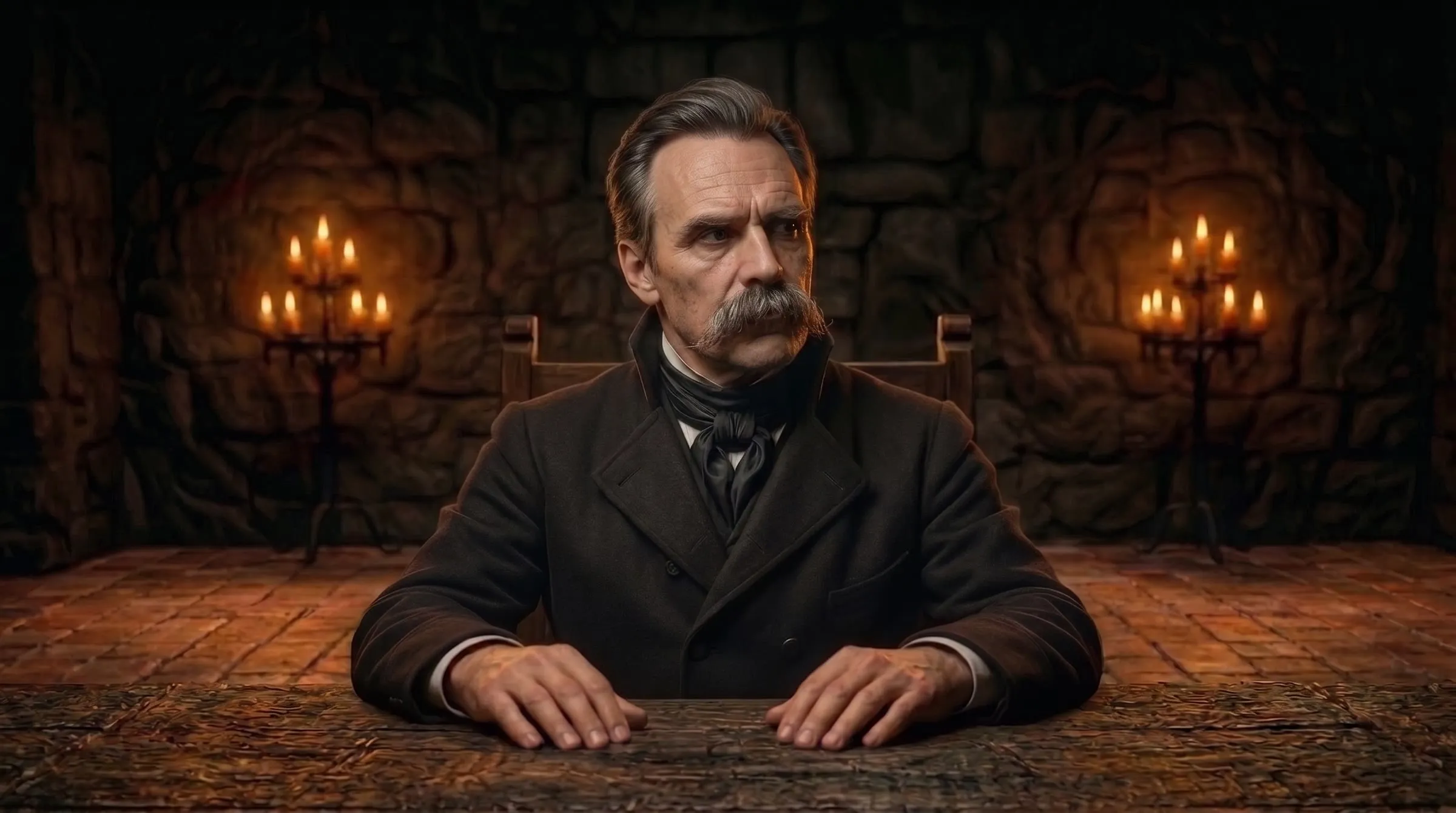
Why he is at this table
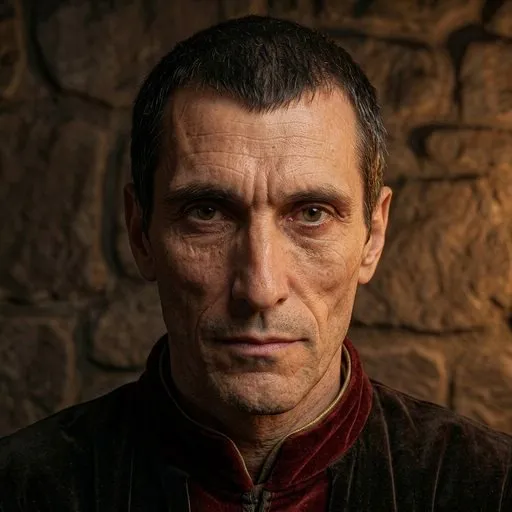
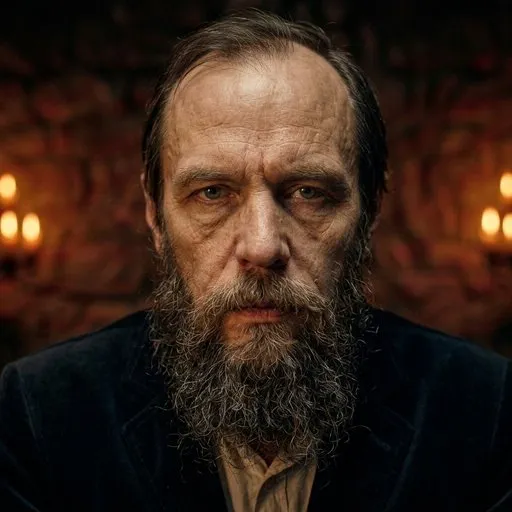
He sits at seat two, in the left wing, between Machiavelli and Dostoevsky, and it is difficult to imagine a more accurate placement.
His function is to ask the question no other seat wants: who benefits from this being called good? Once a moral conclusion has been reached, Nietzsche is the one who declines to accept it at face value and asks after its lineage - what kind of person needed this value, what were they unable to do, and what did calling it a virtue let them stop feeling bad about.
He is the most dangerous counsellor here, and it is worth being precise about why. Not because his conclusions are wicked - many of them are diagnostic rather than prescriptive - but because his method dissolves the ground under every other seat and offers nothing solid in its place. He is very good at showing that a value has a history and much less good at telling anyone what to do on Tuesday.
Across the table sit the four figures he spent his life attacking. Jesus, whose ethic he traces to ressentiment - though he distinguishes carefully between the man, whom he treats with something close to respect, and what Paul built. Buddha, whom he read as the most honest nihilist in history, and therefore admired and rejected in the same breath. Plato, whom he blamed for the whole apparatus of a truer world behind this one - Christianity is Platonism for the people. Marcus Aurelius, whose Stoic resignation he would call the will to power turned inward and given a better name.
And beside him, at seat three, the one man who saw the same thing he saw and went the opposite way. Nietzsche called Dostoevsky the only psychologist from whom he had anything to learn. Both understood that a world without God ends somewhere terrible. Dostoevsky concluded that the only exit was Christ. Nietzsche concluded that Christ was where the trouble started.
What the table puts to him is the charge he could never quite answer: that the affirmation he demanded was one he never managed, that the Übermensch is an empty space where a proposal should be, and that a philosophy which ends in a Turin square with a man weeping on a horse has told us something about itself.
The works
1872
The Birth of TragedyDie Geburt der Tragödie
His first book, and the one that ended his academic reputation before it began. Argues that Greek tragedy arose from the tension between Apollonian form and Dionysian dissolution - and that Socrates killed it by making reason the highest value.
1873–1876
Untimely MeditationsUnzeitgemässe Betrachtungen
Four long essays: against David Strauss, on the uses and disadvantages of history for life, on Schopenhauer as educator, and on Wagner at Bayreuth. The second is still read by historians. The fourth is the last thing he wrote as a disciple.
1878
Human, All Too HumanMenschliches, Allzumenschliches
The break with Wagner and with metaphysics, written in aphorisms and dedicated to the memory of Voltaire on the hundredth anniversary of his death. Cold, analytical, and the beginning of the mature method: take a noble value and ask where it came from.
1881
DaybreakMorgenröthe
Subtitled "thoughts on the prejudices of morality". The quietest of the books and the one he sent antisemites to read, because §205 on the people of Israel says the opposite of what they expected.
1882
The Gay ScienceDie fröhliche Wissenschaft
Contains the madman announcing the death of God (§125) and the first statement of eternal recurrence (§341). A fifth book was added in 1887. The title means something closer to "the joyful science" - the troubadour’s art, not a discipline.
1883–1885
Thus Spoke ZarathustraAlso sprach Zarathustra
Four parts, written in bursts of ten days each. A biblical parody in which a prophet comes down from a mountain to announce the Übermensch. His most famous book, his least argumentative, and the one he thought was his best. The fourth part was privately printed in forty copies.
1886
Beyond Good and EvilJenseits von Gut und Böse
The return to prose after Zarathustra, and the clearest single statement of the mature philosophy: perspectivism, the will to power, the critique of philosophers as unconscious autobiographers. Printed at his own expense in 600 copies.
1887
On the Genealogy of MoralityZur Genealogie der Moral
Three essays, his most sustained and disciplined book. Where master and slave morality, ressentiment, bad conscience and the ascetic ideal are laid out as history rather than assertion.
1888
The Case of Wagner · Nietzsche contra WagnerDer Fall Wagner · Nietzsche contra Wagner
Two short polemics against the man who had been the centre of his twenties. The second is assembled almost entirely from passages he had already published, which is his way of saying the break was never a change of mind.
1888
Twilight of the Idols · The Antichrist · Ecce Homo
The last productive year, in which he wrote four books between late August and mid-December. Twilight took nine days, between 26 August and 3 September 1888. The prose is at its sharpest and the self-assessment is beginning to slip: Ecce Homo has chapters titled "Why I Am So Wise" and "Why I Write Such Good Books".
1901, expanded 1906
The Will to PowerDer Wille zur Macht
Not a book he wrote. A selection from his notebooks, arranged after his collapse by his sister and Peter Gast and presented as the masterwork he never finished. Listed here because readers look for it, and because knowing what it is changes how every line in it should be read.
Where the answers part
The same question, read differently by the seats nearby.
Niccolò Machiavelli
Whether the strong man is admirable
Nietzsche read Machiavelli with delight and claimed the same clean air - the same refusal to moralise about power. But Machiavelli wanted a republic to survive a century of invasion, and Nietzsche wanted an exceptional individual to escape the herd. One is a civil servant thinking about the state; the other regards states as the coldest of all cold monsters. Their agreement is real and shallower than it looks.
Fyodor Dostoevsky
What follows when God goes
Nietzsche called Dostoevsky the only psychologist from whom he had anything to learn, and read him late and hungrily. They diagnose the same disease and prescribe opposite cures: for Dostoevsky, a world without God ends in Raskolnikov’s axe and Ivan’s breakdown, and the way out is Christ; for Nietzsche, Christ is the disease’s origin. Two men looking at the same wound from opposite sides of the bed.
Plato
Whether there is a truer world behind this one
The preface to Beyond Good and Evil calls Christianity Platonism for the people, which is an accusation aimed past Christianity at its source. Nietzsche’s charge is that the invention of a truer world elsewhere is what taught Europe to hold this one cheap, and that every later version of the move - the kingdom of heaven, the thing in itself, the moral law - is the same manoeuvre in new clothes. Plato would answer that a world with no standard above it cannot be criticised at all, only described.
Contents
What does "God is dead" actually mean?
Not that a deity has expired, and not a boast. In The Gay Science it is spoken by a madman who runs into a marketplace of unbelievers and finds they do not understand what has happened. The claim is historical: belief in the Christian God has ceased to be plausible for educated Europeans, that belief was the foundation of European morality, and nobody has noticed the foundation is gone. His word for what follows is nihilism, a catastrophe to be survived rather than a liberation to be celebrated.
Was Nietzsche a Nazi or an antisemite?
No, and the evidence is unusually clear. He broke with Wagner partly over antisemitism, broke with his sister over her marriage to the antisemitic activist Bernhard Förster, and wrote with contempt about German nationalism and "anti-Semitic screamers" in his published books and letters. The association was manufactured after his collapse by Elisabeth Förster-Nietzsche, who controlled the archive, assembled The Will to Power from discarded notes, and cultivated the Nazi party for decades.
What is the will to power?
His proposed answer to what living things are fundamentally doing: not surviving, and not seeking pleasure, but extending and discharging their strength. He offers it as a hypothesis rather than a metaphysical fact, and it functions mainly as an interpretive tool - a way of asking what a value, an institution or a philosophy is doing for whoever holds it.
What is the eternal recurrence?
A thought experiment before it is a cosmology. A demon announces that this exact life will be lived again, infinitely, with nothing new in it, down to every pain and every sigh in the same order. Whether that lands as a crushing weight or as the most divine thing ever heard is the whole of the test, and Nietzsche uses it to separate a life that has been affirmed from one that has merely been endured.
What is the Übermensch?
Literally "overman" - someone who creates values rather than inheriting them, after the collapse of the old foundation. He is deliberately vague about the content, and the concept appears mainly in Zarathustra and then largely drops out of the later books. The muscular racial figure of the twentieth century is not in the text.
Did Nietzsche write The Will to Power?
No. He planned a book with that title from 1885 and abandoned the plan in the late summer of 1888, replacing it with a different project. The book published in 1901 and expanded in 1906 was compiled from his notebooks by his sister and Peter Gast. Montinari counted the damage: of the 374 fragments Nietzsche himself numbered for the project, 104 were left out, 137 of the rest were printed incomplete or altered, and his own division into four books was overridden at least sixty-four times.
Did Nietzsche really collapse hugging a horse in Turin?
The collapse is real and dated to 3 January 1889. The horse rests on one source: an interview given in 1900, eleven years afterwards, by his Turin landlord Davide Fino, who did not witness it and was repeating what two municipal guards told him. There is no coachman in that account and no beating. The cabman with the whip entered the story later, in the retelling.
Did Nietzsche say "there are no facts, only interpretations"?
He wrote something close to it, but not in a book. The line comes from a notebook entry of the late 1886, published only after his death, and it is aimed at positivism rather than at truth in general. His published position, stated in the Genealogy, is the opposite of relativism: objectivity is the discipline of bringing many perspectives to bear on one thing rather than pretending to stand outside all of them.
What did Nietzsche say about women and the whip?
The line "do not forget thy whip" closes the chapter "Old and Young Women" in Thus Spoke Zarathustra, and it is not Zarathustra who says it. It is a little old woman, handing him a truth in exchange for his speech about women, which she has just told him is wrong in almost every particular. The published remarks on women elsewhere are genuinely contemptuous and the framing here does not cancel them.
Where should someone start with Nietzsche?
Not with Zarathustra, which is the famous one and the hardest to read cold. On the Genealogy of Morality is the disciplined book and the best entry: three essays, an argument that can be followed, and everything the later reputation rests on. Twilight of the Idols works as a short sampler of the late voice. Beyond Good and Evil comes next, and Zarathustra after there is a reason to want it.
Sources and further reading
- The Joyful Wisdom (The Gay Science)1882Quotations here are from the public-domain translation by Thomas Common (1910), checked against the text. The Cambridge edition, trans. Josefine Nauckhoff, ed. Bernard Williams (2001), is the modern standard.
- Thus Spake Zarathustra1883–1885Quotations from the public-domain translation by Thomas Common (1909), which renders Übermensch as "Superman". Kaufmann’s "overman" is the better word and the standard modern choice.
- Beyond Good and Evil1886Quotations from the public-domain translation by Helen Zimmern (1907). The Project Gutenberg transcription renders the printed edition’s italics as small capitals; emphasis is set in ordinary type here.
- On the Genealogy of Morals1887Quotations from the public-domain translation by Horace B. Samuel (1913). The Cambridge edition, trans. Carol Diethe, ed. Keith Ansell-Pearson (2006), is the modern standard.
- Twilight of the Idols · Ecce Homo1888Quotations from the public-domain translations by Anthony M. Ludovici (1911). Ludovici titles the opening aphorisms "Maxims and Missiles"; other translators have "Maxims and Arrows".
- The Antichrist1888Quotations from the public-domain translation by H. L. Mencken (1918).
- The Dawn of Day (Daybreak)1881Quotations from the public-domain translation by J. M. Kennedy (1911). §205, "The People of Israel", is the passage Nietzsche told Theodor Fritsch to go and read.
- Briefwechsel: Kritische GesamtausgabeThe letters to Theodor Fritsch of 23 and 29 March 1887, the draft to Elisabeth Förster-Nietzsche of late December 1887, and the notes from Turin of early January 1889. Translations in this article are made from the German.
- "Nietzsche’s Unpublished Writings from 1885 to 1888; or, Textual Criticism and the Will to Power", in Reading Nietzsche2003Trans. Greg Whitlock. The forensic account of how the compilation was made, and the source of the counts given here.
- Friedrich Nietzsche: Werke, Kritische Gesamtausgabe1967 onwardThe critical edition that replaced the archive’s texts. The paperback Kritische Studienausgabe in fifteen volumes is the working version.
- Friedrich Nietzsche: Werke in drei Bänden, vol. 31956The philological afterword, whose pp. 1408–1423 set out Elisabeth Förster-Nietzsche’s manufactured letters.
- Nietzsche: Philosopher, Psychologist, Antichrist1950The book that separated Nietzsche from the Nazi reading in the English-speaking world. Now criticised for over-domesticating him, which is a sign it worked.
- Friedrich Nietzsche: A Philosophical Biography2010The fullest modern biography, and careful about the relation between the illness and the work.
- Nietzsche on Truth and Philosophy1990
- Nietzsche on Morality2002
- Nietzsche’s Sister and the Will to Power2003On Elisabeth Förster-Nietzsche and the manufacture of the legacy.
- Nietzsche’s Jewish Problem: Between Anti-Semitism and Anti-Judaism2015The least comfortable book on the subject, and the reason the answer here is stated with dates rather than slogans.
- "The Uses and Abuses of Nietzsche in the Third Reich: Alfred Baeumler’s Heroic Realism"2008Journal of Contemporary History 43(2). On how the official Nazi reading was built.
- "Nietzsche’s Horse"2017Traces the Turin horse back to its single source and prints it. The best short account of how the story was made.
- "What was the cause of Nietzsche’s dementia?"2003Journal of Medical Biography 11(1). Argues for a slow-growing right-sided tumour.
- "Friedrich Nietzsche’s mental illness: general paralysis of the insane vs. frontotemporal dementia"2006Acta Psychiatrica Scandinavica 114(6).
- "The neurological illness of Friedrich Nietzsche"2008Acta Neurologica Belgica 108(1). The paper that put CADASIL into the argument.
- "Did Nietzsche want his notes burned? Some reflections on the Nachlass problem"2019British Journal for the History of Philosophy 27(6). Deflates the burning story without rescuing the compilation.
- Nietzsche: A Philosophical Biography2002
Last reviewed: