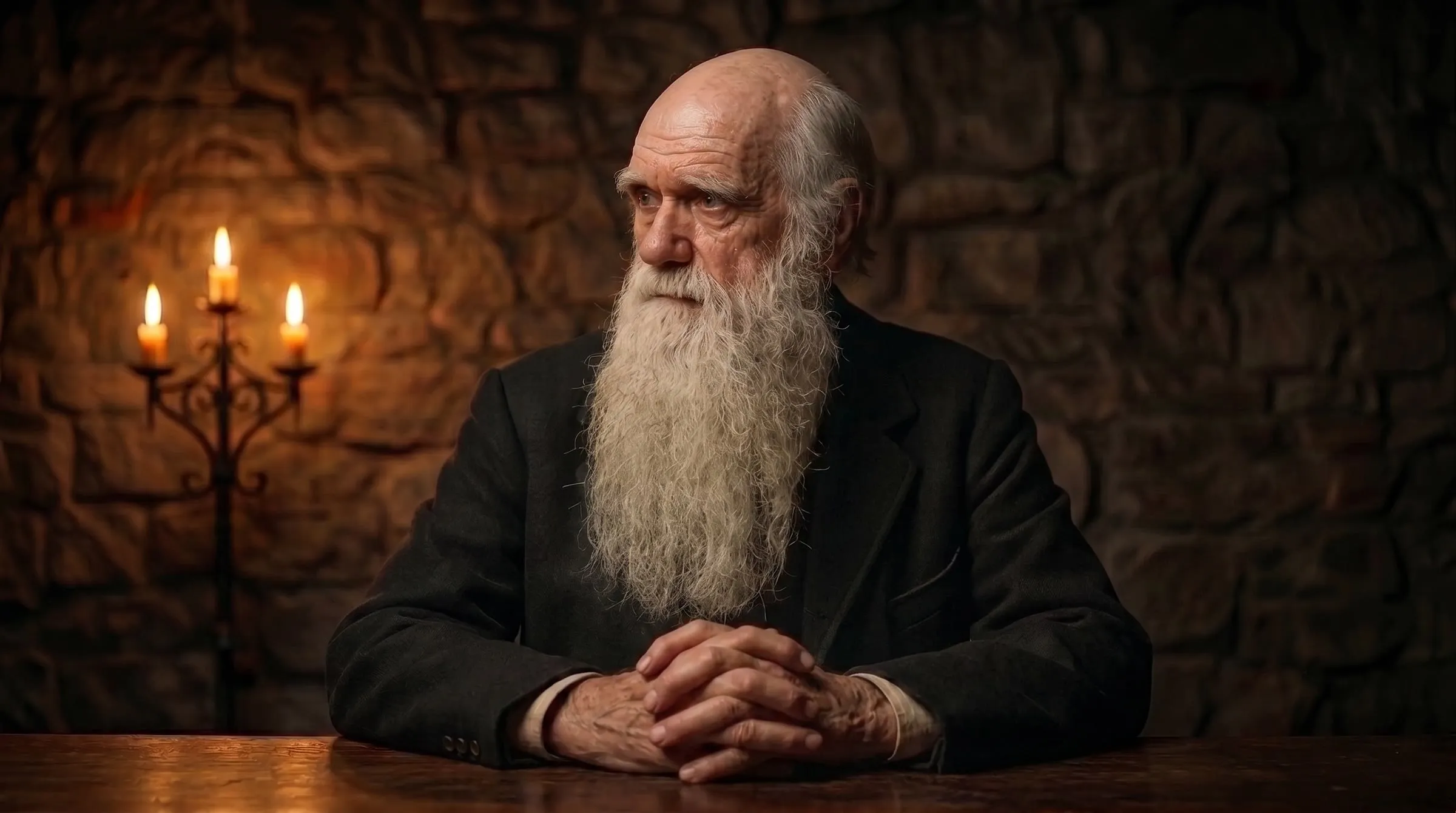
In June 1858 a letter reached Down House in Kent from Ternate, in the Malay Archipelago. It contained an essay of about four thousand words by Alfred Russel Wallace, a specimen collector fourteen years Darwin’s junior, setting out a theory of species change by the differential survival of varieties.
It was Darwin’s theory. He had written it out privately in 1842 and again, at greater length, in 1844, and shown it to almost nobody. He wrote to Lyell the same day: I never saw a more striking coincidence. If Wallace had my MS sketch written out in 1842 he could not have made a better short abstract.
Then he added the sentence that gives away the previous sixteen years: So all my originality, whatever it may amount to, will be smashed.
The unpromising young man
Born 12 February 1809 in Shrewsbury, into money on both sides. His father Robert was a successful and physically enormous physician; his grandfather Erasmus Darwin was a poet, physician and - significantly - the author of a work proposing that all warm-blooded animals had descended from a single living filament. His mother, Susannah Wedgwood, was the daughter of Josiah Wedgwood, the pottery industrialist, and she died when Charles was eight.
He was sent to Edinburgh to study medicine and left after two years, unable to bear the surgery, which in 1826 was performed without anaesthetic. His father had already told him, back in the school years, that he cared for nothing but shooting, dogs and rat-catching, and would be a disgrace to himself and to his family. He was then sent to Cambridge to prepare for the clergy - a respectable destination for a young gentleman with an interest in beetles, since natural history was a normal clerical pastime.
Edinburgh was not entirely wasted. Robert Grant, a marine zoologist who dredged the Firth of Forth and argued openly for Lamarck, took him out collecting, taught him to dissect sea mats and sponges under a lens, and let him hear transmutation defended by someone who was neither a crank nor a pamphleteer.
At Cambridge he did what he was going to do anyway: collected beetles obsessively, and attached himself to the botany professor John Stevens Henslow. It was Henslow who put his name forward when Captain Robert FitzRoy of HMS Beagle asked for a gentleman naturalist and companion for a surveying voyage to South America.
His father refused. His uncle Josiah Wedgwood II argued the case in writing, and his father relented. He was twenty-two.
Five years
The Beagle sailed on 27 December 1831 and returned on 2 October 1836. It was meant to take two years.
He was seasick for most of five. He was also, crucially, ashore for around three-fifths of the voyage, and he spent that time as a geologist. He had taken Charles Lyell’s Principles of Geology, which argued that the earth’s features were produced by ordinary processes acting over immense time. In Chile in February 1835 he experienced a major earthquake at Valdivia and afterwards observed mussel beds lifted several feet above the tideline - and he had his demonstration. Land rises. Slowly, in increments, by processes still going on. Given enough time, small forces do very large things.
That is the intellectual armature of the whole later theory, and he acquired it from rocks rather than from finches.
The Galápagos, in September and October 1835, were five weeks in the middle of a five-year voyage, and the popular story about them is wrong in an instructive way. He did not have a revelation there. He collected the finches carelessly, without recording which island each came from, and had to reconstruct the localities later from the notes of other crew members. It was the ornithologist John Gould, in London in March 1837, who told him they were not a mixed assortment of blackbirds and finches at all but twelve separate species of a single closely related group found nowhere else.
That was the moment. It happened at a desk in London, over specimens someone else had identified, sixteen months after he left the islands.
He had also been marked by something that had nothing to do with biology. In Brazil he saw slavery directly, and the passages in his journal are furious. He records hearing moans from a house he was passing near Pernambuco, and an estate owner near Rio who came close to selling the women and children of thirty families away from the men at public auction; he says that to this day, if he hears a distant scream, it brings the scene back. The Darwins and the Wedgwoods were abolitionist families, and Desmond and Moore have argued that his insistence on the common descent of all human beings had a moral engine behind it as well as an evidential one.
The last chapter of the Journal closes the subject in a line. Leaving Brazil in August 1836, he thanks God he will never again visit a slave country: a sentence that appears in the second edition of 1845 and not in the first.
What the Galápagos finches story gets wrong
The Beagle was in the archipelago from 15 September to 20 October 1835, and what happened there has been compressed into a scene that never took place.
Frank Sulloway went through the surviving collections in 1982 and established the scale of the carelessness. Darwin took thirty-one finch specimens and recorded an island locality for three, all of them on James. To place the rest he borrowed other people’s labels: FitzRoy’s, which were properly documented, four birds shot by his servant Syms Covington, and eight taken by a shipmate, Harry Fuller. In his own master catalogue he drew a line under his first eight specimens and guessed at them collectively, Chatham Isd??, the question marks his own and added after the voyage. He was not collecting evidence, because he did not yet think he needed any.
John Gould reported on the birds to the Zoological Society on 10 January 1837. What Darwin had filed variously as finches, wrens, grosbeaks and blackbird relatives was one group of ground finches, so peculiar as to form an entirely new group, containing twelve new species.
Darwin went to see him in early March, and what turned him in that conversation was not the finches. It was the mockingbirds. Gould told him three of the four Galápagos forms were separate species rather than varieties of one, and Darwin had already written in his ornithological notes that if there were the slightest foundation for what he had noticed, such facts would undermine the stability of species.
He improved the story himself. The second edition of the Journal of Researches, in 1845, carries a sentence the 1839 edition does not:
Seeing this gradation and diversity of structure in one small, intimately related group of birds, one might really fancy that from an original paucity of birds in this archipelago, one species had been taken and modified for different ends. Journal of Researches, second edition, 1845, chapter XVII
The finches are named nowhere in the Origin, in any of its six editions; Darwin argued from the mockingbirds and the plants instead, because those had localities he could defend. The phrase Darwin’s finches was coined by Percy Lowe in the 1930s and made famous by David Lack’s book of that title in 1947.
Twenty-one years
By July 1837 he had opened the first notebook on transmutation. In late September 1838 he read Malthus’s Essay on the Principle of Population, for amusement as he later put it, and found the mechanism. Malthus argued that populations grow geometrically while food supply grows arithmetically, so that a struggle for existence is inevitable. Darwin saw immediately what a struggle for existence would do to a population of varying individuals.
By 1842 he had a thirty-five-page pencil sketch. By 1844 a 230-page essay, which he sealed with a letter to his wife instructing her to publish it if he died.
And then, for fourteen more years, nothing.
He married his first cousin Emma Wedgwood in 1839, having first drawn up a famous two-column list, Marry / Not Marry, with entries including constant companion (and friend in old age), better than a dog anyhow, and against it less money for books and terrible loss of time. It was a happy marriage of forty-three years and ten children. Emma was devoutly Christian and understood early what her husband thought, and wrote him a letter asking him not to let the habits of scientific enquiry close off other kinds of truth. He kept it for the rest of his life, and wrote on it: When I am dead, know that many times, I have kissed and cryed over this.
They moved to Down House in Kent in September 1842 and he essentially never left it again. He was ill for the rest of his life, with vomiting, boils, palpitations and exhaustion, and with a condition never diagnosed and still argued about: Chagas disease contracted in South America, lactose intolerance, the strain of the secret itself. He worked in four-hour stretches on good days and not at all on bad ones.
He spent eight of those years on barnacles. Four volumes, every known species, living and fossil. It looks like avoidance and it did two things he needed: it made him a taxonomist with standing, rather than a gentleman traveller with an opinion, and it showed him just how much variation exists inside what everyone was calling one species.
He also bred pigeons, ran experiments on his lawn, and corresponded with sheep farmers and gardeners and diplomats and missionaries. Some fifteen thousand of those letters survive. He floated seeds in salt water for months to see whether they could cross oceans and still germinate. He weighed the earth that worms bring to the surface.
The delay was fear, and the fear was specific. Evolutionary ideas in 1840s Britain belonged to radicals and street atheists; the anonymous Vestiges of the Natural History of Creation (1844) had been savaged. To publish was to be classed with people who wanted to bring down the Church and the social order, and he was a wealthy, respectable, chronically ill man married to a believer. He called it, in a letter to Hooker in 1844, like confessing a murder.
Then in April 1851 his eldest daughter Annie died at ten, of an illness that was probably tuberculosis, after months of decline. He wrote a private memorial a week later and could not attend the funeral. Whatever remained of his Christianity did not survive it. He wrote later that he could not see how anyone could wish Christianity to be true, since it plainly implied that unbelievers, his father and his brother and his closest friends among them, would be everlastingly punished. And this is a damnable doctrine.
The Marry / Not Marry notes of 1838
Two scraps of paper survive in the Darwin Archive at Cambridge University Library, written in the months before he proposed. They are not a joke assembled later by a biographer. The Darwin Correspondence Project dates the first to after 7 April 1838 and the second to July.
The second is headed This is the Question, in two columns.
Marry. Children, if it please God. A constant companion and friend in old age, an object to be beloved and played with, and then the phrase that has outlived the rest of the page: better than a dog anyhow. A home, and someone to take care of it. The charms of music and female chit-chat, which are good for one’s health, and then, without changing column, but terrible loss of time.
Not Marry. Freedom to go where one liked. Choice of society, and little of it. Conversation of clever men at clubs. Not being forced to visit relatives and to bend in every trifle. Against them the expense and worry of children, and the loss of the evenings, since a married man cannot read in the Evenings. He ends the column with what he expects to become: fatness & idleness.
He is twenty-nine, has a theory of species change in a private notebook, and is costing out whether a wife would interrupt it.
What settles it is a picture rather than an argument: a nice soft wife on a sofa with a good fire, books and music perhaps, against what he calls the dingy reality of Great Marlborough Street, where he was then living alone. Then, in his own shorthand, Marry - Mary - Marry Q.E.D.
He proposed to Emma Wedgwood on 11 November 1838 and was accepted the same day. Nothing in the notes suggests he expected to be happy, and by every account he was.
The eight barnacle years, and what they were for
In October 1846 he picked up a small burrowing barnacle he had brought back from Chile, meaning to write it up as a short paper. To describe it properly he had to compare it with its relatives, and nobody had described the relatives. He was still at it eight years later.
The result was four volumes: two on living Cirripedia for the Ray Society, in 1851 and 1854, and two on the fossil forms for the Palaeontographical Society. Every known barnacle, extant and extinct. The Royal Society gave him its Royal Medal in 1854, largely for the work. To his second cousin William Darwin Fox, on 24 October 1852:
I hate a Barnacle as no man ever did before, not even a Sailor in a slow-sailing ship. Letter to W. D. Fox, 24 October 1852
The usual reading is displacement, and that is some of it. It is also where the argument of the Origin was built, and three things came out of it. The first is standing: after 1854 he was a systematist who had done the hardest descriptive work there is, on a group nobody else would take on, and the Origin could not be dismissed as the speculation of an amateur.
The second is variation. Working through thousands of specimens of what was nominally a single species, he found the differences between individuals were continuous, everywhere, and often larger than the differences being used to separate one species from another. The species boundary stopped looking like a fact about the world and started looking like a decision made by whoever held the pen.
The third is the strangest thing he ever found. In several genera there were tiny degenerate males living inside the body of the hermaphrodite, which he named complemental males. Barnacles were supposed to be hermaphrodites throughout. Here was a group caught between two sexual systems, with the intermediate arrangements not inferred from fossils but alive, in a jar, on his desk.
Darwin’s illness, and the diagnoses still argued over
From his late twenties until his death he was chronically ill, and nobody has established with what.
The symptoms are unusually well documented, because he documented them. Vomiting, often two or three hours after eating. Flatulence, recorded obsessively. Palpitations, trembling, boils, eczema, headaches, ringing in the ears, and episodes of exhaustion that took away whole weeks. He kept a health diary and took the water cure at Malvern and at Ilkley, and it sometimes helped, and he could not say why.
The working day contracted around it, to short stretches and rarely more than four productive hours. Hooker and Huxley did the arguing in public partly because Darwin could not stand up in a room and do it.
The candidate diagnoses have accumulated for a century and none closes the case.
Chagas disease, from the bite of the benchuca bug he recorded in Argentina in March 1835, was proposed by Saul Adler in 1959. It fits the timing and some of the cardiac trouble, and fits badly with the complaints that began before the voyage.
Systemic lactose intolerance, argued by Anthony Campbell and Stephanie Matthews in 2005, fits the two-to-three-hour delay between eating and vomiting, and the improvements when milk and cream were out of his diet.
Cyclical vomiting syndrome with a mitochondrial inheritance on his mother’s side is John Hayman’s proposal, and it accounts for the family pattern: his mother, an uncle and a maternal aunt all had unexplained illnesses of their own.
Ménière’s disease accounts for the ear symptoms and little else.
And there is the reading some historians still hold: that a man carrying an unpublished theory he expected to be destroyed for was paying for it in his body. It cannot be tested, which is a reason to handle it carefully rather than discard it.
A patient dead since 1882 cannot be examined, and four decades of symptoms need not have had a single cause.
Publication
Wallace’s letter arrived on 18 June 1858. Darwin’s youngest son died of scarlet fever ten days later.
Lyell and Hooker arranged a compromise: extracts from Darwin’s 1844 essay and a letter of 1857, together with Wallace’s paper, were read to the Linnean Society on 1 July 1858, with neither author present. Nobody noticed. The society’s president reported at the end of the year that it had not been marked by any of those striking discoveries which revolutionise a department of science.
Darwin then wrote the book in thirteen months. On the Origin of Species by Means of Natural Selection was published on 24 November 1859. The whole edition had already gone at Murray’s trade sale two days earlier, where booksellers subscribed for more copies than the 1,250 that had been printed. The story that the public bought it out on the first day comes from a line in Darwin’s own diary and is not what happened.
The argument is deliberately unspectacular, which is why it worked.
Organisms produce far more offspring than can survive. Individuals within a species vary, and some of that variation is inherited. In the resulting struggle for existence, individuals whose variations happen to suit the conditions are more likely to survive and leave offspring. Their variations therefore become more common. Given enough time, the accumulated differences produce new species.
The great rhetorical move is the first chapter, which is about pigeon fanciers. Everyone in Victorian Britain knew that breeders had made pouters and fantails and tumblers from the common rock dove by choosing which birds to breed. Darwin lets the reader agree that selection can do this, and only then substitutes nature for the breeder - with the difference that nature has unlimited time and no aesthetic preferences.
He was honest about the difficulties to a degree that is rare. A whole chapter, Difficulties on Theory, raises the objections himself: the absence of transitional fossils, the problem of instinct, and above all the eye - that to suppose the eye could have been formed by natural selection seems, he writes, absurd in the highest possible degree. Then he answers it, by showing the gradations of light-sensitive organs that actually exist in living animals. Creationist quotation of the first half of that sentence without the second has been going on for a century and a half.
And on humans, the book says almost nothing. One sentence: Light will be thrown on the origin of man and his history. He knew exactly what he was doing.
Darwin and Wallace, and who arrived first
Alfred Russel Wallace was a professional collector, fourteen years younger, working the Malay Archipelago and paying for it by selling specimens. He was not an outsider to the question. In 1855 he had published a paper arguing that every species comes into existence coincident in space and time with a pre-existing closely allied species, which describes the pattern of descent without naming a cause. Darwin read it, annotated it, and did not see what was in it.
In February 1858, on Ternate, Wallace wrote out about four thousand words titled On the Tendency of Varieties to Depart Indefinitely from the Original Type. Varieties diverge from the parent form; the check of limited subsistence bears hardest on the least well adapted; and nothing sets a limit to how far a population can be carried from where it began. That last clause is the radical one, because the naturalists of the day would grant variation within a species and would not grant that it goes anywhere.
It is the same mechanism, and not the same body of work. Wallace has the idea; Darwin had twenty years of evidence assembled to make the idea unavoidable, and reasons about individuals where Wallace reasons about varieties and races. Wallace posted it asking that it be forwarded to Lyell, and it reached Down House on 18 June 1858, ten days before Darwin’s youngest child, Charles Waring, died of scarlet fever at eighteen months.
The Linnean arrangement that followed was made by Lyell and Hooker rather than by Darwin, and that is where the case against it sits. Wallace’s paper went third and last, behind material that existed only in manuscript, in a proceeding got up by two of Darwin’s closest friends while the other party was unreachable by anything faster than a ship and could not be asked.
Wallace never took the point up. He called his 1889 book Darwinism and spent his life defending the theory in public while Darwin stayed at home. Accepting the Darwin-Wallace Medal at the Linnean Society on 1 July 1908, fifty years to the day, he set out the difference himself. Darwin had the idea in October 1838 and spent two decades collecting evidence for it; Wallace’s version was thought out in a few hours during an attack of fever, written down, copied onto thin letter paper and posted, the whole of it inside a week. Their shares, he said, might be estimated as twenty years is to one week.
He also declined the frame the question is usually put in. Nobody deserves praise or blame for the ideas that come to him, he said, but only for what he does about them.
Whether Darwin discovered evolution
He did not, and he said so in print.
The idea that species change, and are descended from other species, was old by 1859 and had been argued in Britain by people Darwin had read.
Erasmus Darwin, his own grandfather, published Zoonomia between 1794 and 1796, proposing that all warm-blooded animals had arisen from a single living filament with the power of acquiring new parts. Charles read it as a young man and recorded the effect in his autobiography: none.
Jean-Baptiste Lamarck set out a complete transformist system in Philosophie zoologique in 1809, with a mechanism attached: organs used are strengthened, organs neglected wither, and the changes pass to the offspring. Darwin met the argument at Edinburgh from Robert Grant, who one day, walking, burst out in high admiration of Lamarck. Darwin wrote afterwards that he listened in silent astonishment and, so far as he could judge, without any effect on his mind.
Patrick Matthew, a Scottish landowner, published a statement of natural selection in 1831, in an appendix to On Naval Timber and Arboriculture. Nobody read the appendix. Matthew wrote to the Gardeners’ Chronicle on 7 April 1860 to say what he had done, and Darwin replied on 21 April, in public and without a fight, that Matthew had anticipated by many years the explanation he had offered under the name of natural selection. Matthew handed the credit back on 12 May: the law had come to him intuitively, almost without an effort of concentrated thought, so that Darwin seemed to him to have the more merit in the discovery.
Robert Chambers published Vestiges of the Natural History of Creation anonymously in 1844, a developmental cosmology from nebulae to humanity in one readable volume. The professionals savaged it, everyone else read it, and according to James Secord it outsold the Origin in Britain until the 1890s. His authorship was acknowledged only in 1884, thirteen years after his death.
So descent was not the news. Three other things were.
The mechanism, first: natural selection requires no drive, no inner tendency toward improvement and no inheritance of effort, only overproduction, heritable variation and differential survival, all three of which can be watched happening. The evidence, second: Vestiges asserts, while the Origin argues from breeding, biogeography, embryology, rudimentary organs, instinct and the fossil record, and puts the objections to itself before its critics can.
And the shape. Almost every earlier scheme kept the ladder, with humanity at the top. The single diagram in the Origin, its only illustration, is a branching tree, and a tree has no top.
He added An Historical Sketch of the Recent Progress of Opinion on the Origin of Species to the third English edition in April 1861, naming his predecessors one by one. He wrote it under pressure, after complaints, and it is why the priority question has a paper trail at all.
What Darwin wrote about the eye
Chapter VI of the Origin is titled Difficulties on Theory, and it exists so that his critics would find nothing he had not already put on the table. Its section on organs of extreme perfection contains the most quoted sentence he ever wrote, and it is almost always quoted with the second half removed.
Both sentences, in full:
To suppose that the eye, with all its inimitable contrivances for adjusting the focus to different distances, for admitting different amounts of light, and for the correction of spherical and chromatic aberration, could have been formed by natural selection, seems, I freely confess, absurd in the highest possible degree. Yet reason tells me, that if numerous gradations from a perfect and complex eye to one very imperfect and simple, each grade being useful to its possessor, can be shown to exist; if further, the eye does vary ever so slightly, and the variations be inherited, which is certainly the case; and if any variation or modification in the organ be ever useful to an animal under changing conditions of life, then the difficulty of believing that a perfect and complex eye could be formed by natural selection, though insuperable by our imagination, can hardly be considered real. On the Origin of Species, chapter VI
The shape is the one he uses throughout: state the objection more forcefully than the objector would have, then take it apart. I freely confess is a concession offered in order to be withdrawn two clauses later.
And the withdrawal is empirical rather than verbal. What follows is a survey of the light-sensitive organs that exist in living animals: an optic nerve with pigment and no lens; a shallow pit; a deeper pit; a pit with a transparent covering that begins to focus; and so on to the vertebrate eye, every stage in current use by an animal that sees well enough with it. The claim is not that a complex eye could conceivably have arisen, but that the gradations do not have to be imagined. They are alive.
The truncated version was circulating within a decade and has never stopped. It works because it is four words of doubt from the author himself, with the sentence that answers them taken out.
Whether Darwin coined “survival of the fittest”
He did not. Herbert Spencer did, in The Principles of Biology in 1864, and Spencer was explicit that he meant it as a restatement of Darwin rather than a rival: what he had sought to express in mechanical terms, he wrote, was what Mr Darwin had called natural selection.
The phrase reached the Origin through Wallace, who wrote in July 1866 arguing that natural selection misled readers by inviting them to picture nature choosing. Darwin agreed on 5 July, with one reservation that has aged well: the trouble with Spencer’s expression is that it cannot be used as a substantive governing a verb. Nature selects. Nothing survivals. Whether the term would be rejected, he added, must now depend on the survival of the fittest. It went into the fifth edition in 1869, in the heading of chapter IV, alongside the older term rather than in place of it.
What fittest does not mean is strongest, fastest, healthiest or best. Fit here is fit in the sense of a joint or a key: fitted to this environment, in this population, at this moment. Change the environment and the fit changes with it, which is why a species superbly adapted to a stable world is the first casualty when the world moves.
The damage was done by the grammar rather than the biology. Fittest is a superlative, superlatives invite a ranking, and a ranking invites the question of who stands at the top of it. Natural selection makes no such claim. A tapeworm is exquisitely fitted to its environment.
The last sentence of the Origin of Species, and the Creator added in 1860
The book ends with an entangled bank, and the closing sentence is doing a specific job: insisting that a world produced by law rather than by intention is not a diminished world.
There is grandeur in this view of life, with its several powers, having been originally breathed into a few forms or into one; and that, whilst this planet has gone cycling on according to the fixed law of gravity, from so simple a beginning endless forms most beautiful and most wonderful have been, and are being, evolved. On the Origin of Species, first edition, 1859, closing sentence
That is the text of November 1859. The second edition, published on 7 January 1860, has three words more:
having been originally breathed by the Creator into a few forms or into one On the Origin of Species, second edition, 1860
They stayed in every subsequent edition and are in most modern reprints, so most readers have never seen the sentence as first written. He said so to Hooker on 29 March 1863: he had long regretted truckling to public opinion and using the Pentateuchal term of creation, by which he had really meant appeared by some wholly unknown process.
The other thing about that sentence is its last word. Evolved closes every edition, and yet the noun evolution does not appear in the Origin until the sixth edition of 1872. In the vocabulary of the period the word meant the unfolding of something already present and already specified, which is close to the reverse of what he was describing.
How the Origin was received, and the Oxford meeting of 1860
The trade had taken the whole edition before publication day, and a second printing of three thousand followed within seven weeks. What came after was neither the uniform outrage of legend nor an easy victory.
Among naturalists the resistance was technical before it was religious. Richard Owen, the most powerful comparative anatomist in Britain, reviewed the book anonymously and savagely in the Edinburgh Review in April 1860. Adam Sedgwick, who had taught Darwin field geology in North Wales in 1831, wrote on 24 November 1859 to say he had read it with more pain than pleasure, and that Darwin had deserted the true method of induction. Louis Agassiz at Harvard never accepted any of it. Even the allies balked at the mechanism while granting the descent: Lyell came part of the way and never all of it, and Asa Gray, the theory’s American champion, wanted the variations divinely guided, which Darwin refused to concede.
The famous scene is the meeting of the British Association at the new Oxford University Museum on 30 June 1860. Samuel Wilberforce, Bishop of Oxford, spoke against the book and asked Thomas Huxley whether it was through his grandfather or his grandmother that he claimed descent from a monkey. Huxley’s own account, written two months afterwards, has him answering that he would rather have an ape for a grandfather than a man of great gifts who used them to introduce ridicule into a grave scientific discussion.
What the telling leaves out is that the surviving accounts are late, that they disagree with each other, that several people in the room thought Wilberforce had the better of it, and that the version in which Huxley routs the Church was assembled decades later, largely by Huxley’s admirers. Wilberforce’s review in the Quarterly was competent enough that Darwin called it uncommonly clever and said it picked out the most conjectural parts with skill.
Darwin was not there. He was away taking the water cure, and read about all of it in letters.
What Darwin got wrong
The theory survived. A good deal of the 1859 package did not, and he knew where the weakest joint was.
Inheritance. He had no theory of it, and the one he produced was wrong. The Variation of Animals and Plants under Domestication (1868) sets out what its own chapter title calls the provisional hypothesis of pangenesis: every cell throws off minute particles, gemmules, which circulate, collect in the reproductive organs and pass to the next generation. It makes inheritance an average of the whole body and lets acquired characters in through the front door. Francis Galton tested it by transfusing blood between differently coloured rabbits and told the Royal Society in 1871 that he had found nothing. Darwin replied in Nature that he had never said gemmules travelled in the blood, and conceded that pangenesis presented so many vulnerable points that its life was always in jeopardy.
Blending. The inheritance everyone assumed was a mixing, with offspring intermediate between their parents, so that a single advantageous variant is halved in every generation and vanishes before selection can accumulate anything from it. Fleeming Jenkin, an engineer, reviewed the Origin anonymously in the North British Review in June 1867, and Darwin took it as the most valuable criticism of the book he had read. Quite what Jenkin argued is now disputed: the swamping-by-blending objection has been read back into the review by later writers, and historians going back to Morris in 1994 have pointed out that those themes are largely absent from what he actually wrote. It pushed him, in later editions, to lean harder on the inheritance of use and disuse, which was a step backwards. The answer he needed, that inheritance is particulate and a variant is carried whole rather than diluted, already existed in print.
Mendel. Gregor Mendel published in 1866 in the proceedings of the natural history society of Brünn and was ignored until 1900. The story that Darwin owned an uncut copy of the paper is not true; there is no Mendel offprint in his archive. What is true is duller and worse. In 1881 Darwin acquired Wilhelm Focke’s Die Pflanzen-Mischlinge, which summarises Mendel’s results, and lent it to George Romanes for an encyclopaedia article on hybridism. The pages dealing with Mendel are uncut. He died the following April.
The age of the earth. William Thomson, later Lord Kelvin, calculated it from the rate of cooling and arrived in 1862 at something near a hundred million years, inside a range he narrowed as he went. Natural selection needed far more than the lower end allowed. Darwin wrote to Wallace on 14 April 1869 that Thomson’s views of the recent age of the world had been for some time one of his sorest troubles, and to James Croll in January that he required a very long period before the Cambrian formation. He softened his own estimate for the denudation of the Weald and eventually cut the calculation out. Kelvin’s physics was sound and his premise was not: he could not know about radioactive heating, identified in 1903. The earth is about 4.54 billion years old.
Gradualism, possibly. He held that nature makes no leaps and repeated the tag natura non facit saltum through the Origin. Whether the long stasis and abrupt turnover of the fossil record falsifies that, or merely records what fossilisation can preserve, is an argument Niles Eldredge and Stephen Jay Gould reopened in 1972 and that has not closed.
The core held. The two things he most needed and did not have, a mechanism of inheritance and a timescale, both arrived within thirty years of his death, and both arrived on his side.
The Descent of Man, and the difficult parts
He waited twelve more years and then, in 1871, said it directly. The Descent of Man argues that humans descend from earlier primate ancestors, that our mental and moral faculties differ from animals’ in degree and not in kind, and - against the racial science of his time - that all living humans are one species with a common origin, probably in Africa, on the evidence of the great apes there.
It also introduces sexual selection at length: that traits which look useless or costly for survival, like a peacock’s tail, can spread because they are preferred by mates. Most of the two volumes is that argument rather than the first, and is not about human beings at all. The claim that female preference is an evolutionary force in its own right was then neglected for a century.
And it contains passages that are indefensible and cannot be quarantined. He writes that at some future period the civilised races will almost certainly exterminate and replace the savage races throughout the world, and states it as a prediction rather than a wish, and the passivity of the framing is its own problem. He writes that man attains a higher eminence than woman in whatever he takes up, and offers a biological explanation for it.
Both, in his own words:
At some future period, not very distant as measured by centuries, the civilised races of man will almost certainly exterminate, and replace, the savage races throughout the world. The Descent of Man, second edition 1874, part I, chapter VI
The chief distinction in the intellectual powers of the two sexes is shewn by man’s attaining to a higher eminence, in whatever he takes up, than can woman. The Descent of Man, second edition 1874, part III, chapter XIX
Set against them, chapter VII, a sustained attack on the polygenists: the school, strong in Britain and dominant in the American South, that held human races to be separately created species. Darwin’s answer is that they interbreed freely, that they share innumerable small features independent origins would not predict, and that naturalists who rank them as species are misusing the word.
The last page takes its side in a sentence that is admirable and repellent at once:
I would as soon be descended from that heroic little monkey, who braved his dreaded enemy in order to save the life of his keeper… as from a savage who delights to torture his enemies… The Descent of Man, second edition 1874, part III, chapter XXI
The dignity he grants to animals is paid for by putting particular human beings underneath them.
Both things are true of him at once: he was a committed abolitionist who argued for human unity when much of the scientific establishment argued for separate origins, and he wrote a hierarchy of human groups into a founding text of biology, where it was used by people whose politics he did not share. He did not coin survival of the fittest - Spencer did - and he did not invent social Darwinism, and he did supply the vocabulary, and the eugenics movement was founded by his own cousin, Francis Galton, in his lifetime.
Darwin, social Darwinism and eugenics
The vocabulary was taken. The question is how much of it he handed over.
Herbert Spencer was applying an evolutionary frame to society before the Origin existed. Social Statics is from 1851, and its harshest pages, arguing that poor relief and public sanitation obstruct a purifying process, precede Darwin’s book by eight years. Spencer’s system is Lamarckian at the base and progressive in a way Darwin’s is not: it has a direction and a destination, which natural selection has not. The label social Darwinism became standard only through Richard Hofstadter’s Social Darwinism in American Thought in 1944.
Francis Galton was Darwin’s half-cousin, and that link is direct. He read the Origin in 1859 and said it changed the course of his life. He published Hereditary Genius in 1869, arguing that ability is inherited and distributed as measurable variation, and coined the word eugenics in Inquiries into Human Faculty in 1883. Darwin cited Hereditary Genius approvingly in The Descent of Man.
What Darwin supplied is real and should not be trimmed. He writes that civilised societies check the process of elimination, building asylums for the imbecile, the maimed and the sick, passing poor laws and saving lives that would otherwise be lost, so that the weak members of civilised societies propagate their kind. He writes that both sexes ought to refrain from marriage if they are in any marked degree inferior in body or mind.
What he did not supply is the conclusion. The chapter that sets out the problem also refuses the policy that seems to follow from it:
The aid which we feel impelled to give to the helpless is mainly an incidental result of the instinct of sympathy… Nor could we check our sympathy, even at the urging of hard reason, without deterioration in the noblest part of our nature. The Descent of Man, second edition 1874, part I, chapter V
And the marriage passage carries its own brake in the next clause: such hopes, he writes, are Utopian and will never be even partially realised until the laws of inheritance are thoroughly known. He proposed no programme, endorsed no legislation, and never argued for compulsion.
That is the ledger, and it does not balance in anyone’s favour. He described a mechanism, supplied a vocabulary that could be aimed at human beings, wrote down his unease about it, and did nothing to stop the people who dropped the unease and kept the rest. One of them was in his own family.
What Darwin actually believed about God
He went to Cambridge to become a clergyman, and he was not pretending. In the autobiography he records that he did not then doubt the strict and literal truth of every word in the Bible, and that Paley’s Evidences of Christianity and Natural Theology gave him as much delight as Euclid.
The retreat took thirty years and had three causes.
The first was the ordinary Victorian crisis: the Old Testament read as history is not credible, and the miracles require a standard of evidence nobody applies anywhere else. The autobiography records a process rather than an event. Disbelief crept over him at a very slow rate, he writes, but was at last complete, and so slowly that he felt no distress.
The second was the argument from design, and that one is his own doing. Paley’s watch found on a heath had been the strongest argument available in English, and natural selection removed the need for it: the old argument of design in nature, as given by Paley, which formerly seemed to him so conclusive, fails now that the law of natural selection has been discovered.
The third is suffering, and it is the one he never got round. To the American botanist Asa Gray, on 22 May 1860:
I cannot persuade myself that a beneficent & omnipotent God would have designedly created the Ichneumonidæ with the express intention of their feeding within the living bodies of caterpillars, or that a cat should play with mice. Letter to Asa Gray, 22 May 1860
The same letter refuses the opposite conclusion as firmly. He inclines to see everything as resulting from designed laws with the details left to chance, and then says plainly that this does not satisfy him either.
Annie’s death in April 1851 is where whatever was left of the Christianity went. But the doctrine he names in the autobiography is not the problem of suffering. It is hell:
I can indeed hardly see how anyone ought to wish Christianity to be true; for if so the plain language of the text seems to show that the men who do not believe, and this would include my Father, Brother and almost all my best friends, will be everlastingly punished. And this is a damnable doctrine. Autobiography, in the passage restored by Nora Barlow in 1958
Emma read that passage and noted in the margin, in October 1882, six months after his death, that she should dislike it published and that it seemed to her raw. When Francis Darwin printed the autobiography in the Life and Letters in 1887 the religious passages came out at her insistence, and Nora Barlow, their granddaughter, restored them only in 1958. Two generations met a Darwin edited by his family, through the decades when the argument about him was fiercest.
The word he settled on was coined by his own defender. Thomas Huxley invented agnostic in 1869; Darwin took it. To John Fordyce, on 7 May 1879:
In my most extreme fluctuations I have never been an atheist in the sense of denying the existence of a God. I think that generally, and more and more so as I grow older, but not always, that an agnostic would be the most correct description of my state of mind. Letter to John Fordyce, 7 May 1879
The autobiography puts it the same way: the mystery of the beginning of all things is insoluble by us, and he must be content to remain an agnostic. He kept nearly all of this private, and the reason was in the house with him.
The last years
He kept working: on orchids and how they trick insects into pollinating them, on climbing plants, on insect-eating plants, on the expression of emotion, and finally on earthworms - a book on how worms, over centuries, bring the whole topsoil of England through their bodies and bury the ruins of Roman villas. It is a book about immense results from imperceptible causes, which is the same book he had been writing since Valdivia.
The botany was not a retirement hobby. Fertilisation of Orchids, in 1862, describes flower after flower as machinery for getting pollen onto an insect and off again, out of parts that had been doing something else in the ancestor. He told Asa Gray it was a flank movement on the enemy, and there is no polemic anywhere in the text.
He died on 19 April 1882. He had expected to be buried in the churchyard at Downe. A petition got him Westminster Abbey instead, a few feet from Isaac Newton - a piece of establishment absorption that would have amused him and horrified him in equal measure. Huxley, Hooker and Wallace were among the pallbearers, which is to say that the man who had sent the letter from Ternate helped carry the coffin.
The deathbed conversion story, spread by an evangelist called Lady Hope, is false. His children, who were present, denied it flatly and repeatedly.
The Lady Hope story, and whether Darwin recanted
The claim that Darwin renounced evolution and returned to Christianity at the end has exactly one source, and the source postdates the deathbed by thirty-three years.
Elizabeth Reid Cotton, Lady Hope, was an evangelist and temperance campaigner who had lived near Downe. In 1915 she told a story at a conference in Northfield, Massachusetts, and it was printed in the Watchman-Examiner, a Baptist paper, on 19 August that year. In it she calls on Darwin in the autumn of 1881, finds him in bed reading the Epistle to the Hebrews, hears him regret the way he had expressed his theory, and is asked to gather local people to sing hymns in the summerhouse.
Darwin died on 19 April 1882. He was not bedridden in the autumn of 1881; he was seeing the earthworms book through the press, and it came out that October. No household record mentions the visit.
The family answered it as often as it came round. Francis Darwin wrote in 1918 that Lady Hope’s account of his father’s views on religion was quite untrue, that he had accused her publicly of falsehood, and that she had never replied. Henrietta Litchfield, Darwin’s daughter, wrote in The Christian on 23 February 1922 that she had been present at his deathbed; that she believed he never even saw Lady Hope; that in any case the woman had no influence over him in any department of thought or belief; and that he never recanted any of his scientific views, then or earlier.
Whether Lady Hope visited Down House at all cannot now be settled. What can be settled is that there was no recantation, and that the people who were in the room spent the rest of their lives saying so.
Why he is at this table
Seat ten, at the far end of the right wing, and structurally the mirror of Diogenes at seat zero. Both are outer limits; both dissolve rather than build.
His function is to remove the purpose from the question. When the table asks what a human being is for, Darwin is the one who declines the for. There is no plan, no ladder, no direction; there is variation, and a filter, and time. This is not nihilism and he was not a nihilist; the last sentence of the Origin calls it grandeur. But it takes the ground out from under most of the answers the other seats want to give.
He is also the table’s only professional evidence-gatherer, and the only one who published a theory he knew would cost him. Machiavelli described what he had seen and was called wicked for it; Darwin described what he had counted and was called worse, and unlike Machiavelli he had a choice and took twenty years to make it.
The disagreements arrange themselves neatly. Plato, immediately to his left, needs fixed kinds; Darwin’s whole achievement was to show there are none, and that variation is the reality of which the type is a shadow - the exact reversal of the Theory of Forms. Jesus and Buddha both build on a human condition that is somehow apart from the rest of nature; Darwin’s difference is one of degree. Nietzsche read him and disliked what he found - he thought Darwin had mistaken mere survival for the fundamental drive, and that the herd survives while the exceptional does not. Machiavelli, four seats away across an empty chair, would recognise the method instantly: observe what organisms do rather than what they ought to do, and follow it wherever it goes.
And Dostoevsky puts the question Darwin himself could not answer. Darwin wrote to Asa Gray in 1860 that he could not persuade himself that a beneficent and omnipotent God would have designedly created the Ichneumonidae, which lay their eggs in living caterpillars. His way out was to remove the designer, which converts the horror into a fact with nobody responsible for it.
Ivan Karamazov will not take that exit. He wants an accounting. Darwin’s universe has none to give, and Darwin knew it, and said so in a letter rather than in a book.
The works
1839
The Voyage of the BeagleJournal of Researches
The travel narrative that made him famous long before the theory. Geology, natural history, and an unambiguous denunciation of slavery written by a man who had just seen it in Brazil.
1851–1854
A Monograph on the Sub-class Cirripedia
Four volumes on barnacles, eight years of work. Usually treated as displacement activity; it was in fact where he established his credentials as a describing naturalist and learned how much variation exists within a single species.
1858
On the Tendency of Species to form VarietiesOn the Tendency of Species to form Varieties; and on the Perpetuation of Varieties and Species by Natural Means of Selection
The joint paper read to the Linnean Society on 1 July 1858 with neither author present: extracts from Darwin of 1844 and 1857, then Wallace’s Ternate essay. Natural selection appears in print here for the first time, and almost nobody noticed.
1859
On the Origin of SpeciesOn the Origin of Species by Means of Natural Selection
Written in thirteen months under the pressure of Wallace’s letter, and described by its author as "one long argument". The whole print run of 1,250 was oversubscribed by the trade at Murray’s sale two days before publication.
1862
On the Various Contrivances by which British and Foreign Orchids are Fertilised by Insects
The first book after the Origin, and what Darwin called a flank movement on the enemy. Orchids as machinery for cross-pollination, assembled out of parts adapted from other uses, with no polemic anywhere in the text.
1868
The Variation of Animals and Plants under Domestication
Two volumes of evidence behind the Origin’s first chapter, and the place where he set out pangenesis, his theory of inheritance. It was wrong, and the chapter title calls it provisional, which is a fair measure of how exposed he knew it to be.
1871
The Descent of Man, and Selection in Relation to Sex
Applies the theory to humans directly, which the Origin had almost entirely avoided. Introduces sexual selection at length - and contains the passages on race and on women that are the hardest to read.
1872
The Expression of the Emotions in Man and Animals
That emotional expressions are inherited and continuous across species. One of the first scientific books to use photographs, and the foundation of modern research on facial expression.
1881
The Formation of Vegetable Mould, through the Action of Worms
His last book, published six months before his death, on how earthworms remake the surface of the earth over geological time. It outsold the Origin in its first years.
written 1876, published 1887
The Autobiography of Charles Darwin
Written for his children and not meant for print. Francis Darwin cut the religious passages at Emma’s insistence before it appeared in the Life and Letters; his granddaughter Nora Barlow restored them in 1958, seventy-one years later.
Where the answers part
The same question, read differently by the seats nearby.
Plato
Whether kinds are real
Plato’s system requires each species to be a fixed reality of which individuals are imperfect copies. Darwin’s decisive move is the reverse: the variation between individuals is the real thing and the type is a statistical shadow. Ernst Mayr called it the replacement of essentialism by population thinking, and it may be the deepest conceptual change in the history of biology.
Friedrich Nietzsche
Whether survival is the point
Nietzsche read Darwin through German intermediaries and rejected what he found: that the struggle for existence rewards the mediocre, since the herd persists while the exceptional individual is destroyed by the very conditions that preserve the ordinary. He wanted the fundamental drive to be an expansion of power rather than a persistence in being. Darwin has the better evidence and Nietzsche has the sharper question, which is whether a theory explaining what lasts explains anything worth wanting.
Fyodor Dostoevsky
What the suffering is for
Darwin could not reconcile a benevolent designer with the ichneumon wasp, which paralyses a caterpillar so that its larvae can eat it alive. His solution was to remove the designer, which makes the cruelty meaningless rather than monstrous. Ivan Karamazov will not accept meaningless suffering either, and demands an accounting Darwin’s universe has no way of providing.
Contents
What is natural selection, in one paragraph?
More organisms are born than can survive. Individuals vary, and some of that variation is heritable. Some variations happen to improve the odds of surviving and reproducing in the environment as it is. Those variants therefore become more common in the next generation. Repeat over deep time and the accumulated changes produce new forms. There is no goal, no ladder and no intention: it is a filter, not a plan.
Why did Darwin wait twenty years to publish?
The usual answer is fear - of the reaction, of what it would do to his devout wife, of being classed with radical agitators. That is part of it. But he also spent the time doing the work: eight years on barnacles, years of pigeon breeding, and thousands of letters gathering evidence. He knew the argument would be attacked and wanted it unanswerable. He published when he did because Alfred Russel Wallace sent him the same theory in a letter from Ternate in 1858.
Did Darwin discover evolution?
No, and he said so in print. Descent with modification had been argued by his grandfather Erasmus Darwin in Zoonomia (1794), by Lamarck in 1809, by Patrick Matthew in an 1831 appendix, and by Robert Chambers anonymously in Vestiges in 1844. What was new in 1859 was the mechanism: natural selection, argued from a mass of evidence rather than asserted. Darwin added a historical sketch naming his predecessors to the third edition of 1861.
Did Darwin coin "survival of the fittest"?
No. Herbert Spencer did, in 1864, and Darwin added it to the fifth edition of the Origin in 1869 at Wallace’s suggestion, keeping it alongside natural selection rather than in place of it. "Fittest" does not mean strongest or best - it means best fitted to a particular environment at a particular moment. Change the environment and the fit changes with it.
Did Darwin steal the theory from Alfred Russel Wallace?
No. Darwin had written the theory out privately in 1842 and again in 1844, and had described it in a letter to Asa Gray in 1857, all before Wallace’s essay reached Down House on 18 June 1858. The Linnean Society arrangement of 1 July presented both men without consulting Wallace, who was in the Malay Archipelago and could not be reached in time. Told afterwards, he never objected, and in 1908 put their shares at roughly twenty years to one week.
What did Darwin actually write about the eye?
In chapter VI of the Origin he wrote that to suppose the eye could have been formed by natural selection "seems, I freely confess, absurd in the highest possible degree". The next sentence answers it: if gradations from a simple light-sensitive organ to a complex eye can be shown to exist, and each is useful to its owner, the difficulty "can hardly be considered real". The half-quotation has been circulating since the 1860s.
What did Darwin get wrong?
His theory of inheritance. Pangenesis, published in 1868, held that every cell sheds particles that gather in the reproductive organs; his cousin Francis Galton tested it with rabbit transfusions and found nothing. He allowed some inheritance of acquired characters. He never learned of Mendel. And he had no answer to Lord Kelvin, whose physics gave the earth far less time than natural selection needed. Radioactivity, found after his death, settled that one his way.
Was Darwin an atheist?
He described himself as an agnostic, a word coined by his defender Thomas Huxley. He began as a believer intending to take holy orders, and lost his faith gradually - through the theological problem of suffering in nature, and decisively through the death of his ten-year-old daughter Annie in 1851. He avoided public statements on religion, largely out of consideration for his wife.
Did Darwin recant on his deathbed?
No. The story has one source, an evangelist called Elizabeth Cotton, Lady Hope, who told it in Massachusetts in 1915, thirty-three years after Darwin died. His daughter Henrietta, who was present at the deathbed, wrote in 1922 that he never recanted any of his scientific views, then or earlier, and that she believed he never even met Lady Hope. His son Francis called the account untrue in 1918.
Why do the Galápagos finches matter, and what does the story get wrong?
Darwin had no revelation in the islands. He recorded island localities for three of his thirty-one finch specimens and reconstructed the rest from the collections of FitzRoy, his servant Covington and a shipmate. John Gould identified them as a new group of twelve species in January 1837, and the birds that actually moved Darwin were the mockingbirds. The finches are named nowhere in the Origin; they became famous through David Lack in 1947.
Was Darwin a racist?
He was a lifelong and vehement abolitionist, from a family of prominent abolitionists, and he argued that all humans are one species descended from common ancestors - a position that cut against the polygenist racial science of his day. He also wrote passages in The Descent of Man that rank human groups on a scale of civilisation and predict the extinction of "savage races", and passages on women’s intellectual inferiority. Both are in the record, and the second does not cancel the first.
Sources and further reading
- On the Origin of Species1859The first edition is the one to read; later editions add hedges and concessions to critics, including "survival of the fittest".
- The Descent of Man, and Selection in Relation to Sex1874Second edition, cited by part and chapter. Chapter V on the moral faculties, chapter VI on genealogy, chapter VII on the races, chapter XIX on the sexes, chapter XXI for the summary. The parts are renumbered from the first edition of 1871, which has no part III, and several passages were reworded, so the edition has to be named for the citations to be checkable.
- The Autobiography of Charles Darwin 1809-1882, with the original omissions restored1958The only edition to use. The 1887 text printed by Francis Darwin is missing the passages on religion, which is what most people quote it for.
- On the Origin of Species: an editorial introduction and bibliographyThe bibliographical record of every edition. It is also where the story that the public bought out the first printing on publication day is traced back to a line in Darwin’s diary and corrected.
- The Complete Work of Charles Darwin OnlineEvery published work in facsimile and transcription, with a variorum of the six editions of the Origin. Edited by John van Wyhe.
- The Correspondence of Charles DarwinSome 15,000 letters, freely searchable. The primary source for almost everything about how he worked.
- Charles Darwin: Voyaging (1995) and Charles Darwin: The Power of Place (2002)The definitive two-volume biography.
- Darwin: The Life of a Tormented Evolutionist1991The social and political reading - why a wealthy Whig naturalist had reason to be frightened of his own theory.
- Darwin’s Sacred Cause: Race, Slavery and the Quest for Human Origins2009Argues that the abolitionist commitment was a driver of the common-descent argument. Contested, and important.
- The Growth of Biological Thought1982On population thinking, and why it was the conceptual revolution rather than the evidence.
- The Beagle collections of Darwin’s finches (Geospizinae)1982The specimen-by-specimen reconstruction that dismantled the Galápagos legend. Island localities recorded for three of thirty-one finches.
- Where do Darwin’s finches come from?2012How a group of birds Darwin never named in the Origin became the emblem of the theory, by way of Percy Lowe and David Lack.
- Victorian Sensation: The Extraordinary Publication, Reception, and Secret Authorship of Vestiges of the Natural History of Creation2000On the book that took the shock before the Origin did, and outsold it in Britain until the 1890s.
- On the Tendency of Varieties to Depart Indefinitely from the Original Type1858The Ternate essay. Four thousand words, written in February, read at the Linnean Society on 1 July with the author eight thousand miles away.
- The Darwin-Wallace Celebration held on Thursday, 1st July, 19081908Contains Wallace’s own account of the 1858 arrangement, and his estimate of the two men’s shares as twenty years to one week.
- Annie’s Box: Charles Darwin, His Daughter and Human Evolution2001
- Darwin’s Illness2008The fullest catalogue of the symptoms and of the diagnoses proposed for them, by a physician who spent forty years on the question and declined to close it.
Last reviewed: