There is a difficulty at the start, and pretending otherwise makes everything afterwards less useful.
Nothing was written down for something like four hundred years. The teaching was preserved orally by communities of monks who chanted it in formulaic, heavily repetitive units designed for accurate memorisation - which is why the texts read the way they do, with their lists and their endless recapitulations. That system is more reliable than modern intuitions expect, and it is not a transcript.
The dates are also unsettled. The traditional reckoning gives roughly 563–483 BCE; most current scholarship favours a later window, with death somewhere around 400 BCE. The birthplace at Lumbinī is attested by a pillar the emperor Ashoka erected there in the third century BCE, which is the earliest hard evidence for any of it.
What historians accept: there was a man, of the Śākya people in what is now the Nepal–India border region, who left ordinary life, taught in the Ganges basin, founded a mendicant order that outlived him, and was known by an epithet rather than a name - buddha, the awakened one.
When the Buddha lived: the long chronology against the short
The gap between the two main answers is close to a hundred and twenty years, and no honest account picks one and moves on.
The long chronology comes from the Sinhalese chronicles, the Dīpavaṁsa and the Mahāvaṁsa, which put 218 years between the death and the consecration of Ashoka. Read literally, that gives a death in 544 or 543 BCE, and it is the date still used liturgically in Sri Lanka, Myanmar and Thailand. The Buddhist era is counted from it.
The chronicles, however, were also placing Ashoka too early. Once Ashoka’s reign was fixed independently, from the Greek kings he names in his thirteenth rock edict, the same 218-year interval yielded a corrected long chronology with the death in 486 or 483 BCE. That is the date in the older handbooks, and it held for most of the twentieth century.
The short chronology comes from Indian sources preserved in Sanskrit and in Chinese and Tibetan translation, which give 100 years rather than 218 between the death and Ashoka. The same arithmetic then produces a death around 368 BCE.
In April 1988 Heinz Bechert convened a symposium at Hedemünden, under the Göttingen Academy of Sciences, for the sole purpose of settling this. It did not settle it. What it did was destroy the corrected long chronology’s standing: of those who committed to a figure, most landed within twenty years either side of 400 BCE. Bechert’s own conclusion was that the death fell between about 80 and 130 years before Ashoka’s consecration, which is to say between roughly 400 and 350 BCE, and therefore not long before Alexander reached the Indus.
Richard Gombrich went further in the same collection. Reworking the ordination lineages preserved in the Dīpavaṁsa, he argued that the interval is 136 years, and arrived at a death in 404 BCE.
Against all of this stands one piece of physical evidence. At Lumbinī, on the Nepalese side of the border, a polished sandstone pillar carries a Brahmi inscription recording that twenty years after his consecration the king Devānāṁpiya Piyadasi came in person and worshipped, because the Buddha, the sage of the Śākyas, was born here: hida Budhe jāte Sakyamuni ti. He exempted the village from tax and reduced its grain due to an eighth share. The pillar was found in December 1896 by Khadga Shamsher Jang Bahadur Rana, working with the archaeologist Alois Anton Führer, who was dismissed two years later for fabricating finds elsewhere and whose involvement has kept a thin line of doubt alive.
What the pillar proves is narrower than it looks. It shows that around 249 BCE the site was believed to be the birthplace and was worth an imperial visit and a tax remission. It says nothing about when the birth was.
The one figure the texts are firm about is his age. At DN 16 he tells Ānanda he is eighty. Whatever date is chosen for the death, the birth is eighty years earlier, and the century in which he lived shifts with it. On the short chronology he is a younger contemporary of Socrates rather than a figure of the generation before him, which is the sort of thing that changes what a comparison is worth.
The story the tradition tells
The full biography, with the palace and the prophecy and the four sights and the flight by night, is assembled from later sources and grows more elaborate the later the source. The earliest texts do not narrate it this way. It is best read as the tradition’s account of what the teaching means, arranged as a life.
He was born Siddhartha Gautama, son of Śuddhodana, a leading figure of the Śākya clan - the texts call him a king, and modern historians think an oligarchic republic more likely. His mother Māyā died seven days after the birth.
A prophecy at his birth: the child would become either a universal monarch or a great holy man. His father, wanting the first, kept him inside a designed pleasure - three palaces for the three seasons, every unpleasantness removed. He married Yaśodharā and had a son, Rāhula, whose name means fetter.
At twenty-nine he went out, and saw four things his father had arranged that he should not see. An old man. A sick man. A corpse. And a wandering ascetic, calm, with nothing.
The point of the four sights is not that he had never heard of ageing. It is that he had never let it be about him. What breaks is not his ignorance but his exemption.
That night he left, and the tradition calls it the Great Departure. He was twenty-nine, with a wife and an infant son. The texts do not soften this - the abandonment of the family is stated plainly, and the discomfort it produces is old.
The night the Buddha left, and what the earliest account says instead
The version everyone knows has a sleeping wife, a newborn glimpsed by lamplight, a white horse and a charioteer. None of it is in the oldest account, which is the one he gives in his own voice.
At MN 26 he tells the story himself, and the whole of the renunciation is a single sentence:
Some time later, while still with pristine black hair, blessed with youth, in the prime of life - though my mother and father wished otherwise, weeping with tearful faces - I shaved off my hair and beard, dressed in ocher robes, and went forth from the lay life to homelessness. MN 26, trans. Bhikkhu Sujato
No palace. No four sights. No horse. No night. And no wife and no child: the people weeping are his parents, which is itself a puzzle, since the tradition has his mother dead seven days after his birth and his aunt Mahāpajāpatī raising him. The formula is a stock one, used elsewhere of other people’s renunciations, and that is part of the point. The earliest layer treats his departure as an instance of a recognised social act, the going forth of a householder into the samaṇa life, which in the Ganges basin of the period was common enough to have a vocabulary.
The wife is thinner in the record than her later fame suggests. The Pāli discourses and the Vinaya call her Rāhulamātā, the mother of Rāhula, and the earliest reference gives her the personal name Bhaddakaccānā. Yasodharā, which means something like fame-bearer, belongs to the later strata: the Apadāna, the commentaries, and the Sanskrit lives.
What the canon does record is the return. The Vinaya has him come back to Kapilavatthu, and the boy Rāhula, seven in the traditional reckoning, is sent to ask for his inheritance. What he is given is ordination: Sāriputta admits him as the order’s first novice. Śuddhodana then comes to the Buddha and makes a request, which is granted and survives as monastic law to this day: no child is to go forth without the consent of his parents. A grandfather lost a grandson and got a rule out of it.
So the charge of abandonment is not a modern complaint retro-fitted by unsympathetic readers. The texts stage it themselves, in Śuddhodana’s grief and in the concession he wins. Aśvaghoṣa’s Buddhacarita, written perhaps six hundred years later, goes further and gives Yaśodharā a speech of reproach, because by then the discomfort needed a voice.
The tradition’s answer is that he came back and ordained them: Rāhula as a novice, Mahāpajāpatī and, in the later accounts, the mother of Rāhula among the first nuns. That answer only works if the destination justifies the departure, and it does not pretend otherwise.
Six years, and the failure
He went first to two meditation teachers, Āḷāra Kālāma and Uddaka Rāmaputta, mastered what each could teach - the formless attainments, states of profound absorption - and left both, because when he came out of the state, the problem was still there.
Then, with five companions, he tried austerity, and the accounts of it are unsparing. He cut his food down, in the series MN 12 gives, to a single jujube, then a single mung bean, then a single sesame seed, then a single grain of rice a day. He held his breath until it felt, in the similes of MN 36, as though a strong man were boring into his skull with a sharp point, and as though a leather strap were being twisted tight around his head. He describes touching his belly and feeling his spine. His scalp, he says, shrivelled like a green bitter-gourd cut and left in the wind and the sun.
And it did not work. This is the crucial admission, and it is why the story is a philosophical argument rather than a hagiography. Six years of the most extreme discipline available produced a nearly dead man with no answer.
So he stopped. He accepted a bowl of milk-rice from a village woman named Sujātā. His five companions, disgusted at the backsliding, walked away.
Under the tree
He sat down beneath a pipal tree at Uruvelā, on the bank of the Nerañjarā, and resolved not to rise until it was done.
The tradition describes a night of assault by Māra - the personification of death and craving - with armies, storms, and daughters named Craving, Discontent and Lust. Māra challenges his right to be there, demanding a witness; the Buddha touches the earth with his right hand, and the earth answers for him. That gesture, bhūmisparśa, is the most reproduced image in Asian art.
What happened by dawn is described in the texts as three knowledges: the recollection of former lives, the perception of beings passing away and being reborn according to their actions, and the destruction of the taints - the direct knowledge that craving had ended and would not return.
He was thirty-five. He spent some weeks afterwards, according to the tradition, inclined not to teach at all, on the grounds that what he had seen ran against the grain of everything people wanted and nobody would follow it. He was persuaded otherwise, and walked to the Deer Park at Sarnath to find the five who had left him.
What the Buddha’s awakening is described as in the texts
Strip out the art and the later poetry and what remains is a technical account, given twice, in two versions that do not match.
The fuller version is at MN 36, told to a Jain debater. The turning point is a memory rather than a vision. Sitting starved under a rose-apple tree, he recalls being a boy in the shade while his father worked, and entering effortlessly into the first absorption, the first jhāna. The recollection produces one line: that is the path to awakening. He asks himself why he should be afraid of a pleasure that has nothing to do with sensuality, decides he is not, eats solid food, and loses his five companions on the spot.
Then the four jhānas, in order, and then the three knowledges, one in each watch of the night. Recollection of former lives. The sight of beings dying and being reborn according to their deeds. And the ending of the āsavas, usually rendered taints or defilements, together with the knowledge that they have ended. Each is described in the same formula: ignorance banished, knowledge arisen, darkness banished, light arisen.
The shorter version is at MN 26, and it contains none of that. It goes from the two teachers straight to the attainment, and finishes with a sentence:
Knowledge and vision arose in me: ‘My freedom is unshakable; this is my last rebirth; now there’ll be no more future lives.’ MN 26, trans. Bhikkhu Sujato
The mismatch is a real scholarly problem, not a copyist’s slip. Lambert Schmithausen in 1981 and Johannes Bronkhorst in 1986 pointed out that the corpus contains several incompatible accounts of what the liberating insight actually consisted of, and that the three-knowledge scheme has the look of a later standardisation: the content of the third knowledge is the four truths, which everywhere else is what disciples realise, not what distinguishes a Buddha. Bhikkhu Anālayo has argued the other way from the Chinese parallels, where the three knowledges also appear. The argument is live.
What survives every version is small and specific. It happened in meditation, at night, after he had started eating again, and it is described as an ending rather than an arrival. Nothing in the early accounts says he saw a truth about the universe. They say a fire went out and he knew it had.
The tree was a pipal, Ficus religiosa, and only afterwards the bodhi tree, the tree of awakening. Māra, in the early texts, is not a general with an army but a recurring interlocutor who turns up throughout the forty-five years and argues. The armies, the daughters and the earth-touching belong to the later biographies and to the sculptors, who needed something to carve.
The teaching
Four truths, in the form of a diagnosis
The first sermon lays out a structure that several scholars have noted follows the medical formula of the period: identify the disease, its cause, whether it is curable, and the treatment.
Dukkha. Usually rendered “suffering”, which is too narrow. The word suggests a wheel whose axle is off-centre - something that will not run true. It covers physical pain, and also the friction of a world that does not stay put: the pleasure that ends, the relationship that changes, the vague dissatisfaction in the middle of a good day. Birth, ageing, illness, death, being joined to what is disliked, being parted from what is loved, not getting what is wanted.
Its origin. Craving - taṇhā, literally thirst. Not desire in general, but the demanding, clinging quality: craving for sense pleasure, craving for existence, craving for non-existence. The claim is specific and testable: the suffering is not produced by the change itself but by the demand that things be otherwise.
Its cessation. If it arises from a cause, removing the cause removes it. This is the truth that makes the first one not a counsel of despair.
The path. Eight factors, usually grouped in three: wisdom (right view, right intention), ethical conduct (right speech, right action, right livelihood), and mental discipline (right effort, right mindfulness, right concentration). The word translated right is sammā, which is closer to complete or well-aligned than to morally correct. They are not sequential steps; they develop together.
And framing the whole thing, the middle way: neither indulgence, which he had had in the palace, nor mortification, which he had had for six years. Both were tested by the man proposing the alternative. That is the rhetorical force of the biography.
The three marks
Everything conditioned has three characteristics: it is impermanent (anicca), it is unsatisfactory (dukkha), and it is not-self (anattā).
The third is the radical one, and it is what separates him from every other Indian teacher of the period. The Upaniṣadic tradition held that behind the changing person is ātman, an unchanging self, identical with ultimate reality. The Buddha’s second sermon takes that apart.
Examine what a person consists of: form, feeling, perception, mental formations, consciousness. Take each in turn. Is it permanent? No. Is what is impermanent satisfactory? No. Is it fitting to regard what is impermanent and unsatisfactory as this is mine, this I am, this is my self? No.
The argument has a second edge that is often missed: if any of these were truly one’s own, it could be told what to do. It cannot. A body does not stop ageing on instruction, and a mind does not un-have the thought it has just had.
He is careful about the conclusion. Asked directly whether there is a self, he says nothing; asked directly whether there is not, he says nothing again. He explains afterwards that yes would have been eternalism and no would have been annihilationism, and that both are traps. The teaching is not a metaphysical denial of existence. It is that a person is a process rather than a possession, and that the effort to defend a fixed self against a world that will not hold still is the machinery producing the suffering.
Dependent origination
Paṭicca-samuppāda: this being, that becomes; from the arising of this, that arises. Everything conditioned arises in dependence on other conditions and ceases when they cease. It is the general principle behind the four truths, and the reason there is no first cause in the system to appeal to.
The questions he refused
Certain questions he set aside as undetermined: whether the world is eternal or not, whether it is finite, whether a liberated one exists after death.
His reason is given in the parable of the arrow. A man is shot with a poisoned arrow and his family brings a surgeon; the man says he will not have the arrow removed until he knows the name and caste of the archer, whether he was tall or short, what the bow was made of, what feathers were on the shaft. He dies before any of it is answered.
These questions, he says, are not connected with the goal, do not lead to dispassion, to peace, to direct knowledge, to awakening. So he does not answer them. This is not evasion but a stated policy about what philosophy is for - and it is the single sharpest difference between his method and everyone else’s at this table.
What the Buddha meant by dukkha, and why “suffering” is a poor translation
“Life is suffering” is not a sentence in the first sermon, and the difference matters more than any other single point of translation in Buddhism.
What SN 56.11 says is a list:
Rebirth is suffering; old age is suffering; illness is suffering; death is suffering; being coupled with the disliked is suffering; separation from the liked is suffering; not getting what you wish for is suffering. In brief, the five grasping aggregates are suffering. SN 56.11, trans. Bhikkhu Sujato
The last clause carries the argument. Saṅkhittena pañcupādānakkhandhā dukkhā: in brief, the five grasping aggregates. Not the world, and not experience as such, but experience taken hold of as mine. Remove the grasping and the list does not become false, it becomes survivable.
The tradition itself distinguishes three kinds. At SN 38.14 Sāriputta is asked what suffering is and gives them: the suffering inherent in painful feeling, the suffering inherent in conditions, and the suffering inherent in perishing. The first is what English means by suffering. The second is not an emotion at all. It is a structural property of anything assembled out of parts and dependent on circumstances, which is to say of everything.
The famous etymology, that duḥkha is a badly bored axle-hole that makes the cart lurch, is attractive and probably folk. Monier-Williams and most philologists since prefer duḥ-stha, standing badly, unsteady. The cart image survives the correction: the first verse of the Dhammapada has suffering following a corrupt intention the way the wheel follows the foot of the ox that pulls it.
Two further problems sit inside the standard English phrase.
The first is ariyasacca, translated “noble truth” since the nineteenth century. K. R. Norman’s 1982 philological study showed that the compound admits several readings: the nobles’ truths, the truths for nobles, the ennobling truths, the truths possessed by the noble ones. His own preference is the truth of the noble one, meaning how things look to a Buddha. Peter Harvey proposed “true realities for the spiritually ennobled”. Nothing in the Pāli makes the truths noble in themselves.
The second is that they are not propositions to be believed but tasks to be done. SN 56.11 states each truth three times over, in what it calls three rounds and twelve aspects: this is suffering, it is to be fully understood, it has been fully understood; this is the origin, it is to be given up, it has been given up; and so through cessation, to be realised, and the path, to be developed. The Buddha adds that until knowledge in all twelve aspects was purified he did not claim awakening. A doctrine cannot be completed. A task can.
Finally, the medical parallel. It is real, and the direction of influence is not what it is usually said to be. Albrecht Wezler argued in 1984 that the fourfold division of medicine into disease, cause, cure and remedy became known to Buddhist authors, who then paralleled it to the truths, and that there is no evidence the medical scheme inspired the Buddha. What is left is a genuine and striking formal resemblance, and no claim about who borrowed from whom.
The eightfold path the Buddha set out, factor by factor
The canonical definition is one short discourse, SN 45.8, and it is more specific than the poster version.
Right view (sammā-diṭṭhi). Knowing suffering, its origin, its cessation, and the practice leading to its cessation. MN 117 splits this in two: a mundane right view, that actions have consequences and that this world and another exist, and a supramundane one that belongs to the path proper.
Right purpose (sammā-saṅkappa). The purposes of renunciation, of good will, and of harmlessness. Often rendered right intention or right thought.
Right speech. Refraining from speech that is false, divisive, harsh or pointless. Four specified faults, not a general injunction to be nice.
Right action. Refraining from killing, from stealing, and, in the monastic formulation of SN 45.8, from unchastity. The lay version substitutes sexual misconduct, which is a different rule for a different life.
Right livelihood. SN 45.8 defines it circularly, as giving up wrong livelihood. The content is at AN 5.177, which names five trades a lay follower should not take up: weapons, living creatures, meat, intoxicants and poisons.
Right effort. Four strivings: preventing unskilful states that have not arisen, abandoning those that have, arousing skilful states, and maintaining those already there.
Right mindfulness. The four establishments: observing an aspect of the body, of feelings, of the mind, and of mental phenomena, keen, aware and mindful.
Right immersion (sammā-samādhi). Defined not vaguely but as the four jhānas, in sequence, ending in an absorption with neither pleasure nor pain, only equanimity and mindfulness. Whatever right concentration means, the canon means something formally specified.
Three things about the list are routinely lost.
Sammā is not “right” in the sense of correct against a rulebook. It is the opposite of micchā, which means crooked or awry; the sense is aligned, complete, running true. The same cart is still in the metaphor.
The eight are limbs, aṅga, not rungs. The grouping into ethics, immersion and wisdom is not in SN 45.8 at all: it comes from MN 44, where the nun Dhammadinnā is asked whether the three trainings are contained in the path or the path in the three trainings, and answers that the path is contained in them. Right speech, action and livelihood fall under ethics; effort, mindfulness and immersion under immersion; view and purpose under wisdom.
And right view stands both at the start and at the end. It is the first factor and also the thing the other seven produce, which is why the diagram for it is a wheel with eight spokes rather than a staircase with eight steps.
Whether the Buddha taught that there is no self
This is the question people arrive with, and both of the confident answers are wrong.
The conclusion of the second sermon is worth reading in the Pāli, because the English usually overshoots it. What SN 22.59 has the five ascetics agree to, aggregate by aggregate, is netaṁ mama, nesohamasmi, na meso attā: this is not mine, I am not this, this is not my self. A refusal of identification, applied item by item, and not a proposition about what exists.
Then comes the passage that decides the section, and it is a silence.
At SN 44.10 the wanderer Vacchagotta comes and asks whether the self exists. The Buddha says nothing. Vacchagotta asks whether the self does not exist. The Buddha says nothing again. Vacchagotta gets up and leaves. Ānanda, who has been watching, asks why:
Ānanda, when Vacchagotta asked me whether the self survives, if I had answered that ‘the self survives’ I would have been siding with the ascetics and brahmins who are eternalists. When Vacchagotta asked me whether the self does not survive, if I had answered that ‘the self does not survive’ I would have been siding with the ascetics and brahmins who are annihilationists. SN 44.10, trans. Bhikkhu Sujato
He gives two more reasons. A yes would not have helped Vacchagotta towards the knowledge that all things are not-self. And a no would have left an already confused man thinking: the self I once had no longer survives, which is the annihilationist view arrived at by another road.
Even the translation of the question is contested. Sujato renders atthattā as “does the self survive”, reading atthi in the sense of continuing to exist, and points to Kaṭha Upaniṣad 1.20, where Naciketas asks what becomes of a man after death because some say he survives and others say he does not. Bhikkhu Bodhi and Thanissaro both render it flatly, “Is there a self?”. The two Englishes describe two different conversations, and the Pāli supports both.
Against a purely apophatic reading stand several passages that go further than “not-self” as a mere strategy. The formula sabbe dhammā anattā, all things are not-self, uses dhammā, which is wider than the conditioned aggregates. MN 22 states that a self and what belongs to a self are not found as a genuine fact. And SN 12.15 rejects both “all exists” and “all does not exist” as extremes, which cuts against reading the texts as covert affirmations of anything.
The modern disagreement is not decorative and it is not close to settled.
Steven Collins, in Selfless Persons (1982), reads the denial as real and as functioning inside a system that keeps ordinary person-language at the conventional level. Richard Gombrich, in What the Buddha Thought (2009), reads anattā against the Upaniṣads and concludes that the Buddha was denying the Brahminical ātman directly, often with irony, and meant it.
Thanissaro Bhikkhu takes the opposite line: anattā is a perception to be applied, a strategy for letting go, and the silence at SN 44.10 is the whole answer. To turn it into “there is no self” is to answer a question the Buddha declined. Bhikkhu Bodhi replied that he agrees the Buddha never asserted the bare proposition, and denies that the teaching can be detached from a claim about what is the case: it works as a strategy of release precisely because it corrects a mistake about how things are.
A minority has argued that only the false, empirical self is denied, leaving room for a true one. Kamaleswar Bhattacharya (1973) and Joaquín Pérez-Remón (1980) are the usual names. Alexander Wynne, in a long study for the Journal of the International Association of Buddhist Studies in 2010, argued from grammar and chronology that the negation is early, genuine and not so qualified.
Two facts should temper any confident summary.
The first is grammatical. Rūpaṁ anattā can be construed as “form is not-self”, “form is not the self”, or “form has no self”. One Pāli sentence, three English claims of different strength, and the compilers did not leave a note.
The second is historical. The question was not settled inside Buddhism either. An early school, the Pudgalavādins, held that there is a pudgala, a person, neither identical with the aggregates nor separate from them, and they were not a fringe: when Xuanzang travelled India in the seventh century the Sāmmitīya branch was among the largest of all the non-Mahāyāna schools. Every other school attacked them for it. A doctrine that needs six centuries of internal refutation was not obvious to the people closest to its source.
What the texts are consistent about is the use. Whatever anattā asserts, it is deployed to dismantle the reflex of appropriation, and the sentence that follows the argument is never a metaphysical conclusion. It is a report of what happened to the audience.
How the Buddha held karma and rebirth with no self to be reborn
The objection is old enough to be in the canon. At MN 109 a monk sitting in the assembly thinks: if form, feeling, perception, choices and consciousness are all not-self, then how will deeds done by not-self affect the self? The Buddha, aware of the thought, calls it a misconceived question and says so publicly.
Why it is misconceived is set out at SN 12.17, where the naked ascetic Kassapa asks whether suffering is made by oneself or by another. Both are refused, and then the refusal is explained:
Suppose that he who does the deed and he who experiences the result are one and the same. Then for one who has existed since the beginning, suffering is made by oneself. In speaking like this, one implies this is eternal. Suppose that he who does the deed is one, and he who experiences the result is another. Then for one stricken by feeling, suffering is made by another. In speaking like this, one implies this is annihilated. SN 12.17, trans. Bhikkhu Sujato
The middle route is dependent origination: not one person carrying a ledger forward, and not a stranger inheriting one, but a causal sequence in which nothing needs to persist unchanged for the sequence to hold.
Two moves make this workable.
The first is the redefinition of karma itself. AN 6.63 puts it in four words of Pāli: cetanāhaṁ bhikkhave kammaṁ vadāmi, it is intention that I call deeds. In the Brahminical use, karman was ritual act; in the Jain use, a quasi-physical residue accumulated by action and burnt off by austerity, a view rejected at MN 101. Making intention the unit shifts the whole system from ritual accountancy to ethics, and Gombrich argues this single move is the most consequential thing the Buddha did.
The second is that what continues is described in terms of process, never of a bearer. Craving is what “leads to future lives” in the second truth. Consciousness and name-and-form condition each other. When the monk Sāti announces at MN 38 that it is this very same consciousness that runs on and wanders through rebirths, he is rebuked at unusual length: consciousness too is dependently arisen, named after whatever condition it depends on, as a fire is named after its fuel.
The famous images used to explain this in the West are later than the discourses. The flame passed from lamp to lamp, and the formula that the reborn being is neither the same person nor a different one, come from the Milindapañha, the dialogue between the monk Nāgasena and a king identifiable as the Indo-Greek Menander, who reigned in the second century BCE. It is a fine text and it is not the four collections.
The modern argument runs at a different angle. A large part of the Western readership drops rebirth and keeps the rest, a position Stephen Batchelor has argued for openly. Bhikkhu Bodhi’s answer is that the four truths are about the ending of rebirth, and that a version without it is answering a different question. Both positions are held by serious people, and the texts do not help the first: rebirth is not a cultural assumption the discourses carry incidentally, it is what the second truth says craving does.
What nibbāna is, and the four things the Buddha said it is not
The word is a metaphor that had already gone dead in Pāli and comes back to life when translated. Nibbāna is a blowing out, a going out, what happens to a flame with no more fuel. The related participle nibbuta is used of a person and means cooled.
The plainest definition in the canon is not the Buddha’s. At SN 38.1 a wanderer asks Sāriputta what this thing called extinguishment is, and gets one line: the ending of greed, hate and delusion. Asked whether there is a path to it, he names the eightfold path, and that is the whole discourse.
Iti 44 splits it in two. The element with residue is the living arahant: defilements ended, but the five senses still working, still meeting the agreeable and the disagreeable, still feeling pleasure and pain. The element without residue is what obtains after death, where everything felt, no longer relished, becomes cool. The first of those is decisive for what follows: whatever nibbāna is, the texts describe people walking around in it for decades.
The single most quoted passage is Udāna 8.3, and it is also the sharpest illustration of how much a translator decides. Thanissaro Bhikkhu renders the opening: “There is, monks, an unborn - unbecome - unmade - unfabricated.” Sujato renders the same Pāli: “There is, mendicants, freedom from rebirth, freedom from what has been produced, made, and conditioned.” One English announces a reality; the other announces a condition. The dispute is over whether ajātaṁ is a substantive or an abstraction, and Thanissaro sets it out in his own footnote rather than hiding it. The Pāli does not adjudicate.
The clearest thing the Buddha says about it is a refusal to be drawn. At MN 72 Vacchagotta asks where a liberated monk is reborn, and is told the question does not apply, in all four of its forms. The Buddha then asks him about a fire:
It doesn’t apply, worthy Gotama. The fire depended on grass and logs as fuel. When that runs out, and no more fuel is added, the fire is reckoned to have become quenched due to lack of fuel. MN 72, trans. Bhikkhu Sujato
The point of the simile is not that the fire is destroyed. It is that “where did it go” was never a well-formed question about fire.
Four things it is not, on the texts’ own showing.
Not annihilation. Annihilationism is one of the two positions the Buddha names and rejects, at SN 44.10 and throughout.
Not a place. Nothing in the early discourses describes a destination, and the fire simile exists to break the habit of asking for one.
Not union with a divine self. DN 13 has brahmins teaching the path to union with Brahmā, and the Buddha comparing them to a queue of blind men, each holding the one in front, and to a man who builds a ladder for a longhouse he has never seen.
Not death. Iti 44 rules this out by describing it in a person still alive, and the arahants of the canon go on teaching, walking and eating.
What is left is not a blank. The canon assembles long lists of positive epithets for it, the deathless, the peaceful, the shelter, the island, the far shore. But when a monk called Anurādha tries to make one of the four post-mortem options stick, he is taken through the aggregates until he admits that a realized one is not found as a fact even in this life, and then given the sentence that stands behind all of it:
In the past, as today, what I describe is suffering and the cessation of suffering. SN 22.86, trans. Bhikkhu Sujato
The arrow at MN 63, and the ten questions the Buddha would not answer
The monk Māluṅkyaputta gives the Buddha an ultimatum. There are ten questions he has never answered, and unless he answers them, Māluṅkyaputta will leave the order.
The ten are fixed and always listed in the same order. Whether the cosmos is eternal or not eternal. Whether it is finite or infinite. Whether the soul and the body are the same thing or two things. And, in four forms, whether after death a realized one exists, does not exist, both, or neither. The Sanskrit traditions count fourteen by expanding the first two pairs into four-cornered form; the Pāli count is ten.
The reply begins with a point about contracts. The Buddha never invited anyone to join the order on the promise of answering these, and Māluṅkyaputta never joined on that condition, so there is nothing to renounce. Then the arrow:
Suppose a man was struck by an arrow thickly smeared with poison. His friends and colleagues, relatives and kin would get a surgeon to treat him. But the man would say: ‘I won’t extract this arrow as long as I don’t know whether the man who wounded me was an aristocrat, a brahmin, a peasant, or a menial.’ MN 63, trans. Bhikkhu Sujato
The list runs on for a page: the archer’s name and clan, his height, his complexion, his village, whether the bow was straight or recurved, the fibre of the bowstring, the wood of the shaft, which bird the fletching came from, which animal’s sinew bound it, and the shape of the head. Then one sentence closes it. The man would still not have learned these things, and meanwhile he would die.
The stated reason is not that the questions are unanswerable. It is that “they aren’t beneficial or relevant to the fundamentals of the spiritual life”, and do not lead to dispassion, cessation, peace, insight, awakening or extinguishment. Against that, four things he does declare: this is suffering, this is its origin, this is its cessation, this is the practice leading to its cessation.
Two things keep this from being a shrug.
The first is that setting a question aside is a classified move. AN 4.42 lists four ways of answering: categorically, analytically, with a counter-question, and by setting the question aside. The fourth is a response, not a refusal to respond, and a monk who cannot tell which question needs which is described as unskilled.
The second is that MN 72 gives a harsher account of the same ten. There, they are called the thicket of views, the desert of views, the twist of views, the dodge of views, the fetter of views. That is not the vocabulary of a man declining to speculate for reasons of time.
Which leaves the question scholars still argue: is the silence practical, on the grounds that the answers would not help, or logical, on the grounds that the questions are malformed? SN 22.86 supports the second reading, since a realized one is said not to be found as a fact even while alive, so that asking what becomes of him afterwards presupposes something the analysis has already removed. K. N. Jayatilleke argued along those lines, that the questions are meaningless as posed rather than merely unhelpful. MN 63 itself gives only the practical reason, which is why the argument continues.
What the Buddha said about God, and about the gods
The texts are full of gods and contain no creator, and the two facts are less contradictory than they look.
Devas appear constantly. They come to hear teaching, they are addressed in verse, they are born into their realms by merit and they die out of them when it runs out. They are inside the system, subject to impermanence and to rebirth, and no better placed than anyone else. What they are not is a source of anything.
The creator is handled in three distinct ways, and none of them is silence.
The first is comic. At DN 11 a monk wants to know where the four elements cease without remainder. He rises through the heavens asking, and nobody knows; each rank sends him up to the next. Eventually Brahmā himself appears. Asked the question, he recites his titles: the Great Divinity, the Vanquisher, the Unvanquished, the Universal Seer, God Almighty, the Maker, the Creator, the First, the Begetter, the Father of all who have been born and are yet to be born. Asked a second time, he recites them again. Then:
Mendicant, these gods think that there is nothing at all that I don’t know and see and understand and realize. That’s why I didn’t answer in front of them. But I too do not know where these four principal states cease with no residue left behind. DN 11, trans. Bhikkhu Sujato
He takes the monk aside by the arm to say it, and then tells him off for not asking the Buddha in the first place.
The second is genealogical. DN 1 explains where the conviction comes from. At the start of a world cycle a being is reborn first into an empty Brahmā realm, is alone for a long time, wishes that others would come, and when others eventually do appear, concludes that he made them. Those who arrive afterwards, finding him there already, agree. The belief in a creator is thus given a natural history, which is a more corrosive move than denial.
The third is argumentative, and it is the one that shows he did not treat this as an undetermined question. AN 3.61 examines the doctrine that everything a person experiences is caused by a supreme god’s creation, and draws out the consequence: then killing, stealing, lying and wrong view are also caused by that creation.
Those who believe that God Almighty’s creative power is the most important thing have no enthusiasm, no effort, no idea that there are things that should and should not be done. AN 3.61, trans. Bhikkhu Sujato
The same discourse applies the identical argument to past-action determinism and to pure randomness. All three are rejected for the same reason: each removes the ground on which anything could be worth doing.
Petition gets the same treatment. DN 13 has two young brahmins arguing over which teacher gives the true path to union with Brahmā, and the reply is a series of similes: the queue of blind men, the ladder built for a longhouse never seen, the man in love with the finest lady in the land who cannot say her name or clan or what she looks like, and the man standing on one bank of the Aciravatī calling to the far bank to come over.
So neither “atheist” nor “theist” describes the position. There are gods, there is no creator, the creator idea is explained and argued against rather than set aside, and nothing outside a person’s own conduct is going to help. The one undetermined question adjacent to this, whether the cosmos is eternal, is declined for the same reason as the other nine.
Whether the Buddha admitted women to the order
He did, and the account of how he came to is one of the most examined passages in the canon.
The Vinaya’s version, at Cullavagga X, opens with Mahāpajāpatī Gotamī, his aunt and the woman who raised him after his mother’s death, asking that women be allowed to go forth. Three times she asks and three times she is told to let it be. She leaves in tears, shaves her head, puts on ochre robes and walks to Vesālī with a group of Sakyan women. Ānanda finds her outside the gatehouse, “sad and tearful, covered in dust, her feet swollen”.
Ānanda asks on her behalf, three times, and is refused three times. Then he changes the question: are women, having gone forth, capable of the four attainments up to full liberation? Yes, they are. On that footing, and on the ground of what Mahāpajāpatī did for him as an infant, Ānanda asks again, and the answer changes.
What follows is the eight garudhammas, the eight principles of respect, accepted as the condition of her ordination. The first sets the tone:
A nun who has been fully ordained for a hundred years should bow down to a monk who was given the full ordination on that very day, and she should stand up for him, raise her joined palms to him, and do acts of respect toward him. Vinaya, Cullavagga X, trans. Bhikkhu Brahmali
The eighth is that nuns may not correct monks, though monks may correct nuns. And when Ānanda reports the acceptance, the Buddha says the true teaching would have lasted a thousand years and will now last five hundred, and gives three similes for it: a household with many women and few men is easy for thieves to rob, a rice field struck by whiteheads does not last, a sugarcane field with red rot does not last.
The passage has been doubted for a long time, and on internal grounds rather than sentimental ones.
The sixth rule requires that a trainee nun who has trained for two years may seek full ordination from both Sanghas. Neither the two-year trainee status nor a Sangha of nuns could exist at the moment this rule was supposedly laid down, since there were no nuns yet. A rule cannot presuppose the institution it is creating.
Ute Hüsken has noted that the eight, though presented as the precondition of ordination, appear nowhere in the ordination formula for nuns and are not in the nuns’ Pātimokkha, while seven of them have parallels among lesser offences elsewhere, where the penalty is confession rather than disqualification. Bhikkhu Anālayo, comparing the Vinayas preserved in Chinese, Sanskrit and Tibetan, found that the Mūlasarvāstivāda, Sarvāstivāda and Saṃmitīya versions of the sixth rule are shorter, without the trainee requirement and with ordination by monks alone, which looks like an earlier form that the Pāli then updated to match later practice. His summary of the historicity of the eight is that it is a doubtful matter.
The five-hundred-year prophecy has its own problem. At DN 16, in the same collection, the Buddha recalls telling Māra that he would not pass away until his four assemblies, monks and nuns and laymen and laywomen, were accomplished and competent. That presupposes an order of nuns as part of the plan from the beginning, and sits badly with a passage in which their admission is a concession that halves the lifespan of the teaching.
What is not in doubt is the result. The order admitted women, in a society that offered them no other route out of the household, and it produced the Therīgāthā, seventy-three poems in 522 verses attributed to named nuns, which is the earliest known collection of women’s literature anywhere.
The later history is bleaker than the founding. The Theravāda nuns’ ordination lineage died out and was not restored for centuries; the East Asian lineage descending from the Dharmaguptaka Vinaya survived, and has been used since the 1990s to reconstitute the Theravāda one, over continuing objection. The argument in the monasteries today turns on the same passage, read by both sides.
Forty-five years, and the end
He taught for about forty-five years, walking the Ganges plain, and the order grew: monks, then - after a documented and uncomfortable hesitation - nuns, admitted at the request of his stepmother Mahāpajāpatī and the intervention of his attendant Ānanda, under eight additional rules that have been argued about ever since. Laypeople supported the order and received teaching. Membership cut across caste, which in fifth-century India was itself a position.
He died at about eighty, at Kusinārā, after a meal provided by Cunda the smith - sūkara-maddava, a dish whose name may mean pork or a kind of truffle, and which has been argued about for two millennia. He made a point, while dying, of instructing Ānanda to reassure Cunda that the meal was blameless and had in fact been meritorious, which is a strikingly considerate thing to do while dying of it.
Lying between two sal trees, he told Ānanda that after his death the teaching and the discipline would be the teacher; there would be no successor. His last recorded words:
Conditions fall apart. Persist with diligence. DN 16, trans. Bhikkhu Sujato
The last meal, and the death at Kusinārā
DN 16 is the longest discourse in the Pāli canon and it reads like an itinerary. The last year is a journey north out of Rājagaha, town by town, with teachings given at each stop, and the effect of the accumulated place names is of a man finishing a circuit he has walked for decades.
The illness comes first, at the village of Beluva, where he takes the rains residence. It is severe, with dreadful pains, and he considers it improper to die without taking leave of the order, so he suppresses it by effort and lives on. When he emerges, Ānanda admits he had been consoled only by the thought that the Buddha would not pass away without leaving instructions for the community. The reply is one of the most quoted things in the canon:
The Realized One doesn’t have the closed fist of a tutor when it comes to the teachings. DN 16, trans. Bhikkhu Sujato
There is no esoteric remainder, nothing held back for initiates, and therefore nothing to bequeath. Then he says he is eighty, that his body is kept going like a decrepit cart held together with a rope, and gives the instruction that carries the whole succession problem: attadīpā viharatha, which Sujato renders “live as your own island, your own refuge”, with the teaching as the second island and no third. Rhys Davids in 1881 took dīpa in its other sense, lamp, and be ye lamps unto yourselves is the form in which the sentence entered English. The commentary and most modern translators take the other sense, island, a piece of high ground in flood.
The last meal is at Pāvā, at the house of Cunda the smith, who serves a quantity of sūkaramaddava. The Buddha asks to be served it himself and instructs that the rest be buried in a pit rather than given to anyone. After eating he falls ill with bloody dysentery, close to death.
What the dish was has been argued for a very long time. Sūkara is pig; maddava is soft or tender. Arthur Waley in the early 1930s and R. Gordon Wasson in a 1982 paper for the Journal of the American Oriental Society argued for a fungus, something pigs root for, which Wasson pursued through the botany of Bihar and Orissa. Against that, truffles do not grow there and truffle-hunting with pigs is a recent European practice. Sujato reads maddava in the sense it carries of flowers at Dhammapada 377, overripe, and translates “pork on the turn”, which fits the dysentery. The Theravāda tradition has generally read pork; parts of the Mahāyāna tradition, committed to vegetarianism, have read a plant dish. The Pāli does not decide, and the request to bury the remainder is the detail every theory has to account for.
Dying, he raises Cunda twice. Someone may make Cunda feel it was his fault; Ānanda is to tell him instead that he is fortunate, that a meal given immediately before a Buddha’s final extinguishment is of the same great fruit as the meal given before his awakening. It is the act of a man managing another person’s guilt from inside the illness that is killing him.
At Kusinārā, between two sal trees, a wanderer named Subhadda asks to be admitted and becomes the last person ordained in his presence, and an arahant. Then the last words. The Pāli is four words and a verb: vayadhammā saṅkhārā appamādena sampādetha. Rhys Davids gave it as “Decay is inherent in all component things”, followed by an exhortation to diligence; Sujato gives “Conditions fall apart. Persist with diligence.” No English carries both halves of sampādetha, which means to accomplish and to bring to completion.
The body was treated as a monarch’s. After the cremation the Mallas of Kusinārā put the relics in their town hall behind a cage of spears and honoured them for seven days with dance, music and garlands, and then had to arbitrate between seven claimants who arrived demanding shares. The brahmin Doṇa divided them into eight portions, and monuments were raised over them, with two further monuments over the urn and the embers.
That is where archaeology touches the story. In early 1898 William Claxton Peppé, excavating a mound at Piprahwa near the Nepalese border, found a sandstone coffer holding caskets, bone fragments and ornaments, and one casket carried a Brahmi inscription referring to a relic deposit of the Buddha, of the Śākyas. K. M. Srivastava re-excavated the site in the 1970s and found earlier construction phases beneath it. Whether the bones are his is not a question archaeology can answer. That a relic cult existed within a few centuries of the death, exactly as DN 16 describes, is not seriously in doubt.
How the Buddha’s discourses reached writing
Four hundred years is the number that unsettles people, and it is the wrong thing to be unsettled by on its own.
The discourses are not remembered prose. They are built out of pericopes, fixed verbal blocks reused verbatim across hundreds of texts, and out of numbered lists, and out of passages that repeat with a single term substituted each time. Reading them is tedious in exactly the way that a memorisation system is supposed to be. The style is the technology.
The specialists were the bhāṇakas, reciters, organised into lineages each responsible for a collection: the reciters of the long discourses, of the middle-length ones, and so on. They preserved different collections, they occasionally disagreed, and the tradition recorded which lineage held which variant, which is the behaviour of transmitters rather than authors. Communal recitation supplies the error correction: a group chanting the same text together makes any deviation audible.
Whether the intention was verbatim reproduction is itself a scholarly argument. Alexander Wynne and Mark Allon have argued from the internal evidence and from a Vinaya rule about learning texts that the material was meant to be transmitted word for word, against the model borrowed from Homeric studies in which oral performers recompose at each telling. Others allow more improvisation. Both sides agree the texts are not a stenographic record.
The councils belong here, with the caveat that they are traditional accounts and the first is doubted by many historians. The tradition places a recitation at Rājagaha shortly after the death, a second at Vesālī about a century later over ten disputed points of discipline, and a third at Pāṭaliputta under Ashoka, which only the Theravāda records.
Writing arrives in Sri Lanka. The Dīpavaṁsa reports that in the reign of Vaṭṭagāmaṇi Abhaya, 29 to 17 BCE, the monks who had preserved the texts and their commentary orally wrote them down in books, and the tradition names the cave complex at Aluvihāra near Matale. The reasons given are famine, war and the rise of a rival monastery. Nothing from that event survives: palm leaf does not last in a monsoon climate, and a manuscript tradition means recopying every few centuries.
The oldest Buddhist manuscripts in existence are therefore not Pāli at all. In 1994 the British Library acquired twenty-nine birch-bark scroll fragments in the Gāndhārī language and the Kharoṣṭhī script, said to have been buried in an inscribed clay pot, and dated to around the first century CE. Richard Salomon attributes them to a Dharmaguptaka monastery near Nagarāhāra in what is now eastern Afghanistan. They are the oldest Indian manuscripts of any kind, and they are the library of a different school.
That is what makes the field possible rather than what undermines it. The same discourses survive in Chinese translation as the Āgamas, rendered from Indic originals belonging to schools that separated from the Theravāda line early. Where the Pāli and the Chinese agree closely, the shared material must predate the separation. Where they differ, the difference is evidence about what changed and when. Bhikkhu Anālayo has built a career on the comparison.
The honest statement is that the corpus is not a transcript, is not a fabrication, and contains layers of demonstrably different ages, and that the tools for telling them apart are philological rather than devotional. The parts that can be shown to be old are old by a method.
Words the Buddha never said
A page that advertises its sources should say which of the famous lines are not his. The pattern in the fabrications is more interesting than any of them individually.
“Holding on to anger is like grasping a hot coal with the intent of throwing it at someone else; you are the one who gets burned.” Not in the canon. The image belongs to Buddhaghosa’s Visuddhimagga, written in Sri Lanka around the fifth century CE, where a person who takes up a burning ember or filth to strike another is burnt or fouled first. It was attached to the Buddha in print at least by Joan Borysenko’s Minding the Body, Mending the Mind in 1988, and has been unstoppable since.
“Believe nothing, no matter where you read it or who said it, unless it agrees with your own reason and your own common sense.” This is presented as the Kālāma Sutta and reverses it. AN 3.65 does say a great deal about what not to go by:
Please, Kālāmas, don’t go by oral transmission, don’t go by lineage, don’t go by testament, don’t go by canonical authority, don’t rely on logic, don’t rely on inference, don’t go by reasoned train of thought, don’t go by the acceptance of a view after deliberation, don’t go by the appearance of competence, and don’t think ‘The ascetic is our respected teacher.’ AN 3.65, trans. Bhikkhu Sujato
Logic, inference and reasoned trains of thought are three of the ten things on the list. The sutta’s test is not private reason but consequence, checked against what sensible people criticise or praise: whether acting on the teaching leads to harm or to welfare. And “no matter where you read it” is an anachronism in a setting with nothing written.
“The mind is everything. What you think you become.” The first verse of the Dhammapada says something narrower: intention leads, and suffering follows a corrupt intention as the wheel follows the foot of the ox. The sentence in circulation appears in Ralph Waldo Trine’s In Tune with the Infinite of 1897, a book of American New Thought.
“Three things cannot be long hidden: the sun, the moon, and the truth.” There is a real passage behind this one, and the paraphrase changes its subject. AN 3.131, numbered 3.129 in the editions that follow the Pali Text Society, lists three things carried under cover and three that shine in the open: the moon, the sun, and the teaching and training proclaimed by a Realized One. It is a statement about the absence of an esoteric doctrine, matching the closed-fist line at DN 16, not a general claim that truth surfaces.
The fabrications share a direction. They are more individualist, more optimistic, and considerably more confident about the power of thought to arrange circumstances than anything in the discourses. That is a fact about the market for inspirational quotation rather than about the man, and it is the same distortion, at retail scale, that the nineteenth century performed wholesale.
Two smaller corrections belong here. He laid down no general rule of vegetarianism, and refused to when Devadatta demanded one; the monastic rule is about not eating meat from an animal one knows was killed for the purpose. And the middle way is not moderation as a way of life. It is a specific route between two named ascetic programmes, one of which he had been raised in and the other of which nearly killed him.
What the West did with it
Europe met Buddhism seriously in the nineteenth century, largely through Schopenhauer, who found in it a confirmation of his own conclusion that the will must be denied. That reading - Buddhism as a philosophy of world-denial and passive extinction - passed to Nietzsche, who called it a hundred times more realistic than Christianity and rejected it as the most honest nihilism in history: a hygiene for the exhausted.
It is not a fair reading of the sources, and it is not an accidental one either. Nibbāna means blowing out - of a flame, and the flame being extinguished is craving, not the person. The texts describe the awakened as active, teaching, walking and eating for decades afterwards. But a European tradition that assumed the self was the thing to be saved was always going to hear the abolition of the self as annihilation.
The twentieth-century Western reception ran the other way and made a different error: Buddhism as stress relief, stripped of rebirth, of the monastic discipline, and of the goal. What survives in a mindfulness app is a technique detached from the claim it was a technique for.
Whether what the Buddha founded is a religion or a philosophy
The question is put constantly and it is malformed, which is the most useful thing about it.
Neither category exists in the source language. There is no Pāli word for religion. The nearest term is sāsana, an instruction or dispensation, and the Buddha’s own name for what he left is dhammavinaya, the teaching and the discipline, which at DN 16 he appoints as the teacher after him in place of a successor.
The case for philosophy is easy to assemble. No creator, no revelation, no scripture claimed as divine, no soul. A stated method, an invitation to test it, an argument at every point where a doctrine might be asserted, and a diagnostic scheme in place of a creed. The core can be set out in a thousand words and evaluated on the page.
The case for religion is longer and is usually left out. Rebirth and karma as literal claims about how the world runs. A cosmology with thirty-one realms and gods in most of them. Monastic law running to hundreds of rules, an ordination lineage, a schedule of observance days. Relics and monuments, arranged by the founder himself in his own last discourse. Merit, and the transfer of merit to dead relatives. Chanting for protection. And a goal that cannot be inspected from outside and is guaranteed by nobody.
What is worth knowing is where the clean answer came from. It was manufactured. Philip Almond’s The British Discovery of Buddhism traces how Buddhism was constituted as an object in nineteenth-century Britain out of manuscripts and translations, by scholars who had met no Buddhists, and how it was shaped to serve as the rational and non-theistic contrast to a Christianity then under strain. David McMahan’s The Making of Buddhist Modernism follows what happened next: Asian reformers, arguing against colonial missionaries, adopted the compliment, presented Buddhism as the scientific religion, and exported the composite back. The version that says “a philosophy, not a religion” is a hundred and fifty years old and has a passport.
Anyone who wants to hold the line has to account for what most Buddhists have always done, which is offer flowers, chant, accumulate merit, venerate relics and ask monks for protective verses. Calling that the corruption of a pure philosophy requires believing that the tradition misunderstood itself from the first generation, which is a strong claim to make on the basis of a text collection selected for its philosophical content.
The better conclusion is the one the study of religion reached partly by way of this case: that “religion” names a family with no shared essence, and that a system with rigorous argument, no creator, and a full apparatus of ritual and cosmology is not an anomaly requiring reclassification. It is evidence that the classification was never very good.
Where to begin with the Buddha’s discourses
The word Buddhism covers three canons, and only one of them is close to the man.
The Pāli canon of the Theravāda has four main collections of discourses: the Dīgha, thirty-four long ones; the Majjhima, a hundred and fifty-two middle-length; the Saṁyutta, thousands of short ones grouped by subject; and the Aṅguttara, arranged by number. A fifth, the Khuddaka, holds the Dhammapada, the Udāna, the Sutta Nipāta, the Therīgāthā and the Jātaka. The Chinese canon contains the Āgamas, which are the same four collections transmitted through other schools, alongside the Mahāyāna sūtras. The Tibetan canon is later again.
The Mahāyāna sūtras, the Heart Sutra, the Diamond Sutra, the Lotus, are magnificent and are not evidence about the historical man. They were composed centuries later and present themselves as teachings preserved rather than as records.
A short route through the Pāli, for anyone who wants the primary material rather than a summary of it: SN 56.11 for the first sermon and SN 22.59 for the second, which between them are shorter than this article. MN 26 for the life in his own voice. MN 63 for the method, and MN 72 for what it looks like when someone will not accept it. AN 3.65 for the epistemology, read in full rather than in the version on the poster. DN 16 for the last year. And the Aṭṭhakavagga and Pārāyanavagga of the Sutta Nipāta, which are metrically archaic and are among the oldest strata in the canon, and which read almost nothing like the rest of it.
On translations, the differences are not cosmetic. Bhikkhu Bodhi’s volumes for Wisdom Publications are the scholarly standard: the Majjhima with Ñāṇamoli in 1995, the Saṁyutta in 2000, the Aṅguttara in 2012, with Maurice Walshe’s Dīgha from 1987. Bhikkhu Sujato has translated all four collections and dedicated the work to the public domain; it is readable free at suttacentral.net alongside the Pāli text and the variant readings, which is why it is the edition quoted throughout this page. Thanissaro Bhikkhu’s translations, at dhammatalks.org, come with the most argumentative footnotes.
Reading one passage in two of them is the fastest education available in what is at stake. Dukkha is suffering in Bodhi and stress in Thanissaro. Nibbāna is Nibbāna in Bodhi and extinguishment in Sujato. Saṅkhārā is formations, fabrications, or choices depending on the translator. None of them is careless, and the divergence marks exactly where the Pāli is doing something English has no single word for.
For secondary reading: Rupert Gethin’s The Foundations of Buddhism for the whole picture, Richard Gombrich’s What the Buddha Thought for the argument that the teaching is a systematic and often ironic reply to its Brahminical setting, and Bhikkhu Ñāṇamoli’s The Life of the Buddha for a biography built out of canonical passages with nothing added from the commentaries, which is the most honest form the life can take.
Why he is at this table
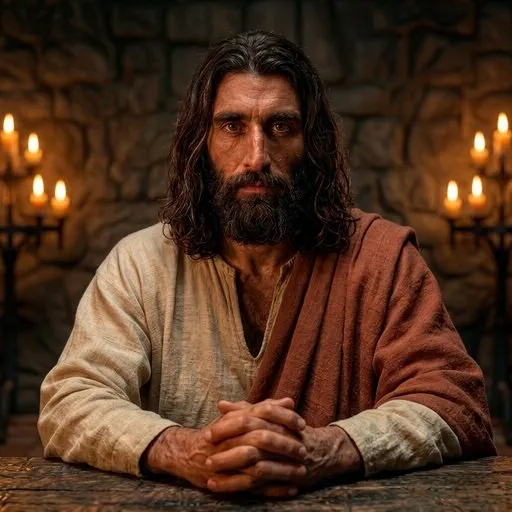
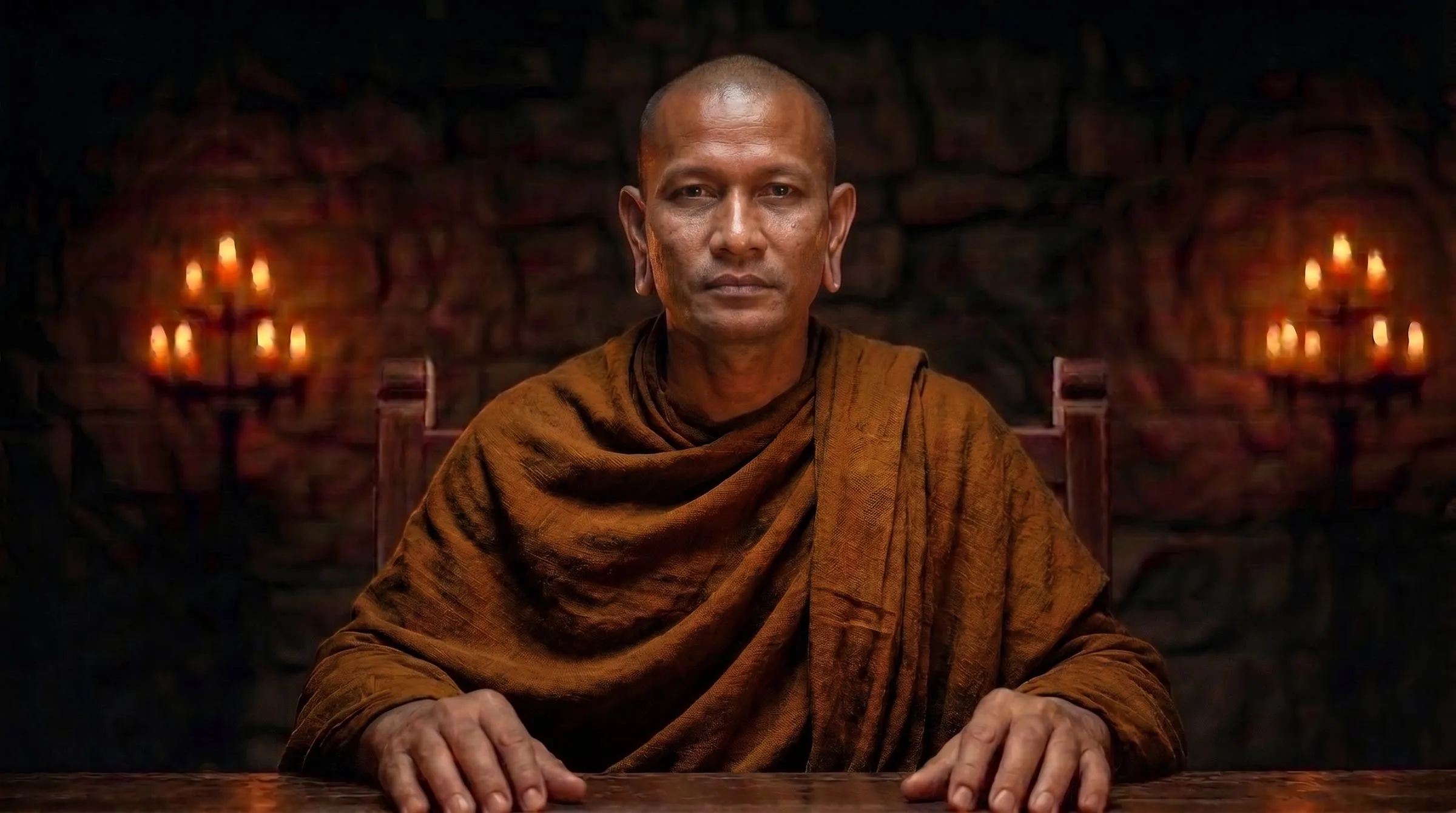
Seat eight, in the right wing, between Jesus and Plato. He is the counsellor who declines the question.
That is his function, and it is unlike anyone else’s here. When an existential question arrives, nine seats begin constructing an answer. Buddha asks what the questioner wants from the answer, and whether having it would change anything - and often concludes that the question is the arrow’s fletching and the man is bleeding.
He is also the only one at the table with a stated method that does not require agreement with him. The Kālāma instruction - test it, and accept it if it leads to benefit - makes the teaching a proposal rather than a doctrine, and it is the closest thing to an experimental attitude in the room until Darwin sits down at seat ten.
The disagreements are structural. Beside him, Jesus offers a self that is loved and saved by a personal God - the two things Buddha’s second sermon dismantles and his silence declines. Plato, on his other side, wants permanent Forms behind the appearances; Buddha says the wanting is the problem, and that impermanence goes all the way down. Nietzsche, across the room, calls the whole thing a beautifully argued exhaustion. Dostoevsky would want to know what the cessation of craving has to say to a mother whose child was torn apart by dogs, and would not accept that her grief is a form of clinging.
Diogenes, at the far end, is the strange near-relation: another man who gave up property, another who made his own body the demonstration. But Diogenes stayed in the marketplace to shout at people, and Buddha walked out of it to sit down, and the two of them would recognise each other before either recognised anyone else at the table.
The objection put to him at every episode is the one his own biography invites. He left a wife and a newborn son in the night. Whatever he found under the tree, he found it by walking away from the two people who most needed him not to - and the tradition’s answer, that he returned years later and ordained them both, is an answer that only works if the destination justifies the departure.
Which is a claim about ends and means, and puts him, unexpectedly, in a conversation with the man at seat one.
The works
traditionally the first teaching, c. 528 BCE
Dhammacakkappavattana SuttaThe Setting in Motion of the Wheel of Dhamma
The first sermon, at the Deer Park in Sarnath, to the five ascetics who had abandoned him. Contains the middle way, the Four Noble Truths and the Eightfold Path in their earliest form. Roughly a thousand words. SN 56.11.
traditionally the second teaching
Anattalakkhaṇa SuttaThe Discourse on the Characteristic of Non-Self
The argument that none of the five aggregates that make up a person can be the self, because none of them is under our control and all of them change. The most radical single claim in the corpus. SN 22.59.
Ariyapariyesanā SuttaThe Noble Search
The earliest first-person account of the departure, the two teachers, the awakening and the decision to teach. It contains no palace, no four sights and no night flight, which is why historians read it before they read the traditional life. MN 26.
Cūḷamālukya SuttaThe Shorter Discourse with Māluṅkyaputta
A monk demands answers to ten metaphysical questions or he will leave the order. The reply is the parable of the arrow, and the list of what the Buddha declares and what he does not. MN 63.
Kālāma Sutta
The passage most quoted in the modern West: do not accept a teaching because of tradition, scripture, logic, inference, appearance, or because a teacher said so, but because it has been tested and found to lead to benefit. The context is narrower than the quotations suggest, and the instruction is still remarkable. AN 3.65.
Mahāparinibbāna SuttaThe Great Discourse on the Final Nibbāna
The longest discourse in the Pāli canon. His last months, the illness at Beluva, the final meal at Pāvā, the death between two sal trees at Kusinārā, the cremation and the division of the relics into eight portions. DN 16.
oral from c. 5th century BCE, written c. 29 BCE
The Pāli CanonTipiṭaka
Some four hundred years of oral transmission before anything was written down in Sri Lanka. The corpus is many times the length of the Bible. What in it goes back to the man is a genuine and unresolved scholarly problem.
The Vinaya PiṭakaThe Basket of Discipline
The monastic law, and the source for the episodes the discourses leave out: the ordination of his son Rāhula, the founding of the order of nuns, and the eight rules imposed on it. The narrative frames are often later than the rules they explain.
Where the answers part
The same question, read differently by the seats nearby.
Plato
Whether anything has an essence
Both hold that ordinary perception is deluded and that a hard discipline is needed to see past it. But Plato concludes that behind appearances lie permanent Forms, and the Buddha concludes that the search for anything permanent - a Form, a soul, a self - is the delusion itself. Two men who agree that the cave is real, and disagree entirely about what stands outside it.
Friedrich Nietzsche
Whether the will should be dismantled
Nietzsche read Buddhism through Schopenhauer and called it a hundred times more realistic than Christianity - and then rejected it as the most honest nihilism in history, a hygiene for the exhausted. The Buddha’s reply would be that Nietzsche has mistaken the cessation of craving for the cessation of life, and that the man demanding eternal recurrence is describing craving in its purest form.
Jesus
Whether there is anyone to be saved
Jesus preaches a person who is known by name, loved, judged and kept. The second sermon at SN 22.59 takes each component of that person in turn and shows it to be impermanent, unsatisfactory and not fit to be called a self. The disagreement is not about whether mercy matters. It is about whether the thing mercy is extended to is the kind of thing that can be permanently held, and neither of them can concede the point without losing everything else he said.
Contents
What are the Four Noble Truths?
One: there is dukkha, the fact that experience does not stay put and cannot be made to. Two: it arises from craving, the demand that things be otherwise than they are. Three: it can cease, because if it is caused it can be uncaused. Four: there is a path, the Eightfold Path. The structure is diagnostic, running from symptom to cause to prognosis to treatment, and the parallel with the medical formula of the period is often drawn, though whether it was the model is disputed.
Is Buddhism pessimistic?
The first truth is usually mistranslated as "life is suffering", which is both bleaker and less precise than dukkha. The word covers acute pain, but also the ordinary friction of a world that will not hold still - the good meal that ends, the relationship that changes. And the third truth is that this can stop, which is not a pessimistic claim. The diagnosis is grim; the prognosis is not.
What is anattā, or non-self?
That there is no permanent, unchanging self to be found. Examined closely, a person is five processes, form and feeling and perception and mental formations and consciousness, each of them changing and none under full control. The claim is not that nobody exists. It is that a person is a process rather than a thing, and that treating it as a thing to be defended is where most of the trouble starts.
Did the Buddha teach that there is no God?
He declined to answer. Certain questions, whether the universe is eternal and whether the self exists after death, he set aside as undetermined, on the grounds that answering them does not lead to the cessation of suffering. His parable is of a man shot with a poisoned arrow who refuses treatment until he knows the archer’s caste and the fletching of the shaft. He dies. The gods appear throughout the texts, but they sit inside the system rather than above it, and they are no help.
How much of his biography is historical?
The bare frame - an ascetic teacher of the Śākya clan, active in the Ganges basin around the fifth century BCE, who founded an order - is accepted by essentially all historians. The palace, the four sights, the flight at night are attested only in later and increasingly elaborate accounts, and the earliest texts do not tell the story that way. It is best read as the tradition’s account of what the teaching means, cast as biography.
When did the Buddha live?
The answer depends on which chronology is used, and they disagree by about a century. The corrected long chronology, from the Sinhalese chronicles, puts the death at 486 or 483 BCE and held scholarly consensus for decades. The short chronology, from Indian sources preserved in Sanskrit, Chinese and Tibetan, puts it around 368 BCE. At the 1988 Göttingen symposium most participants who committed themselves gave a date within twenty years of 400 BCE. He died at about eighty.
Why did the Buddha refuse to say whether there is a self?
At SN 44.10 the wanderer Vacchagotta asks twice, and twice the Buddha says nothing. He explains afterwards to Ānanda that answering yes would have aligned him with the eternalists, answering no with the annihilationists, and that a flat no would have left an already confused man believing a self he once had was now destroyed. The silence is the position, and scholars still disagree about what it implies.
What did the Buddha die of?
A meal at Pāvā provided by Cunda the smith, followed by bloody dysentery, at about the age of eighty. The dish is called sūkaramaddava, from sūkara, pig, and maddava, soft or tender. Translators have read it as tender pork, as pork that had turned, and as a fungus that pigs root for. The Pāli does not settle it. He asked that Cunda be told the meal was blameless.
Is Buddhism a religion or a philosophy?
Both categories are European and recent, and there is no word in Pāli for either. The teaching has no creator and no revelation, and it invites testing. It also has rebirth, karma, gods, relics, merit, monastic law and a goal beyond inspection. The clean answer of "a philosophy, not a religion" was assembled in nineteenth-century Europe before most of its authors had met a Buddhist.
Did the Buddha abandon his wife and son?
The tradition says he left in the night with an infant son, Rāhula, and a wife the later texts call Yasodharā. The earliest first-person account, at MN 26, mentions neither: it says only that he went forth while his parents wept. The Vinaya has him return years later and ordain his son at seven, at which point his own father asks for a rule requiring parental consent, and gets one.
What is nibbāna, or nirvana?
The word means a blowing out, as of a flame. Sāriputta defines it at SN 38.1 as the ending of greed, hate and delusion. It is not annihilation, not a place, not union with a divine self, and not death: Iti 44 describes a living person in whom it has already happened. Asked where a quenched fire has gone, the Buddha treats the question itself as inapplicable.
Sources and further reading
- The Foundations of Buddhism1998The best single scholarly introduction in English.
- What the Buddha Thought2009Reconstructs the historical teaching from the earliest strata, and argues it was a deliberate and often ironic response to Brahmanical ideas.
- In the Buddha’s Words: An Anthology of Discourses from the Pāli Canon2005
- The Life of the Buddha According to the Pali Canon1972A biography assembled entirely out of canonical passages, with nothing supplied from the commentaries.
- Confession of a Buddhist Atheist2010A secular reading; contested within the tradition and useful for showing where the seams are.
- The Origin of Buddhist Meditation2007
- The World as Will and Representation1818The channel through which nineteenth-century Europe, including Nietzsche, first encountered Buddhist ideas - and misread them.
- The four Pāli collections, translated for SuttaCentral2018Complete translations of the Dīgha, Majjhima, Saṁyutta and Aṅguttara, dedicated to the public domain and displayed alongside the Pāli. Every sutta quotation on this page was checked against the Pāli in this edition.
- The Middle Length Discourses of the Buddha1995
- The Connected Discourses of the Buddha2000
- The Long Discourses of the Buddha1987
- Buddhist Suttas1881The first widely read English Mahāparinibbāna Sutta, and the source of "be ye lamps unto yourselves".
- The Dating of the Historical Buddha / Die Datierung des historischen Buddha1991–1997Three volumes from the 1988 Göttingen symposium. The reason no responsible account now gives a single date.
- Dating the Buddha: a Red Herring Revealed1992In Bechert, vol. 2, pp. 237–59. Reworks the ordination lineages of the Dīpavaṁsa and arrives at a death in 404 BCE.
- Inscriptions of Asoka1925The standard edition of the Lumbinī pillar text.
- The Four Noble Truths1982Reprinted in Collected Papers II. Shows that ariyasacca has several defensible construals and prefers "the truth of the noble one".
- The Four Ariya-saccas as “True Realities for the Spiritually Ennobled”2009
- On the Quadruple Division of the Yogaśāstra, the Caturvyūhatva of the Cikitsāśāstra and the “Four Noble Truths” of the Buddha1984Argues the medical parallel was drawn by later Buddhist authors rather than by the Buddha.
- Selfless Persons: Imagery and Thought in Theravāda Buddhism1982
- The Selfless Mind: Personality, Consciousness and Nirvāṇa in Early Buddhism1995
- The Not-self Strategy1993And the later reply to Bodhi, "The Limits of Description: Not-self Revisited". Argues anattā is a perception to be applied rather than a thesis about what exists.
- Anattā as Strategy and Ontology2015Agrees the Buddha never asserted the flat proposition, and denies that the teaching can be detached from a claim about what is the case.
- The ātman and its negation2010
- L’Ātman-Brahman dans le bouddhisme ancien1973The minority case that only the false self is denied. Pérez-Remón argued a similar position in Self and Non-Self in Early Buddhism (1980).
- Early Buddhist Theory of Knowledge1963The standard argument that the undetermined questions are malformed rather than merely unhelpful.
- Pudgalavāda Buddhism: The Reality of the Indeterminate Self1999On the school inside early Buddhism that affirmed a person neither identical with nor different from the aggregates.
- The Cullavagga on Bhikkhunī Ordination2015With The Gurudharma on Bhikṣuṇī Ordination in the Mūlasarvāstivāda Tradition (2014). Comparative work across the Chinese, Sanskrit and Tibetan Vinayas.
- The Eight Garudhammas2010
- The Oral Transmission of Early Buddhist Literature2004
- Ancient Buddhist Scrolls from Gandhāra: The British Library Kharoṣṭhī Fragments1999
- The Two Traditions of Meditation in Ancient India1986With Lambert Schmithausen’s 1981 study of "liberating insight", the source of the argument that the three-knowledge account of the awakening is a later standardisation.
- The Last Meal of the Buddha1982The fungus reading of sūkaramaddava. Arthur Waley had argued a version of it in 1932.
- The Making of Buddhist Modernism2008
- The British Discovery of Buddhism1988How a religion was assembled in European libraries by people who had met none of its adherents.
- Curators of the Buddha: The Study of Buddhism under Colonialism1995
- I Can’t Believe It’s Not Buddha! What Fake Buddha Quotes Can Teach Us about Buddhism2018The standing archive is at fakebuddhaquotes.com, which traces each fabrication to its first appearance in print.
Last reviewed: