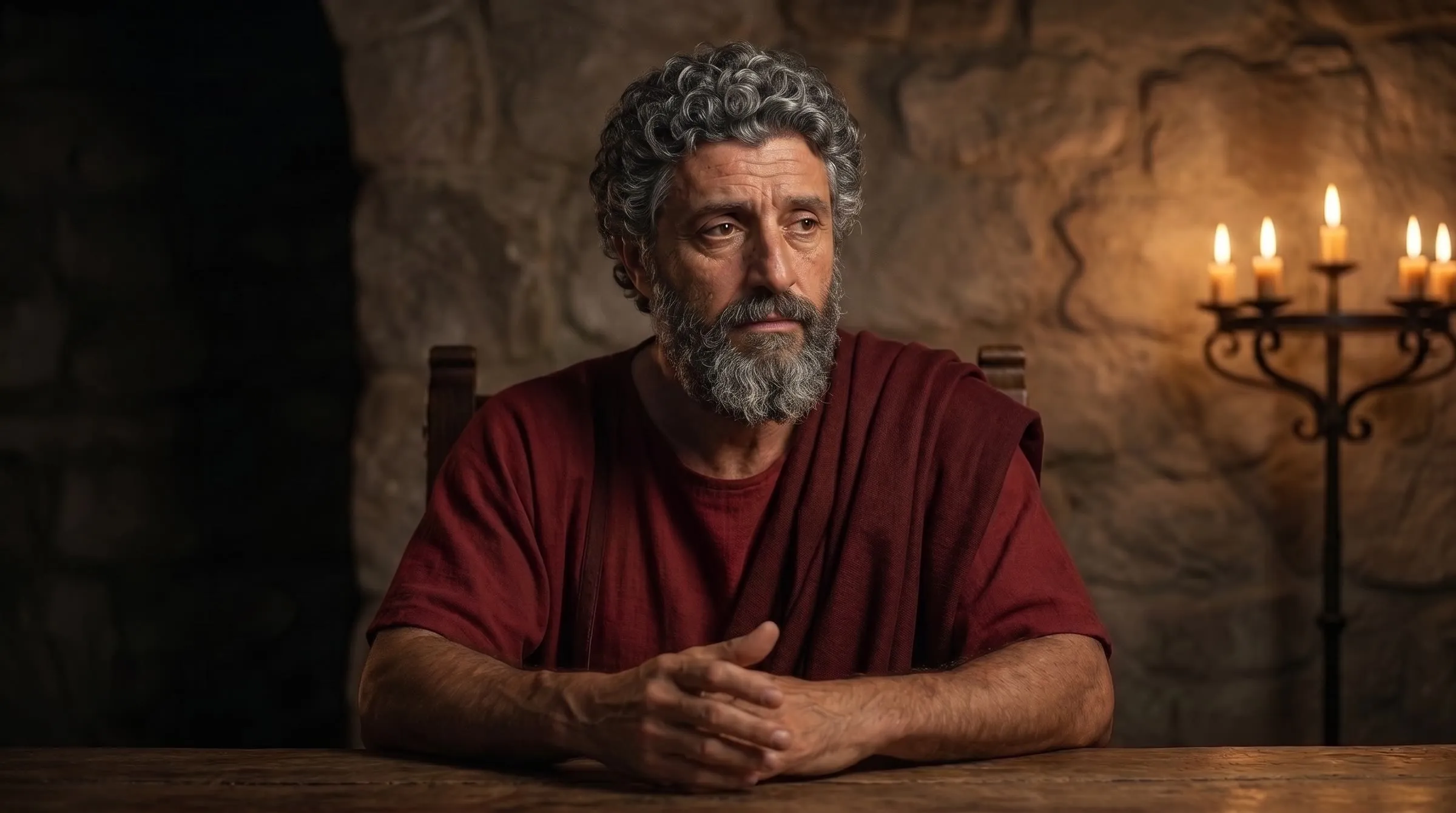
The most-read work of Stoic philosophy in existence was not written to be read.
There is no dedication, no argument developed across chapters, no audience addressed. There are twelve books of notes, repetitive, sometimes contradictory, occasionally bad-tempered, written in Greek by a man who spoke Latin at work, largely in tents on the Danube frontier during a war he did not enjoy. The English title Meditations belongs to a translator of 1634. The heading on the oldest manuscript is Ta eis heauton - to himself.
That is the first fact about the book and it governs everything else. We are reading a man’s private attempts to hold himself together, and we are doing so against his intention.
What the Meditations of Marcus Aurelius actually is
It is not a treatise, not a memoir, not a letter, and not a work of any recognised ancient genre. The nearest description is a commonplace book kept as a discipline: entries of one line or twenty, numbered by later editors, with no order that anyone has convincingly reconstructed.
Several features follow from that, and each of them changes how the sentences should be taken.
Nobody was meant to see it. There is no dedication and no addressee. Nothing in the text anticipates an objection or explains a term, which is what a writer does for a reader. There is no evidence that it circulated in his lifetime, that his household knew of it, or that Commodus inherited a copy.
It is written in Greek. Marcus governed and legislated in Latin, and his correspondence with Fronto is overwhelmingly in Latin, with a handful of Greek letters that Fronto scolded him for. Philosophy in the second century was conducted in Greek, and he wrote his philosophy in the language of the discipline, not the language of the office. The choice is itself a piece of evidence about what he thought he was doing.
The grammar is second person, addressed to himself. The characteristic sentence is an order, and the person receiving it is the writer. No longer talk at all about the kind of man that a good man ought to be, but be such is X.16, and it has the tone of the whole book: someone who has run out of patience with his own commentary.
The repetition is the method, not a defect. Perhaps a dozen ideas recur across the twelve books, dozens of times each. A treatise states a proposition once. A practice returns to it because the practitioner keeps losing it.
The division into twelve books may not be his. The first source to describe the work as twelve books is the Suda, the Byzantine lexicon of the late tenth century. What the arrangement was before that is unknown.
Book One is different from the other eleven. It is a single continuous list of debts to named people, in a register that appears nowhere else, and it is usually discussed apart from the rest.
Against the intimacy all of that suggests, Mary Beard has put the necessary caution. Reviewing Frank McLynn’s biography in 2009, she pointed out that we have no external information at all about the origin or purpose of the work, that much of its material draws on a standard repertoire of school philosophy, and that readers who find a confessional interior in it may be importing one. The book is intimate in form. Whether it is intimate in content is a separate question, and it is not settled.
The making of an emperor
He was born Marcus Annius Verus on 26 April 121 CE, into a wealthy senatorial family of Spanish origin, well connected in Rome. His father died when he was around three. He was raised largely by his grandfather and his mother Domitia Lucilla, and it is worth registering that the whole first book of the Meditations is a list of people and what he learned from each - an inventory of debts, written by a man who had absolute power and evidently did not think he had made himself.
The emperor Hadrian noticed him early and called him Verissimus, the most truthful - a pun on the family name. When Hadrian’s chosen successor died, he arranged the succession in a chain: he adopted Antoninus Pius, on the condition that Antoninus adopt both Marcus, then sixteen, and Lucius Verus.
So Marcus knew from sixteen that he would be emperor. He then waited twenty-three years, which is an unusual apprenticeship and probably explains a great deal.
The Historia Augusta reports that he took to philosophy young and theatrically: at twelve he adopted the rough Greek cloak, studied on the ground, and slept there until his mother negotiated him onto a couch with skins on it. The list of teachers is long and mostly Stoic, and includes Apollonius of Chalcedon, Sextus of Chaeronea, and Junius Rusticus.
The education in rhetoric was intense. Fronto, the leading orator of the day, taught him for years, and their letters survive.
Then, in his mid-twenties, he encountered philosophy properly, and Fronto lost him. Junius Rusticus gave him the Discourses of Epictetus - a former slave who had built the toughest and least consoling version of Stoicism available. Marcus records the debt in a single sentence at I.7: I am indebted to him for being acquainted with the discourses of Epictetus, which he communicated to me out of his own collection. He thanks Rusticus in the same entry, and more tellingly, for showing him that he needed correcting at all.
The other formative presence was Antoninus Pius, whose portrait fills the longest entry in Book One and returns at VI.30 as a standing instruction: Do everything as a disciple of Antoninus. What follows is a list of a working ruler’s habits rather than virtues. He examined everything carefully before letting it pass. He did nothing in a hurry. He bore unjust blame without returning it. He was satisfied with very little in the way of lodging and food. Twenty-three years of watching that man do the job is the closest thing Marcus had to a political education, and the Meditations keep measuring him against it.
What the letters to Fronto show that the Meditations does not
The correspondence with Marcus Cornelius Fronto is the second primary source for this life, and it produces a person the notebook does not.
It nearly did not survive at all. In 1815 Angelo Mai, working in the Ambrosian Library in Milan, noticed that a manuscript of the acts of the Council of Chalcedon had been written on reused parchment, and that the erased under-layer was Fronto. More leaves turned up in the Vatican in the following years. What emerged, from a book that had been scraped clean and written over, was roughly two hundred letters between a rhetoric tutor and the heir to the empire, spanning nearly thirty years. C. R. Haines edited and translated them for the Loeb Classical Library in 1919 and 1920, in the text quoted here.
They are, mostly, about nothing. That is their value.
One letter, written in his early twenties, gives an entire day. He slept late because of a cold. He read Cato’s Agriculture from five until nine, then treated his throat, and is careful to explain that he did not gargle, although the word for it does occur in Novius. He attended his father at a sacrifice. At lunch he ate a scrap of bread while others worked through beans, onions and roe-filled herrings.
We then worked hard at grape-gathering, and had a good sweat, and were merry Marcus to Fronto, Ad M. Caesarem IV.6, trans. C. R. Haines
Then he came home, talked to his mother while she sat on the bed, and the two of them argued about which of them loved their absent friend more. After supper in the oil-press room, he listened to the farm workers making fun of each other, and enjoyed it. Then he wrote the letter, and signed off: Farewell, my Fronto, wherever you are, most honey-sweet, my love, my delight. How is it between you and me? I love you and you are away.
Another letter reports a hunt at which no boar was seen, only heard about, and a hill was climbed. In another, Marcus rides into a flock of sheep, the shepherd swings a crook at him and hits his equerry instead, and he tells the story with obvious pleasure.
That is the register throughout: affectionate, self-mocking, physically detailed, and entirely unphilosophical. The man who later reminds himself at IV.19 that posthumous fame is a noise made by people who will shortly be dead is here asking whether his master has begun the vintage yet, and complaining that the grapes of Signia are too bitter.
Then one letter turns. Reading Aristo, the Stoic of Chios, he writes that the books treat him well and make him feel ill at the same time, because they show him how far short of them he falls.
twenty-five years old as I am, no draught has my soul yet drunk of noble doctrines and purer principles. Therefore I do penance, am wroth with myself, am sad, compare myself with others, starve myself. Marcus to Fronto, Ad M. Caesarem IV.13, trans. C. R. Haines
That sentence is the hinge between the two archives. Everything before it belongs to the letters; everything after it belongs to the notebook.
Two things should be said about how the letters are read now. The first is that the language of love in them is extravagant even by Roman standards, and Amy Richlin’s 2006 translation, Marcus Aurelius in Love, argues that the correspondence records an erotic relationship rather than a rhetorical convention. The counter-case, argued by Christian Laes among others, is that Latin epistolary friendship routinely spoke this way and that nothing in the letters establishes a sexual relationship. The dispute is live, and the letters are undated or misdated often enough that no chronology can settle it.
The second is what Book One does with Fronto. After thirty years of this correspondence, the entry reads in full: From Fronto I learned to observe what envy and duplicity and hypocrisy are in a tyrant, and that generally those among us who are called Patricians are rather deficient in paternal affection. One line, and it is about tyranny. Rusticus, who handed him a book, gets a paragraph.
Book One of the Meditations, and the debts it lists
Seventeen entries, each beginning with a name and a preposition. From my grandfather Verus, good morals and control of temper. From the reputation of my father, whom he barely knew, modesty and a manly character. From my mother, piety, plain living, and abstinence from anything resembling the habits of the rich.
Then the teachers, in order, with the specific thing each one is credited with: Diognetus, not to believe miracle-workers; Rusticus, the sense that his character needed work at all; Apollonius, steadiness under pain and after the loss of a child; Sextus, a household governed like a family and the idea of living according to nature; Alexander the grammarian, not to correct people’s speech in public but to slip the right word into the reply.
Nothing in the list is a virtue in the abstract. Every item is a piece of behaviour observed in a particular person and copied.
The last and longest entry before the gods is Antoninus Pius, and the last of all, I.17, is addressed upward. He thanks the gods for good grandparents, good parents, good teachers, and for a set of things he did not do: that he was not longer brought up with his grandfather’s concubine, that he did not spoil his youth, that circumstances never quite offered him the opportunity to offend. He thanks them for his brother, for children who were not stupid or deformed, and for a wife so obedient, and so affectionate, and so simple. He also thanks them for remedies shown to him in dreams, which is a reminder that the most rational man in the empire took his medical advice partly from sleep.
What the whole book amounts to is an accounting rather than a memoir. The emperor of Rome opens his private notebook by writing down that he did not make himself, and then lists the people who did, item by item, with the receipts. It is the least self-made document ever produced by a man with that much power, and it explains a good deal of what follows.
Nineteen years
Antoninus Pius died in 161. Marcus, thirty-nine, immediately did something no emperor had done: he insisted the Senate confirm Lucius Verus as co-emperor with him, splitting supreme power voluntarily.
What followed was, by almost any measure, an appalling run of luck.
War in the east. Parthia invaded Armenia almost immediately. Verus went out to Antioch as the nominal commander while the fighting was done by professionals, among them Statius Priscus and a Syrian general named Avidius Cassius, who sacked Seleucia and Ctesiphon in 165. The campaign was won by 166, and the returning army brought back something worse than it had defeated.
The Antonine Plague. Probably smallpox. It arrived in 165–166 and recurred for a generation. Modern estimates of mortality range widely, but the low end is around two million dead and the higher estimates put it at a tenth of the empire’s population. It hollowed out the army, disrupted the grain supply and the tax base, and very probably killed Lucius Verus in 169, though the Historia Augusta calls it apoplexy.
The northern wars. The Marcomanni, Quadi and Iazyges crossed the Danube in force from 166 onward, and by 170 had penetrated as far as Aquileia in northern Italy, the first invasion of Italy in 270 years. Marcus, who had never wanted to be a soldier, spent essentially the rest of his life on that frontier. He melted down imperial plate and auctioned palace treasures in the Forum of Trajan rather than raise taxes on a plague-stricken population. He recruited gladiators, and reportedly bandits, into the legions.
Revolt. In 175 Avidius Cassius, his most senior general in the east, was told Marcus was dying and had himself proclaimed emperor. Cassius was killed by his own officers within three months. Marcus’s response is the most attractive thing in the historical record: he made a point of not celebrating, said publicly that his one regret was losing the chance to pardon the man, refused to execute the family, and burned the correspondence unread so he would not know who else had been involved. Cassius Dio preserves what he wrote to the Senate, asking that none of the conspirators be put to death: May it never happen that any one of you should be slain during my reign either by my vote or by yours. The children of Cassius kept more than half their father’s estate and were allowed to live where they liked.
Bereavement. Faustina, his wife of thirty years, died in the winter of 175 at a village in Cappadocia while travelling east with him after the revolt. He had the place renamed after her.
He died on 17 March 180, at Vindobona or Sirmium, aged fifty-eight - probably of the plague, in camp, in the nineteenth year of an almost unbroken emergency.
The Antonine plague, and what it did to the reign of Marcus Aurelius
The disease arrived with the army returning from Mesopotamia in 165 or 166 and never entirely left. Galen, the best physician of the age and briefly the emperor’s, saw it at Rome and again among the troops wintering at Aquileia in 168 and 169, and left the only clinical description: fever, diarrhoea, inflammation of the throat, and an eruption on the skin appearing around the ninth day, sometimes dry and sometimes pustular. That pattern is why most historians have called it smallpox. Measles has been proposed. No genetic confirmation exists, and the identification remains an inference from a single doctor’s notes.
The mortality is genuinely unknown, and the range in the literature is the honest answer rather than a failure of scholarship. R. J. and M. L. Littman, in 1973, estimated seven to ten per cent mortality across the whole episode, higher in cities and in the army, and a total of seven to ten million excess deaths over its twenty-three years. Kyle Harper’s The Fate of Rome treats it as a demographic shock severe enough to mark a turn in Roman history. A revisionist current argues that the evidence, which is papyri, inscriptions, coin hoards and building records rather than any register of deaths, cannot carry conclusions that large. Cassius Dio, describing a later recurrence in 189, says that two thousand people a day were dying in Rome at its worst, and that figure at least comes from a senator who was there.
What the plague did to the reign is easier to state than what it did to the population.
It emptied the legions at the moment the Danube frontier broke. The Historia Augusta lists the improvisations: slaves enrolled and called Volunteers, on the precedent of the emergency after Cannae; gladiators armed and called the Compliant; the bandits of Dalmatia and Dardania turned into soldiers; Germans hired as auxiliaries to fight Germans; two new legions raised.
It emptied the treasury, and Marcus refused the obvious remedy. Rather than levy an extraordinary tax on the provinces, he sold the contents of the palace.
he held a public sale in the Forum of the Deified Trajan of the imperial furnishings, and sold goblets of gold and crystal and murra, even flagons made for kings, his wife’s silken gold-embroidered robes, and, indeed, even certain jewels which he had found in considerable numbers in a particularly holy cabinet of Hadrian’s Historia Augusta, Marcus Antoninus 17.4, trans. David Magie
The sale ran for two months. Cassius Dio adds the sequel: when the war had been won and the money recovered many times over, Marcus announced that any purchaser who wished to return an object could have its price back. Some did. Most declined, and he compelled nobody.
It killed his co-emperor in 169, and it very probably killed him in 180.
And it is in the book, once, transposed. At IX.2, written while the empire was being emptied, he tells himself that the destruction of the understanding is a pestilence, much more, indeed, than any such corruption and change of this atmosphere which surrounds us. For this corruption is a pestilence of animals so far as they are animals; but the other is a pestilence of men so far as they are men. A man surrounded by an epidemic, using it as a figure for moral decay. It is either the most disciplined sentence in the book or the most insulated, and the Meditations give no way to decide which.
The Marcomannic wars, and where Marcus Aurelius wrote the Meditations
The northern war is the setting of almost the entire notebook, and it is worth knowing in outline, because the Meditations were written inside it and say almost nothing about it.
Pressure on the Danube began building in the early 160s and broke in 166 and 167, when the Langobardi and their allies crossed into Pannonia. A truce held briefly. In 168 Marcus and Verus went north to Aquileia, reorganised the defences of Italy and Illyricum, and raised two new legions. Verus died on the way back in January 169.
In 170 the war became a catastrophe. A coalition under the Marcomannic king Ballomar destroyed a Roman force of some twenty thousand near Carnuntum, crossed the Alps, wrecked Opitergium in northern Italy and besieged Aquileia. No hostile army had entered Italy since the Cimbri in 101 BC. In the same period the Costoboci came down through Thrace into Greece and destroyed the sanctuary at Eleusis, one of the oldest and most protected shrines in the Greek world.
The recovery took five years. Tiberius Claudius Pompeianus, Marcus’s son-in-law, held the command with the future emperor Pertinax under him. Aquileia was relieved, the invaders were pushed back across the Danube by late 171, and in 172 the Romans crossed into Marcomannic territory. Marcus took the title Germanicus.
Somewhere in 172 or 173 the incident occurred that everyone afterwards claimed. A Roman force, cut off and dying of thirst, was saved by a sudden storm that watered them and struck their enemies with lightning. Cassius Dio credits an Egyptian magician named Arnuphis and a prayer to Hermes of the air. Christian writers, from Tertullian onward, credited the prayers of Christian soldiers in the Twelfth Legion, and Eusebius devotes a chapter to it. The rain is carved on the Column of Marcus Aurelius as a bearded god with water streaming from his outstretched arms. Three religions filed a claim on the same weather.
In 175 the Iazyges surrendered. Their king Zanticus returned a hundred thousand Roman prisoners, an indication of what the previous decade had cost, and supplied eight thousand cavalry, of whom five and a half thousand were sent to Britain. Cassius Dio says Marcus intended to annex two new provinces, Marcomannia and Sarmatia, and that the revolt of Avidius Cassius interrupted the plan. The war resumed in 177 and was still running when he died. Commodus made peace within months and the provinces were never created.
Two of the twelve books carry a note of place. One records that it was written among the Quadi on the river Granua, in what is now central Slovakia; the other, at Carnuntum in Pannonia, thirty miles east of modern Vienna, where Orosius and Eutropius say Marcus spent three years. Editions differ over whether these notes close Books One and Two or head Books Two and Three, and the ambiguity is old.
What is remarkable is the silence. Twelve books written in the field across a decade of continuous campaigning contain no strategy, no battle, no named barbarian, no dispatch, no complaint about supply. The one place the war enters the text directly is at X.10, and it enters as an accusation:
A spider is proud when it has caught a fly, and another when he has caught a poor hare, and another when he has taken a little fish in a net, and another when he has taken wild boars, and another when he has taken bears, and another when he has taken Sarmatians. Are not these robbers, if thou examinest their opinions? Meditations X.10, trans. George Long
He had taken Sarmatians. He was, on the sentence’s own terms, in the list.
What Stoicism claims, and what Marcus Aurelius took from Epictetus
Stoicism was founded at Athens around 300 BC by Zeno of Citium, who taught in a painted colonnade, the stoa poikile, which gave the school its name. By Marcus’s day it was four and a half centuries old, had a technical vocabulary, and was divided into three parts: logic, physics and ethics. The three were not optional modules. The ethics depends on the physics, and losing that connection is the main thing that happens to Stoicism in modern use.
The system rests on a small number of claims.
The cosmos is one rational living thing. Everything is matter, but the matter is organised and pervaded by an active principle, pneuma, which the Stoics also call logos, reason, nature, Zeus and fate, treating these as names for the same thing. Events are not accidents inside this whole; they are the whole, unfolding.
Virtue is the only good. Not the highest good among others: the only one. Health, wealth, reputation and length of life are indifferents. Some are preferred and some are not, and a Stoic will reasonably take the preferred ones when they are available, but none of them makes a life good, and their loss takes nothing from it.
Emotions are judgements. Distress is not an event that happens to a person; it is an assent given to a proposition, usually the proposition that something bad has occurred. Because it is a judgement, it can be examined, and withheld.
A human being is a social animal, so living according to nature means justice. This half is often left out, and it is the half Marcus repeats most. That which is not good for the swarm, neither is it good for the bee, he writes at VI.54. Rational beings exist for one another, which is why his exercises always end by returning him to a room full of people.
The transmission to Marcus runs through one man. Epictetus was born a slave around 50 CE at Hierapolis in Phrygia, was owned by a freedman of Nero’s, was lamed, was freed, and taught at Nicopolis in Epirus after Domitian expelled the philosophers from Italy. He wrote nothing; his pupil Arrian took down the Discourses, and condensed them into the Handbook. Marcus never met him. He read the notes, lent by Rusticus, some forty years after Arrian took them down.
The Handbook opens with the move that organises everything Marcus later writes:
Of things some are in our power, and others are not. In our power are opinion, movement towards a thing, desire, aversion; and in a word, whatever are our own acts: not in our power are the body, property, reputation, offices, and in a word, whatever are not our own acts. And the things in our power are by nature free, not subject to restraint nor hindrance: but the things not in our power are weak, slavish, subject to restraint, in the power of others. Epictetus, Handbook I, trans. George Long
The second list is the one to weigh. Property, reputation and office are precisely the three things Marcus had more of than any living human being, and the claim he adopted at twenty-five is that none of them was his.
Hadot’s reconstruction organises the Meditations around three disciplines drawn from Epictetus, corresponding to the three parts of the system: the discipline of assent, which governs judgement; the discipline of desire, which governs what is wanted and feared; and the discipline of action, which governs conduct toward other people. Almost every entry in the book falls into one of the three, and reading it with that grid is the difference between finding it repetitive and finding it methodical.
What Marcus does not do is argue. He never defends the physics; he assumes it, and where he cannot he offers a disjunction instead. Either there is providence or atoms, he writes at IV.3, and repeats the alternative half a dozen times across the book. It is usually read as open-mindedness. It reads equally as a man checking, again, whether the consolation survives the worse of the two options.
What the book is doing
Pierre Hadot’s The Inner Citadel changed how the Meditations are read, and the change is simple. These are not notes toward a philosophy. They are exercises - the written form of a practice, repeated because practice is repetition.
Once that is understood, the features that look like flaws become the method. The same handful of ideas recur dozens of times because he keeps failing to hold them. The tone is imperative because he is instructing himself. There is no argument because he is not persuading anyone; he already agrees and cannot make himself act on it.
The Stoic system he is drawing on has four parts that structure nearly every entry.
The dichotomy of control. From Epictetus, and the load-bearing wall of the whole building: some things are up to us - judgement, impulse, desire, aversion, in a word our own choices - and some are not - body, reputation, office, everything else. Distress comes from treating the second category as if it were the first. Marcus is applying this while holding more external power than almost any human being has held, which gives it a peculiar force: he is the man best placed to test the claim that external power is not where the good lies. The clearest statement of the mechanism is VIII.47: If thou art pained by any external thing, it is not this thing that disturbs thee, but thy own judgment about it. And it is in thy power to wipe out this judgment now.
Living according to nature. The universe is a rational, ordered whole - logos - and a human being lives well by acting according to their own nature, which is rational and social. What is not good for the swarm is not good for the bee. His most-quoted line on duty is a piece of self-bullying at dawn. In Long’s rendering of V.1 he tells himself, on waking unwillingly, I am rising to the work of a human being, and then spends the rest of the entry arguing with the part of himself that would rather stay warm, losing the argument, and setting the plants, the birds, the ants, the spiders and the bees against himself as workers who do not need persuading.
The view from above. A recurring exercise in which he zooms out until Rome is a dot, the present a moment, and his own reputation a set of noises made by people who will shortly be dead. Asia, Europe, are corners of the universe; all the sea a drop in the universe; Athos a little clod of the universe: all the present time is a point in eternity (VI.36). At IX.30 he does the same thing to populations: look down from above on the countless herds of men, their countless ceremonies, their voyages in storms and calms, those being born and those dying. He does this to himself constantly, and it is not despair; it is a technique for cutting a problem down to its real proportions.
Memento mori. Death is everywhere in the book and is treated without drama. You could leave life right now. Let that determine what you do and say and think, in Gregory Hays’s rendering of II.11. And, characteristically, the reminder at VI.24 that Alexander the Macedonian and his groom were brought by death to the same state.
To those four should be added a fifth habit, which is the strangest and the most useful. He takes an object of desire or dread and describes it in its material components until the value drains out of it. Roast meat is the dead body of an animal. Fine wine is grape juice. The purple robe of the emperor is some sheep’s wool dyed with the blood of a shell-fish (VI.13). The exercise is called objective description, and its target is not pleasure but the words that exalt it, and behind them the outward show he calls a wonderful perverter of reason.
Then there are the passages that are unmistakably a specific man in a specific week. The opening of Book Two, written to himself before a day’s work:
Begin the morning by saying to thyself, I shall meet with the busybody, the ungrateful, arrogant, deceitful, envious, unsocial. All these things happen to them by reason of their ignorance of what is good and evil. But I who have seen the nature of the good that it is beautiful, and of the bad that it is ugly, and the nature of him who does wrong, that it is akin to me; not [only] of the same blood or seed, but that it participates in [the same] intelligence and [the same] portion of the divinity, I can neither be injured by any of them, for no one can fix on me what is ugly, nor can I be angry with my kinsman, nor hate him. For we are made for co-operation, like feet, like hands, like eyelids, like the rows of the upper and lower teeth. Meditations II.1, trans. George Long
That is a man about to walk into a room full of people he finds exhausting, talking himself out of contempt. It is the same paragraph anybody might need on a Monday, written by the ruler of the world.
The parts that are harder
Three things sit badly with the reputation, and a full account has to hold them.
The Christians of Lyon. In 177, in his reign, Christians at Lugdunum were tortured and killed in the amphitheatre; the surviving account is one of the most harrowing documents of the early church. There is no evidence Marcus intervened, and the account preserved by Eusebius has the governor referring the cases to the emperor and receiving an answer that confirmed the sentences. The Meditations mention Christians once, at XI.3, and dismiss their readiness to die as mere obstinacy, not the considered readiness a Stoic would respect. Whether Marcus wrote that clause at all is a live textual question, taken up below. Either way it is the sharpest available illustration of the distance between the man writing in the tent and the office he was administering.
The wars. The column erected after his death depicts the German campaigns, and its reliefs are markedly more brutal than Trajan’s a lifetime earlier: villages burned, prisoners executed, women dragged away. Whether these were defensive wars or wars of conquest is genuinely disputed among historians - Cassius Dio says he intended to annex two new provinces. What is not disputed is that the philosopher of universal kinship spent a decade prosecuting them.
Commodus. For eighty years - Nerva, Trajan, Hadrian, Antoninus, Marcus - the empire had passed by adoption, each emperor choosing the ablest man available. Marcus ended that. He made his son co-emperor in 177 and left him the empire in 180, and Commodus proved to be vain, erratic, and eventually convinced he was Hercules; he was strangled in his bath in 192, and the civil war that followed ended the Antonine peace.
The defence is real: Marcus had a living adult son, and in Rome passing over a son usually meant that son’s death or a civil war on someone else’s terms. But there is no getting round the fact that the most thoughtful ruler Rome produced made the single decision that undid the system, and that his notebook - which examines everything else - does not examine it.
The persecution at Lyon in 177, and how far Marcus Aurelius directed it
The account comes from a letter written by the surviving Christians of Vienne and Lyon to the churches of Asia and Phrygia, quoted at length by Eusebius in the fifth book of the Ecclesiastical History. It is a partisan document, written by the losing side within living memory of the events, and it is also the only substantial narrative of a Roman provincial persecution that exists.
The sequence it describes is this. Christians were first barred from public places, then attacked by crowds, then arrested. Household slaves, questioned under torture, produced the standard accusations of cannibal feasts and incest. The governor examined the prisoners, and those who confessed were held. Some died in prison. Pothinus, the bishop, more than ninety years old and barely able to breathe, was dragged before the tribunal, beaten by the crowd, and died two days later. Sanctus, a deacon from Vienne, and Maturus, a recent convert, were tortured and then sent into the amphitheatre with Blandina, a slave, and Attalus, a man of standing from Pergamum. Blandina survived the beasts, was returned to prison, and was killed last, after the boy Ponticus. The bodies were left in the open for six days, then burnt, and the ashes swept into the Rhône so that nothing would remain to be buried. Eusebius names ten; a later martyrology gives forty-eight.
The passage that matters for the question of imperial responsibility is short and specific. Attalus, a Roman citizen, had already been paraded round the arena with a placard when the governor learned his status:
But when the governor learned that he was a Roman, he commanded him to be taken back with the rest of those who were in prison concerning whom he had written to Caesar, and whose answer he was awaiting. Eusebius, Ecclesiastical History 5.1.44, trans. A. C. McGiffert
The answer came:
For Caesar commanded that they should be put to death, but that any who might deny should be set free. Eusebius, Ecclesiastical History 5.1.47, trans. A. C. McGiffert
That is the evidence, and it is worth being exact about what it does and does not establish.
It establishes that the cases were referred up and that a reply came down which confirmed the executions and offered release to anyone who recanted. It does not establish an imperial initiative. The formula in the reply is not new policy: it restates the framework Trajan set out to Pliny seventy years earlier, that Christians were not to be hunted for, that anonymous denunciations were inadmissible, but that anyone accused, convicted and unwilling to recant was to be punished. A governor writing to ask what to do with citizens accused of a capital offence was performing a routine of provincial administration, and emperors answered hundreds of such queries a year, often through the secretariat ab epistulis. Whether Marcus read the file, drafted the words, or initialled a clerk’s draft is unknown and unknowable.
Two further complications belong in the record. The first is that Attalus, a citizen whose status should have limited his sentence to beheading, was sent to the beasts anyway at the crowd’s insistence, which is a fact about the governor and the mob rather than about the emperor. The second is a senatorial decree of the same year, 177, proposed by Marcus and Commodus, capping the prices of gladiators. A clause of it allows provincial priests in Gaul to buy condemned criminals cheaply for the games. Some scholars, following an argument first put by Oliver and Palmer in 1955, have connected that clause to the supply of victims at Lugdunum. The connection is a hypothesis and has never been established, and it is set down here as one, not as a finding.
The rest of the reign points the same way. Justin Martyr and six companions were tried and beheaded at Rome around 165, under the urban prefect Quintus Junius Rusticus, which is the same Rusticus who put the Discourses of Epictetus into Marcus’s hands and whom Marcus thanks in Book One. The martyrdom of Polycarp at Smyrna falls either in 155 or in 167, depending on which chronology is followed, and only the later date puts it in this reign. Melito of Sardis addressed a petition to Marcus, quoted by Eusebius at 4.26, complaining that the pious were being harassed by a new kind of edict everywhere in Asia and that informers were using the situation to help themselves to other people’s property. Athenagoras addressed a defence to Marcus and Commodus around 176. Neither apologist argues against a general edict of persecution, because there was none; both argue against local prosecutions being allowed to run. Tertullian, writing a generation later and quoted by Eusebius at 5.5, makes the same complaint in the form of a question, asking what kind of laws these are that only the impious and the cruel use, laws Vespasian ignored and Trajan partly annulled and neither Hadrian nor Pius endorsed.
Then the notebook. At XI.3, discussing readiness to die, Marcus praises a soul prepared to be separated from the body, provided the readiness comes from a personal judgement,
not from mere obstinacy, as with the Christians, but considerately and with dignity and in a way to persuade another, without tragic show. Meditations XI.3, trans. George Long
Even this is disputed. C. R. Haines, editing the Loeb text, observed that the clause naming the Christians sits outside the grammar of the sentence and has every appearance of a marginal gloss that a copyist absorbed into the text. A few editors have agreed, though the standard texts print the clause, and Haines himself allowed that Marcus may have had the Christians in mind even without it. If they are right, the Meditations never mention Christians at all, and the one place where the philosopher can be heard on the subject is a reader’s note in a margin.
What can be said with confidence is narrow, and it is worse for the reputation than an outright verdict would be. Marcus did not start a general persecution. He also did not stop this one, and the machinery that killed the ten confessors Eusebius names at Lyon ran a query up to his desk and got an answer back that let it continue. The gap between the man who wrote that wrongdoers are kinsmen sharing the same fragment of the divine, and the office that signed off on the amphitheatre, is not a puzzle to be resolved. It is the subject.
Marcus Aurelius and slavery
Stoicism had the premises for an objection to slavery and never made it.
The school taught that all human beings share in reason, that the wise are free wherever they are and the foolish are slaves wherever they are, and that the cosmos is a single city of which all rational beings are citizens. Epictetus, the source Marcus revered most, had been owned. Seneca’s forty-seventh letter argues at length that slaves are human beings, fellow-slaves of fortune, and should be eaten with rather than served by. Chrysippus, the school’s third head and its systematiser, defined a slave as a hired hand for life, which is a denial that anyone is a slave by nature; Seneca preserves the definition at On Benefits 3.22.
None of them concluded that the institution should be abolished, and neither did Marcus. In the Meditations the vocabulary of slavery appears constantly as metaphor, for a mind enslaved to impressions or to other people’s opinions, and never once as a description of the several hundred thousand people who were legally property inside the territory he governed. Book One thanks the gods, at I.17, for the fact that he was not brought up longer with his grandfather’s concubine, a sentence that presupposes a household in which people were owned and does not notice the presupposition.
What he did do was legislate, and the legislation is the strongest thing that can be said on the other side. His rescripts, preserved in fragments through the Digest, return repeatedly to the same areas: the manumission of slaves, decided where the law was ambiguous in favour of liberty; the appointment of guardians for orphans and minors; the supervision of municipal finances. The Historia Augusta credits him with the first appointment of a praetor with sole responsibility for wards, so that the care of minors would not be an afterthought of the consuls’ calendar, and with raising the number of court days in the year to two hundred and thirty in order to clear the backlog of cases. He extended his predecessor’s charitable foundation for poor girls and named the new endowment after his wife.
Those are the acts of a conscientious administrator working inside a system, and they are not nothing: a rule that resolves doubtful manumission cases toward freedom changes real outcomes for real people. They are also, precisely, reforms of the machinery rather than a question about it.
The point is not that a second-century Roman failed a twenty-first-century test. It is narrower and harder. His own premises pointed somewhere, and the notebook that examines his temper, his vanity, his irritation at meetings and his fear of death does not go there, or record that it noticed the direction.
Why Marcus Aurelius left the empire to Commodus
The standard version of the charge is that Marcus broke a working system. The system was less of a system than the charge assumes.
Nerva, Trajan, Hadrian and Antoninus Pius are cited as four emperors who chose their successors on merit. All four of them died without a surviving son. What later writers described as the adoptive principle was, in practice, four consecutive accidents of biology, dressed after the fact as a constitutional idea. When a Roman emperor did have a son, the son succeeded, and had done since Vespasian.
Marcus and Faustina had at least thirteen children and possibly fourteen over roughly thirty years. Six survived him: five daughters and Commodus. Commodus himself was a twin, born on 31 August 161, whose brother Titus Aurelius Fulvus Antoninus died at four. Another son, Marcus Annius Verus, died at seven in 169. By the mid-170s Commodus was the only son left alive, and he was not a candidate among several. He was the candidate.
The elevation was gradual and public. He was made Caesar in October 166, took the toga of manhood in 175 during the Avidius Cassius emergency, when Marcus summoned him urgently from Rome, held a consulship in January 177 at fifteen, and was made co-Augustus in the same year. From 177 there were two emperors, as there had been from 161 to 169, and the arrangement was familiar rather than novel.
What the alternative would have cost is the part usually skipped. Passing over an adult son in Rome did not produce a quiet retirement for him. It produced either his execution or a standing pretender around whom the next army commander could organise, and Avidius Cassius had just demonstrated, on nothing more than a rumour of the emperor’s death, how quickly that happened. Marcus had watched a general in the east raise a revolt in three months. A disinherited son of the divine Marcus would have been the most attractive figurehead in the empire.
Against all of that stands the outcome, and it was as bad as the sources say. Commodus abandoned the northern war within months of his father’s death, negotiated a settlement, and never returned to the frontier. He fought in the arena, and the Historia Augusta puts his gladiatorial crowns at a thousand while Dio counts 735 appearances, and he had himself represented as Hercules. His own sister Lucilla conspired against him in 182 and was exiled and killed. On the last night of 192, after poison failed, a wrestler named Narcissus strangled him in his bath, and the following year produced five emperors and a civil war.
Cassius Dio, who lived through it, wrote the epitaph on the whole transition. Marcus, he says, was disappointed in the son he had reared and educated as carefully as he knew how, and with that disappointment our history now descends from a kingdom of gold to one of iron and rust.
The Historia Augusta claims Marcus saw it coming and wished his son dead rather than let him become another Nero or Domitian. That is the least reliable of the sources at its most novelistic, and it is also the story everyone remembers.
The notebook is silent. It examines his irritation, his vanity, his reluctance to get out of bed, the worthlessness of fame and the certainty of death. On the one decision that would determine what his nineteen years had been for, there is nothing. And at VII.3 he had written the standard by which the omission is judged: every man is worth just so much as the things are worth about which he busies himself.
Faustina, and the charges the sources bring against her
Annia Galeria Faustina, daughter of Antoninus Pius, was betrothed first to Lucius Verus and married Marcus in 145. She bore at least thirteen children over three decades, accompanied him on campaign, was given the title Mater Castrorum, mother of the camp, in 174, and died in the winter of 175 at Halala in Cappadocia while travelling east with him after the revolt of Avidius Cassius. He asked the Senate to deify her, renamed the village Faustinopolis, built a temple there, and founded a charity for poor girls in her name.
The literary sources, meanwhile, give her one of the worst reputations in Roman history.
The Historia Augusta reports that she conceived a passion for a gladiator, that Chaldean astrologers advised the emperor to have her bathe in the man’s blood, and that Commodus was the result. It reports that at Caieta she chose lovers from among the sailors and the gladiators. It reports that when Marcus was advised to divorce or kill her he replied that if he sent his wife away he would have to return her dowry, the dowry being the empire. It also lists four of her supposed lovers whom he is said to have promoted.
Cassius Dio adds the political charge. Believing her husband to be dying and her son too young and too simple to hold the throne, Faustina, on his account, secretly encouraged Avidius Cassius to prepare himself, so that he might have both the empire and her.
Almost none of this survives inspection. The Historia Augusta is a fourth-century compilation by a single writer posing as six, containing documented forgeries and a taste for the salacious, and the gladiator story is transparently constructed backwards from what Commodus later became. Dio’s charge requires Faustina to have organised a conspiracy against a husband she expected to die anyway, and to have done so in a way that left no trace in the extensive record of the aftermath, in which Marcus pardoned everyone he could find. Barbara Levick’s study of the two Faustinas separates the recorded acts, which are honours, endowments and thirty years of travel with the army, from the tradition about them, which is gossip preserved by hostile writers.
What can be said is limited and slightly odd. Marcus wrote about her once, while she was alive, in the list of things he owed the gods, and the entry is warm and brief: a wife so obedient, and so affectionate, and so simple. It is the sentence of a man who was content. It is not the sentence of a man who had been asked a question about her.
How Marcus Aurelius died
He died on 17 March 180. Cassius Dio, precise where the other sources are vague, gives the length of the reign as nineteen years and eleven days and the age at death as fifty-eight years, ten months and twenty-two days. The place is disputed: Aurelius Victor puts it at Vindobona, modern Vienna; Tertullian puts it at Sirmium, in modern Serbia. Both were headquarters of the northern war.
The cause is probably the illness that had followed him for years, and possibly the plague, which was still active in the camps. The Historia Augusta’s deathbed scene has him stop eating and drinking in order to hasten the end, send his son away in case the disease was catching, and put a question to the friends around him.
Why do you weep for me, instead of thinking about the pestilence and about death which is the common lot of us all? Historia Augusta, Marcus Antoninus 28.4, trans. David Magie
Asked to whom he entrusted his son, he is said to have answered: to you, if he prove worthy, and to the immortal gods.
Then there is Dio’s remark, which is the only ancient hint of anything else.
he passed away on the seventeenth of March, not as a result of the disease from which he still suffered, but by the act of his physicians, as I have been plainly told, who wished to do Commodus a favour. Cassius Dio, Roman History 72.33, trans. Earnest Cary
The accusation is against the doctors, not against the son, and no other source repeats it. It is worth registering that Dio was a senator with good access and a low opinion of Commodus, and that both of those cut in different directions.
One further medical footnote has attached itself to the reign. Dio records that Marcus, who ate almost nothing during the day, would take a little of the compound drug called theriac, and adds that he did so not so much because he feared anything, as because his stomach and chest were in bad condition. Theriac contained opium. In 1961 Thomas Africa built an argument on that sentence for the emperor’s opium dependence, and it circulated widely. It has since been generally rejected, on the grounds that the doses involved are far below the level at which dependence occurs and that the long deterioration such a habit produces is nowhere visible in the record.
He was deified. According to the Historia Augusta, the Senate and people sat together, which they never otherwise did, and hailed him as a gracious god; and generations later his image was still standing among the household gods in ordinary houses. Cassius Dio’s own verdict is the one that has aged best:
he did not meet with the good fortune that he deserved, for he was not strong in body and was involved in a multitude of troubles throughout practically his entire reign. But for my part, I admire him all the more for this very reason, that amid unusual and extraordinary difficulties he both survived himself and preserved the empire. Cassius Dio, Roman History 72.36, trans. Earnest Cary
The book’s own strange history
It should not have survived. There is no evidence it circulated in his lifetime, and none that anyone read it for nearly two centuries.
The first plausible trace is an address delivered by the orator Themistius around 364, which refers to precepts or admonitions of Marcus without giving a title, and which some scholars think is too vague to count. The first certain reference is far later: Arethas, bishop of Caesarea, had a copy made before 907 and mentions the work by the name the manuscripts carry, ta eis heauton. The Suda, compiled at the end of the tenth century, describes it as a directing of his own life by Marcus the emperor, in twelve books, which is the first attestation of the division we use.
The text then reaches the modern world through a very narrow channel. One complete manuscript survives, Codex Vaticanus Graecus 1950, of the fourteenth century, and it is damaged, with lines lost to copying errors. A second manuscript, the Codex Palatinus, supplied from Heidelberg by Michael Toxites and described by Xylander as mutilated, was used for the first printed edition and has since disappeared entirely. Everything else is fragments: extracts from the first nine books in a Darmstadt manuscript, a few pages in Munich, a single leaf at Trier, and quotations by the fifteenth-century Byzantine scholar Bryennius, who evidently still had a complete copy. Two witnesses, one of them lost, are the foundation of every edition printed since.
The editio princeps came out at Zurich in 1559, printed by Andreas Gesner, with the Greek text edited by Wilhelm Xylander and a Latin translation of his own beside it. Xylander did not call it Meditations. His title was De seipso seu vita sua, on himself, or on his life, and later sixteenth and seventeenth-century editions used similar formulas. The English name arrived in 1634, when Meric Casaubon published the first English translation in London as Marcus Aurelius Antoninus the Roman Emperor, His Meditations Concerning Himselfe. The title everyone now uses is a translator’s choice, made fourteen centuries after the notes were written, and it has quietly shaped the reading ever since by suggesting contemplation where the Greek says only that the writing was for himself.
Thomas Gataker’s Cambridge edition of 1652 established the text and the section numbering that scholarship still argues with, and George Long’s translation of 1862 put it into wide English circulation.
Since then it has been read by almost everyone who has had to endure something: by soldiers, by prisoners, by the dying. James Stockdale, shot down over Vietnam, credited Epictetus and this tradition with getting him through seven years in a Hanoi prison. It has also, in the last two decades, been mined for productivity slogans, which is a fate the passages on fame anticipate almost exactly.
Which translation of the Meditations to read
The choice matters more here than with most ancient texts, because the Greek is compressed private shorthand and the translator has to decide how much to unpack. The same section can arrive as three different sentences.
George Long (1862), published as The Thoughts of the Emperor M. Aurelius Antoninus. Public domain, freely available, and the version quoted throughout this article. Long follows the shape of the Greek closely and marks his own supplements in brackets, which makes it the easiest text to check a claim against. The cost is Victorian diction and thou.
A. S. L. Farquharson (Oxford, 1944). The scholarly edition, with a full commentary. Still the reference for anyone arguing about what a passage says.
Maxwell Staniforth (Penguin, 1964). The standard readable version for a generation, now largely displaced.
Gregory Hays (Modern Library, 2002). The translation responsible for the modern revival, and the one behind almost every quotation that circulates without attribution. Short lines, contemporary idiom, no archaism, and considerable freedom with the structure of the Greek. It reads like the private journal it is. It is also the least literal of the current options, and readers who quote it are frequently quoting Hays as much as Marcus.
Robin Hard (Oxford World’s Classics, 2011). Accurate, annotated, with an introduction and notes by Christopher Gill, and with excerpts from the Fronto letters printed alongside. The best single volume for a reader who wants both accessibility and a text that can be trusted.
Robin Waterfield (2021). An annotated edition attentive to the Stoic technical vocabulary, and the most thorough at explaining what a term is doing.
Christopher Gill, Meditations Books 1–6 (Oxford, 2013). Not a reading edition. A commentary, and the place to go for the argument underneath a passage.
The difference is easiest to see at the opening of Book Two. Long has: Begin the morning by saying to thyself, I shall meet with the busybody, the ungrateful, arrogant, deceitful, envious, unsocial. Hard has: Say to yourself at the start of the day, I shall meet with meddling, ungrateful, violent, treacherous, envious, and unsociable people. The Greek is the same. The register, the rhythm and the list of vices are not, and any argument built on the exact adjectives is an argument about a translator.
Lines attributed to Marcus Aurelius that he never wrote
The Meditations is short and numbered, which means anything genuinely in it can be located. A line that cannot be located usually cannot be located because it is not there. Several of the most widely circulated are traceable to other people.
“Everything we hear is an opinion, not a fact. Everything we see is a perspective, not the truth.” Not in the text, and incompatible with it. Stoic epistemology holds that some impressions are true, that they can be recognised as true, and that assenting to them correctly is the whole business of the discipline of assent. The nearest passage is II.15, where Marcus notes the Cynic Monimus’s saying that all is opinion and adds that it is useful only so far as it is true, which is precisely the opposite qualification.
“You have power over your mind, not outside events. Realize this, and you will find strength.” No translation contains it. It is a modern compression of a real idea. The text it compresses is VIII.47, quoted above, which says something narrower and more demanding: the distress is a judgement, and the judgement is what can be removed.
“The object of life is not to be on the side of the majority, but to escape finding oneself in the ranks of the insane.” Written by Leo Tolstoy, in Bethink Yourselves! of 1904, who attributed it to Marcus himself. The misattribution is more than a century old and originated with a novelist.
“When you arise in the morning, think of what a precious privilege it is to be alive.” Elbert Hubbard, writing under the name “The Fra”, in a 1913 issue of his own magazine.
“What we do in life echoes in eternity” and “Death smiles at us all; all a man can do is smile back.” Both were written for the film Gladiator in 2000, and both are spoken in it by Maximus, a character who did not exist.
Two more are genuine but are usually quoted in a rendering rather than a translation. “Waste no more time arguing about what a good man should be. Be one” is Hays’s version of X.16, which Long gives as No longer talk at all about the kind of man that a good man ought to be, but be such. And “The happiness of your life depends upon the quality of your thoughts” is a loose but defensible compression of V.16, where Long has: Such as are thy habitual thoughts, such also will be the character of thy mind; for the soul is dyed by the thoughts.
The one about revenge is real and is rarely quoted accurately. At VI.6 Marcus writes that the best way of avenging oneself is not to become like the person who did the wrong. It is the shortest entry on the subject and the hardest to follow.
What the film Gladiator invented about Marcus Aurelius
More people have met this emperor through Ridley Scott’s film of 2000 than through any book, and the film’s version of his death is now the popular one. Almost none of it happened.
The succession crisis is invented. In the film, Marcus intends to bypass his son and hand power to a general, Maximus, as regent, with a view to restoring the Republic. In fact Commodus had been co-Augustus since 177, ruling jointly with his father for three years before the death. There was no vacancy to fill and no decision left to make at the bedside.
The republican ambition is invented, and inverted. No source suggests Marcus wanted to restore the Republic. The Historia Augusta says the saying constantly on his lips was Plato’s, that states prosper where philosophers are kings or kings are philosophers, which is an argument for the office he held rather than against it.
The murder is invented. Marcus died of illness on 17 March 180 at Vindobona or Sirmium, after a decline his household had watched for days. The only ancient hint of foul play is Dio’s remark about the physicians, and it accuses the doctors of hastening the end, not the son of smothering him.
Maximus is invented, though pieces of real men went into him. Tiberius Claudius Pompeianus, Marcus’s son-in-law, actually held the northern command. Marcus Valerius Maximianus actually won the campaign against the Quadi in 179. Narcissus, the wrestler who killed Commodus, supplied the ending.
Lucilla is real, and the film compresses her. She was Marcus’s daughter and Lucius Verus’s widow, and she did conspire against her brother, in 182, two years after the film’s timeline. The plot failed, she was exiled to Capri and then killed.
Commodus in the arena is real. He fought there repeatedly: the Historia Augusta puts his crowns at a thousand, Dio his appearances at 735, and he had himself shown as Hercules. He did not die there. He was strangled in his bath on 31 December 192 by Narcissus, after an attempt to poison him failed.
The film is a good film and was never claiming otherwise. The cost of it is specific: the succession, which is the genuinely hard question about this reign, is now remembered by most people as a murder committed against Marcus rather than as a decision taken by him. The invention lets him off the only charge that sticks.
What the modern Stoicism industry takes from Marcus Aurelius, and what it leaves behind
The Meditations now sells better than it has at any point in its history, and the reason is a revival that began around 2012. Stoic Week, run out of Exeter by the Modern Stoicism group, has taken tens of thousands of participants through structured exercises. Ryan Holiday’s books, beginning with The Obstacle Is the Way in 2014 and The Daily Stoic in 2016, have sold several million copies, and the associated newsletter and social accounts reach an audience in the millions.
A large part of what that revival says is correct, and saying so first is only fair.
The Meditations really is a practical book. Hadot’s reading, that these are exercises rather than doctrine, is scholarship rather than marketing, and it is the reading the popular versions have adopted. The dichotomy of control really is the load-bearing idea, and Epictetus really did teach it as a drill to be repeated until it became automatic. A reader who arrives through a daily email and leaves with the habit of asking whether a thing is up to them has taken something the tradition actually contains, and has taken it from the right place.
What gets left behind is worth naming precisely, because the gaps are structural rather than accidental.
The physics. Classical Stoicism is a cosmology before it is an ethics. The reason it is acceptable that a thing has happened is that the universe is a single rational living whole and the thing is part of its order. Remove that and the consolation has no foundation left, only a technique. Marcus knew the weight the premise was carrying, which is why he keeps returning to the disjunction: providence, or atoms. A Stoicism that quietly drops the cosmology has to find some other reason why what happens is bearable, and mostly does not go looking.
Indifference, in the strong sense. The doctrine is not that externals should be handled calmly. It is that they are not good. Health, money, standing and length of life are indifferents, preferred where available and worth nothing in themselves. Modern use tends to invert this: the practice is recommended because it improves performance, resilience and results, which makes the calm instrumental to precisely the externals the doctrine denies. That is not a small adjustment. It reverses the direction of the argument.
Justice. Marcus’s most repeated conclusion is social. Rational beings exist for one another. What is not good for the swarm is not good for the bee. The exercises are not for private composure; the morning passage at II.1 exists to get him through a door and into a room full of people he would rather avoid, and it ends with the claim that he cannot hate them. A version of Stoicism organised around individual performance keeps the composure and drops the room.
The failure. The notebook is repetitive because he keeps losing the thread. It is a record of not getting there, written by a man who had read the same doctrine for thirty years and still needed to write it out again before breakfast. A method presented as a method implies an outcome. The book’s actual testimony is that the outcome did not arrive, and that he kept going anyway, which is a harder and more useful thing to hear.
Underneath all four is the simple observation the section rests on. This is the private notebook of a man with absolute power, reminding himself, over and over, that power is worthless. That is a different object from a productivity system, and the difference is not one of emphasis. The notebook argues that the things a performance culture wants more of are not where a good life is located. Read as a method for getting more of them, it is being read against itself.
None of which is an argument against the readers who arrive that way, and there is no version of this observation that improves by being made scornfully. Most people meet the book through the modern packaging, and a book that tells a person their reputation and their standing are not where their good lies is a good book to meet by any route. Marcus met Epictetus the same way, through a copy a friend lent him, without a teacher, about a decade after the man had died, and he spent the next three decades failing to live up to it. Scholars working inside the revival, Massimo Pigliucci among them, have questioned how faithfully the popular versions render the philosophy rather than whether anyone should be reading it. The distortion is one of selection more than of error. The lines that circulate are the ones about resilience. The lines that do not circulate are the ones about death, about justice, and about how little any of it will matter shortly.
Why he is at this table
Seat four, at the end of the left wing, next to the empty chair. He is the counsellor who held power and concluded it was irrelevant to the only question that mattered.
That gives him a specific function in an argument. When the table debates what a person should do about circumstances, Marcus is the one who returns, patiently and without much interest in winning, to the distinction between what is happening and what one is making of it. He does not argue that suffering is unreal. He argues that the judgement added to the suffering is the part that can be examined - and that this is the only part that ever could be.
He is also the table’s realist about death, in a way the religious seats are not and the vitalist seats resist. There is no afterlife in the Meditations. What there is: this ends, it ends soon, everyone who comes to mind is already gone, and none of that changes what a day requires.
Two seats away, Nietzsche calls the whole thing a magnificent piece of self-deception - the will to power turned inward, weakness given the name of virtue, a man persuading himself he does not want what he cannot have. Marcus’s answer would be that he had everything, and that this is precisely the experiment Nietzsche never got to run.
Across the empty chair, Jesus offers a consolation Marcus cannot use: that the order is not merely rational but personal, and that it loves whoever is inside it. Diogenes, at the far end, reached the same indifference to fortune three hundred years earlier while owning nothing, and would want to know how much of the emperor’s serenity was underwritten by the fact that he could stop being an emperor at any time and never did.
And beside him at seat three sits the one objection he has no answer for. The Meditations rest entirely on the universe being rationally ordered - on the whole making sense even where the part does not. Dostoevsky puts Ivan Karamazov’s arithmetic to that premise: one tortured child, and the ledger will not balance. Marcus cannot reply without asking Ivan to grant the very thing Ivan is handing back.
The question that comes back to him, episode after episode, is the one the book never puts to itself. He wrote, more than once, that a man’s worth is measured by the worth of the things he cares about. He cared about the empire, and he left it to his son.
The works
c. 170–180 CE
MeditationsΤὰ εἰς ἑαυτόν - Ta eis heauton, "To Himself"
Twelve books of private notes, written in Greek, in army camps on the Danube. Not addressed to a reader, not titled by him, and very possibly not meant to survive. The English title was given by a translator fourteen centuries later.
c. 139–166 CE
The correspondence with FrontoEpistulae
Letters between Marcus and his rhetoric tutor, recovered from a palimpsest by Angelo Mai from 1815 onward. Affectionate, ordinary, full of colds and grape-harvests, and the best evidence we have of the man before the philosophy hardened.
161–180 CE
The rescripts and legal rulingsRescripta, orationes, constitutiones
Scattered through the Digest and the epigraphic record: rulings on manumission, on the guardianship of minors, on municipal government. The only body of writing in which the philosophy and the office are visibly the same person’s work.
176–192 CE
Column of Marcus Aurelius
Not a text, but a document. The reliefs of the German wars are markedly more brutal than Trajan’s: massacres, burnings, prisoners executed while their families watch. The state’s own account of what the philosopher-emperor’s reign involved.
Where the answers part
The same question, read differently by the seats nearby.
Fyodor Dostoevsky
Whether the order is really there
The whole Stoic consolation rests on the universe being rationally ordered, so that what happens to a person is a part, unseen by them, of a whole that makes sense. Dostoevsky puts Ivan Karamazov’s question to that: a single tortured child, and the arithmetic fails. Marcus has no answer that does not require the premise to be granted first, and Ivan is refusing to grant it.
Diogenes of Sinope
Whether an emperor can renounce anything
Both hold that fortune is not where the good lies, and Diogenes got there first, three centuries earlier, owning a cloak and a drinking cup. The difference is that Diogenes paid for the position with everything he had, and Marcus wrote it down in a tent guarded by the Praetorians, with the grain supply of an empire under his signature. Diogenes would ask whether indifference to power is a discovery when it costs nothing to declare, and Marcus has no way of proving that it cost him something.
Contents
What are the Meditations, exactly?
A private notebook of philosophical self-instruction, written in Greek - the language of philosophy, not of his court - largely during military campaigns in the 170s. There is no argument, no audience and no structure: it is a man reminding himself of things he already believes and keeps failing to act on. The repetition, usually treated as a flaw, is the point of the exercise.
Was Marcus Aurelius a good emperor?
By Roman standards, unusually conscientious: he heard cases personally, expanded provision for the poor and for orphans, refused to raise taxes during the plague and auctioned imperial property instead, and shared power with a co-emperor voluntarily. He also persecuted Christians in Lyon in 177, waged expensive wars of conquest across the Danube, and appointed his son. The word "good" carries a lot of weight in the question.
Did Marcus Aurelius persecute Christians?
Christians died at Lyon in 177 under his reign, and Eusebius preserves the detail that the governor referred the cases to the emperor and that the reply ordered the confessors killed and those who recanted released. There is no evidence of an empire-wide edict and no evidence Marcus intervened. Whether answering a governor’s question amounts to directing a persecution is where the scholarship divides.
What is Stoicism in one paragraph?
That the universe is rationally ordered; that the only thing genuinely in our control is our own judgement and will; that everything else - health, reputation, wealth, how long we live - is outside it and therefore not where our good lies; and that living according to nature means living according to reason, which for a social animal means justice toward other people. Everything in the Meditations is an application of those four claims.
Why is Commodus the problem?
Because for eighty years the emperorship had passed by adoption to the most capable available man, and Marcus ended that by leaving it to his son - who was, by every surviving account, a disaster. Whether he had a real choice is debated: he had a living adult son, and passing him over in Rome usually meant killing him. But it is the one decision that makes the Meditations hard to read innocently.
Where was the Meditations written?
On the Danube frontier, during the Marcomannic wars of the 170s. Two of the twelve books carry a note of place: one records that it was written among the Quadi on the river Granua, in what is now Slovakia, the other at Carnuntum in Pannonia, where Orosius and Eutropius say Marcus spent three years. Editions differ over whether those notes close one book or head the next.
Which translation of the Meditations is best?
It depends on the use. George Long (1862) is free, public domain and faithful to the shape of the Greek, in Victorian English. Gregory Hays (2002) is the version behind the modern revival: blunt, quotable, and the freest with the text. Robin Hard (2011) and Robin Waterfield (2021) are the accurate modern readings, both annotated. Quotations that circulate without a translator’s name are usually Hays.
Did Marcus Aurelius write "you have power over your mind, not outside events"?
No. That sentence appears in no translation of the Meditations and corresponds to no passage. It is a modern compression of an idea he does hold. The nearest real text is VIII.47, where he writes that a person pained by an external thing is not disturbed by the thing but by his own judgement about it, and that the judgement can be wiped out now.
Did Commodus murder Marcus Aurelius?
No. That is the plot of the film Gladiator. Marcus died on 17 March 180, at Vindobona or Sirmium, after an illness, in the nineteenth year of his reign. Cassius Dio does report a rumour that his physicians hastened the end to please Commodus, which accuses the doctors rather than the son, and which no other source corroborates.
What is the dichotomy of control?
The opening move of Epictetus’s Handbook, and the load-bearing wall of the Meditations: some things are up to us, meaning our judgements, impulses, desires and aversions, and some things are not, meaning the body, property, reputation and office. Distress comes from treating the second category as though it belonged to the first. Marcus applies it while holding more office than anyone alive.
Sources and further reading
- MeditationsQuoted here from George Long’s translation of 1862, which is public domain and can be checked line by line. Robin Hard (Oxford World’s Classics, 2011, intro. Christopher Gill) and Gregory Hays (Modern Library, 2002) are named wherever their wording is used.
- Discourses, Handbook, FragmentsMarcus’s direct source, via Junius Rusticus. The Handbook is quoted from George Long’s translation of 1877.
- Roman History, books 71–72Surviving in the epitome of Xiphilinus. Quoted from Earnest Cary’s Loeb translation (1927), following the Loeb book numbering. A senator writing within two generations, and the best narrative source for the reign.
- Marcus AntoninusTrans. David Magie, Loeb, 1921. A fourth-century compilation by a single author posing as six, with documented forgeries. Useful for detail that can be corroborated, unreliable for anything scandalous.
- Ecclesiastical History, book 5Preserves the letter of the churches of Vienne and Lyon on the martyrdoms of 177. Trans. A. C. McGiffert, Nicene and Post-Nicene Fathers, 1890.
- Correspondence1919–1920Trans. C. R. Haines, two volumes. Recovered from a palimpsest by Angelo Mai from 1815; the manuscript had been scraped and overwritten with the acts of the Council of Chalcedon.
- Marcus Aurelius: A Biography1966, rev. 1987The standard historical biography, and the clearest account of why the adoptive succession was a by-product of childlessness rather than a principle.
- The Inner Citadel: The Meditations of Marcus Aurelius1998The book that reframed the Meditations as spiritual exercises rather than as a treatise, and the single most useful thing written about how to read them.
- Marcus Aurelius: Meditations, Books 1–62013Commentary; the best scholarly guide to the Stoic argument underneath.
- Marcus Aurelius: Warrior, Philosopher, Emperor2009
- Was He Quite Ordinary?2009A review of McLynn, and the sharpest statement of how little the evidence for this reign will actually bear.
- The Fate of Rome: Climate, Disease, and the End of an Empire2017On the Antonine plague and what it did to the reign. Argues for severe demographic damage; the revisionist case against him is noted in the text.
- Galen and the Antonine Plague1973The paper behind the widely repeated seven to ten per cent mortality estimate.
- Faustina I and II: Imperial Women of the Golden Age2014The study that separates what is recorded about Faustina from what was said about her.
- Marcus Aurelius in Love2006Translation and reading of the Fronto letters as erotic correspondence. Contested; the counter-case is that the language is a convention of Roman letter-writing.
- Letters to Lucilius 47; On Benefits 3.22The fullest Stoic writing on how slaves should be treated, and the passage preserving Chrysippus’s definition of a slave as a hired hand for life.
- Apologyc. 197Quoted by Eusebius at 5.5. The complaint that the laws used against Christians were laws no reputable emperor had endorsed.
- Minutes of an Act of the Roman Senate1955The edition of the senatorial decree of 177 on gladiator prices, and the origin of the argument linking its Gallic clause to the deaths at Lyon. The link has never been established.
- The Column of Marcus Aurelius: The Genesis and Meaning of a Roman Imperial Monument2011
- The Opium Addiction of Marcus Aurelius1961The hypothesis built on Dio’s remark about theriac. Generally rejected since, on dosage grounds and on the absence of any sign of deterioration.
- Notes on the manuscript tradition of Marcus Aurelius’s Meditations2014Lists the surviving witnesses: Vaticanus Graecus 1950, the lost Palatine manuscript, and the excerpt manuscripts.
- 10 Definitely Fake Quotes Not From The Stoic Emperor Marcus AureliusTraces the circulating misattributions to their real authors, including Tolstoy, Elbert Hubbard and the screenwriters of Gladiator.
Last reviewed: