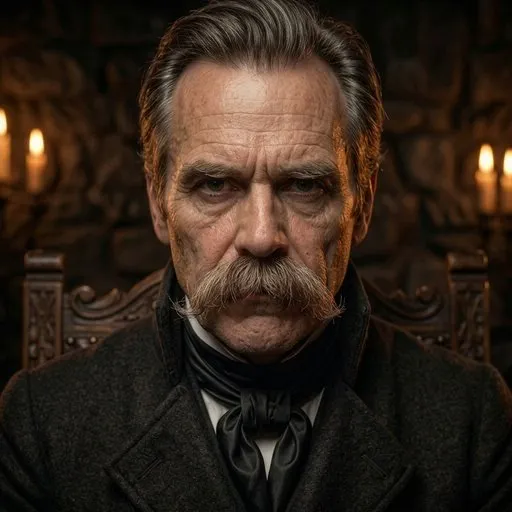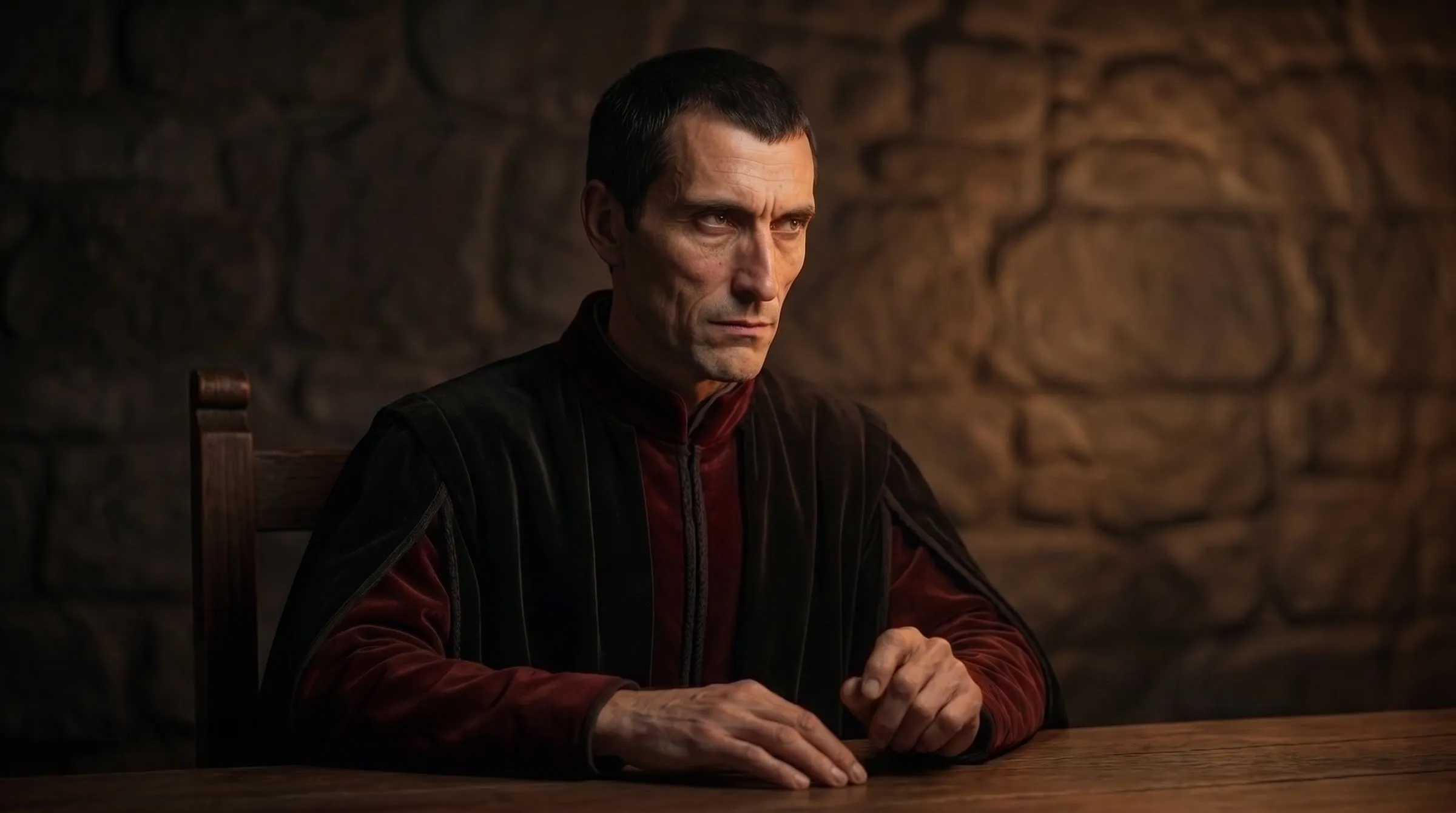
Almost everything the phrase Machiavellian carries - the poisoner, the schemer, the man who smiles while working out how to be rid of a rival, was invented by people who had not read him, applied to a book he wrote in four months while unemployed and frightened, and cemented by a French Huguenot pamphleteer who blamed him for a massacre that happened forty-five years after he died.
The man himself was a salaried civil servant. He spent fourteen years writing dispatches for a republic, lost the job when the republic fell, was tortured on suspicion of conspiring to restore it, and passed the rest of his life on a small farm seven miles from the city he could no longer serve, writing books nobody would publish until after he was buried.
What follows is that life, those books, and the long argument about what he actually meant.
The city that formed him
Florence in 1469 was a republic in name and an oligarchy in practice, run by the Medici bank through a system of offices that looked constitutional and functioned as patronage. Niccolò was born there on 3 May, into the minor gentry - the class with an old name, a coat of arms, and no money.
His father Bernardo was a lawyer of modest and irregular practice, barred for years from public office as a debtor to the commune. What Bernardo did have was books, and a diary - the Libro di Ricordi - which survives and records, among household expenses, how he obtained a copy of Livy’s Decades: not by purchase, but by compiling an index of its place names for the printer in exchange for the volume. His son would spend his life arguing with that book.
The education was humanist and provincial: Latin, Livy, Cicero, Lucretius - Niccolò copied out the whole of De rerum natura by hand as a young man, and the manuscript is in the Vatican Library. No Greek. No university. This matters more than it sounds, because it left him outside the philosophical guild for good. He never acquired the vocabulary of scholastic argument and never pretended to. When he writes about the soul or about God, he writes as a layman with opinions, not as someone who has read Aquinas.
Then came Savonarola. The Dominican friar who ruled Florence from the pulpit between 1494 and 1498, burned the vanities, prophesied the scourge of Italy, was excommunicated, and was hanged and burned in the Piazza della Signoria on 23 May 1498. Machiavelli watched all of it as a young man with no position, and he drew from it the conclusion that runs through everything he later wrote: all armed prophets have conquered and the unarmed ones have been destroyed. It is in chapter six of The Prince, stated as a general law of politics. He had seen the specific case at twenty-nine.
Fourteen years at the centre
Five days after Savonarola’s execution, and with the friar’s party dismantled, the twenty-nine-year-old Machiavelli was nominated Second Chancellor of the Republic. In July he was confirmed, and shortly after was also made secretary to the Ten of War - the committee handling foreign affairs and the military.
For the next fourteen years he was at the centre of everything, without ever being anyone. He was staff, not principal. He drafted, he travelled, he reported, and he watched the men who decided.
The legations are the education. In 1499 he was sent to Caterina Sforza at Forlì and was comprehensively outmanoeuvred by her - a humiliation he wrote up honestly and returned to for the rest of his life. In 1500 he spent six months at the court of Louis XII of France and learned what a real state looked like: unified, taxed, permanently armed, and utterly uninterested in the opinions of Italian city republics. It ruined him for Italian politics. Every later page is written by a man who has seen the scale of the thing coming.
In late 1502 he was attached to Cesare Borgia in the Romagna, and in December he was at Senigallia when Borgia invited the captains who had conspired against him to a friendly meeting and had them strangled. Machiavelli’s dispatch is nearly admiring. He later wrote it up as A Description of the Method Used by Duke Valentino in Killing Vitellozzo Vitelli, Oliverotto da Fermo and Others - a short, flat, technical account of a massacre, written the way a professional writes about a piece of work done cleanly.
He also watched the Romagna afterwards, and recorded the other half. Borgia had put a hard man, Remirro de Orco, into the province to pacify it by brutality; when the province was pacified and hated Remirro for it, Borgia had him cut in two and left in the piazza at Cesena with a block of wood and a bloody knife beside him. Machiavelli’s comment is one sentence: the people were left satisfied and stupefied. That sentence is the whole of his method - the effect on the audience is the fact that matters, and the moral status of the act is a separate question he declines to raise here.
The one thing he initiated himself was the militia. Machiavelli had come to believe that mercenary companies - the standard instrument of Italian warfare - were structurally useless: they were paid to fight and therefore had an interest in not fighting decisively, and they would leave the moment someone paid more. From 1505 he pressed for the ordinanza, a conscripted militia raised from the Florentine countryside, and the law creating it went through on 6 December 1506. He ran it himself. In 1509 it took Pisa, after fifteen years of failure. It was the great success of his career.
In 1512 it collapsed. A Spanish army moving on Florence to restore the Medici met his militia at Prato on 29 August, broke it in an afternoon, and sacked the town. The republic fell within days. On 7 November Machiavelli was dismissed, fined, and confined to Florentine territory.
Whether Cesare Borgia was Machiavelli’s model prince
Chapter VII of The Prince is built around one man. Cesare Borgia was the son of Pope Alexander VI, a cardinal at eighteen, out of the church five years later, and made Duke of Valentinois by Louis XII, which is why Italy called him il Valentino. Machiavelli was attached to his camp for four months across 1502 and 1503 and wrote about him for the rest of his life.
The chapter holds him up without hedging. Borgia’s actions are offered as the instruction a new ruler should study, and Machiavelli says he knows of no better precepts to give.
Then he lists what the duke did, and the list reads as a plan of work. He destroyed the families of the lords he had dispossessed, so that no claimant survived for a hostile pope to sponsor. He drew the Roman nobility away from the Orsini and the Colonna and onto himself. He built the largest single party inside the College of Cardinals. And he set out to hold enough power in his own hands to survive his father’s death. Three of the four were finished by August 1503.
What broke it was not a rival. Alexander VI died on 18 August 1503, and Cesare, who had planned for that day for years, was himself close to death of fever when it arrived. Machiavelli records the duke’s own account, given to him on the day Julius II was elected: he had thought of everything that might happen when his father died and had provided a remedy for all of it, except that he had never anticipated being at the point of death himself.
if his dispositions were of no avail, that was not his fault, but the extraordinary and extreme malignity of fortune. The Prince, chapter VII, trans. W. K. Marriott
One thing he is blamed for. Too weak to elect a pope of his own, Borgia could still have blocked one, and instead he consented to Giuliano della Rovere, a cardinal he had injured. Julius II took the Romagna off him within months. He was arrested, shipped to Spain, held at Chinchilla and then at Medina del Campo, escaped in 1506, took service with his brother-in-law the king of Navarre, and was killed in a skirmish outside Viana on 12 March 1507, at thirty-one.
So the model prince of chapter VII had been dead and stripped for six years when the chapter was written, and every reader in Florence knew it. That is not a fact Machiavelli concealed; it is what the chapter is for. The claim is not that Borgia won. It is that a man can do everything a situation requires, in the right order, with nerve, and still be finished by an illness nobody could have scheduled. The chapter on Cesare Borgia is the chapter that sets up the chapter on fortune.
Rousseau read the same pages two and a half centuries later and drew the opposite conclusion from the same fact, in a footnote: the choice of so detestable a hero gives away the hidden intention. Erica Benner’s ironic reading follows that line. The plainer reading is that Machiavelli admired the method, watched it collapse for reasons the method could not touch, and reported both halves.
Machiavelli’s militia, The Art of War, and the day at Prato
The argument that pushed him into military reform is stated flatly in chapter XII of The Prince:
The chief foundations of all states, new as well as old or composite, are good laws and good arms; and as there cannot be good laws where the state is not well armed, it follows that where they are well armed they have good laws. The Prince, chapter XII, trans. W. K. Marriott
Mercenaries, in the same chapter, are useless and dangerous, disunited and undisciplined, valiant before friends, cowardly before enemies, and held in the field only by a wage too small to die for. Italy had rested on them for a century, which is why Charles VIII walked the length of the peninsula in 1494 needing nothing, in the phrase Machiavelli borrows, but chalk in hand to mark the billets.
His answer was conscription. From 1505 he pressed for a militia raised in the Florentine countryside, and on 6 December 1506 the law creating a permanent magistracy for it, the Nine of the Militia, went through. He was made its secretary and ran it. The muster reached the order of ten thousand infantry from the contado. In 1509 those troops were in the line at the surrender of Pisa, after fifteen years in which Florence had failed to take the city back.
Prato is the other half of the record. On 29 August 1512 the Spanish army of the Holy League under Ramón de Cardona, short of supplies and in a hurry, opened a breach after roughly two days of bombardment. The garrison, some two thousand of Machiavelli’s conscripts, did not hold it. The town was stormed and sacked over the following weeks. Writing in September on the accounts of people who had got out, Machiavelli put the dead at four thousand, and some contemporary reports run higher. Florence surrendered without a siege of its own, and the republic he had served for fourteen years was gone inside a fortnight.
He never dropped the argument. The Art of War, written around 1519 and published in 1521, is the only major political work printed while he lived. It is a dialogue in seven books, set in the Rucellai gardens, with the condottiere Fabrizio Colonna as the principal speaker, and it proposes the Roman legion as the pattern for a modern army: infantry ahead of cavalry, drill ahead of dash, and a citizen body that goes back to its fields when the campaign ends.
Its best-known error is artillery, which Fabrizio subordinates to the infantry rather than treating as decisive. The modern correction is that Machiavelli did not reject gunpowder weapons; he refused them the leading role because, with the guns of 1520, relying on them meant standing still, and he wanted armies that moved. He was wrong about where the century was going and right about the part that turned out to matter most. Drill, standing formations and permanent discipline are what Maurice of Nassau and Gustavus Adolphus built European infantry out of two and three generations later, working from the same Roman model.
The rope
In February 1513 a list was found. Two young men, Pietro Paolo Boscoli and Agostino Capponi, had been plotting against the new Medici regime, and they had written down the names of men they hoped might join them. Machiavelli’s name was on it. There is no evidence he knew either of them well or knew anything about the plot.
He was arrested and tortured with the strappado: the wrists tied behind the back, the body hoisted by them, then dropped short so the shoulders take the whole weight. He took six drops. He did not confess, because there was nothing to confess.
What he did in prison, sometime around this, was write two sonnets to Giuliano de’ Medici - the man whose family had jailed him - complaining about the lice and the stink and asking, with a joke, to be let out. It is a strange, characteristic document. The irony does not switch off under torture.
He was released in March in the general amnesty that marked the election of Giovanni de’ Medici as Pope Leo X. A Florentine on the papal throne; the city celebrating; and Machiavelli, forty-three years old, walking out of prison with dislocated shoulders and no employment.
Sant’Andrea, and the letter
He retreated to the small property his father had left at Sant’Andrea in Percussina, near San Casciano, seven miles south of Florence. He was there, on and off, for the rest of his life.
On 10 December 1513 he wrote to Francesco Vettori, his friend and the Florentine ambassador in Rome, describing his days. It is the most famous letter in Italian literature and deserves the status.
The morning is spent in the woods with bird-lime, a book in his pocket - Dante, Petrarch, Tibullus, Ovid - reading about other men’s love affairs while trapping thrushes. Then the inn on the road, where he plays cricca and triche-trach with the miller, the butcher and two kiln-workers, and the games produce shouting and insults over a farthing, and he takes part with everything he has, because otherwise, he says, his brain would rot.
Then evening:
When evening comes, I return home and go into my study, and on the threshold I take off my everyday clothes, covered in mud and mire, and put on garments regal and courtly; and reclothed appropriately, I enter the ancient courts of ancient men, where, received by them lovingly, I feed on the food that alone is mine and that I was born for. There I am not ashamed to speak with them and to ask them the reasons for their actions; and they in their humanity reply to me. And for the space of four hours I feel no boredom, I forget every trouble, I do not fear poverty, I am not terrified by death: I deliver myself entirely to them. Letter to Francesco Vettori, 10 December 1513
And then, almost as an aside, that he has composed a little work De principatibus - on principalities - and would like Vettori’s advice about whether presenting it to the Medici would do him any good.
That is the origin of The Prince: an unemployed man’s attempt to be hired again, written by someone who had just described the reading of dead authors as the only thing that made him forget he was afraid.
The Medici never gave him the job. There is a story, unverifiable but old, that the manuscript was presented on a day when someone else brought Lorenzo a pair of hunting dogs, and the dogs got more attention.
What The Prince actually says
It is twenty-six short chapters. It is not a treatise; it is closer to a briefing.
The first eleven classify states and how they are acquired. Chapters twelve to fourteen are about armies, and argue that a ruler who relies on mercenaries or auxiliaries is a ruler who has outsourced the only thing that keeps him alive. Chapters fifteen to twenty-three are the ones everyone quotes. The last three are a lament for Italy and a call to expel the foreign armies - the most emotional passage he ever wrote and the one least like the rest of the book.
The hinge is chapter fifteen. Machiavelli says he will depart from what others have written, because:
many have imagined republics and principalities that have never been seen or known to exist in reality; for there is such a gap between how one lives and how one ought to live that anyone who abandons what is done for what ought to be done learns his ruin rather than his preservation. The Prince, chapter XV
The phrase he uses is la verità effettuale della cosa - the effectual truth of the thing. Not what a state should be. What actually happens, and what actually follows.
From that hinge, the notorious conclusions follow with an almost arithmetical calm.
On cruelty (chapter VIII): cruelties can be well or badly used. Well used means done all at once, out of necessity for one’s own security, and then stopped and converted into benefit. Badly used means small at first and increasing over time. The distinction is entirely about duration and quantity, not about permission - and it is worth noticing that even here he is arguing for less violence, applied faster, than the alternative he is criticising.
On being feared or loved (chapter XVII): both would be best, but the two are hard to combine, and if one must be given up it is safer to be feared. Men are ungrateful, fickle and false, and love is held by a bond of obligation which, men being wicked, is broken whenever it serves; but fear is held by a dread of punishment that never fails. Then the qualification that is always dropped from the quotation: the prince must nevertheless avoid being hated, and he avoids it by keeping his hands off other men’s property and other men’s women - because men forget the death of a father more quickly than the loss of a patrimony.
On keeping faith (chapter XVIII): a ruler must know how to use the beast as well as the man, and among beasts must be both lion and fox - the lion cannot detect traps, the fox cannot fight wolves. And so a prudent ruler cannot and should not keep his word when it works against him and the reasons that made him give it are gone. Machiavelli adds, drily, that if all men were good this precept would not be good, but since they are wicked and would not keep faith with him, he is not bound to keep it with them.
On appearances: it is not necessary to have all the good qualities, but very necessary to appear to have them. Everyone sees what a ruler seems to be; few touch what he is.
Two things are worth saying about all of this, because they are usually lost.
The first is that Machiavelli is not describing a preference. He is describing a constraint, and he says so: the ruler must be prepared to enter into evil when necessity commands. Necessity is doing the work in that sentence. Remove it and the whole argument becomes a licence; leave it in and it is a claim about tragic circumstances, which is a much older and much less shocking kind of claim.
The second is that the book has an addressee and a purpose that shape every line. It is addressed to a new prince - someone holding a state he has just taken, in an Italy being carved up by France and Spain. It is not a general theory of government. It is emergency advice for an emergency, written by a man who thought the emergency was the destruction of his country.
The Prince, chapter 17, on being feared or loved
This is the most searched passage in the book and the most reliably truncated. Its traditional title runs: concerning cruelty and clemency, and whether it is better to be loved than feared. The chapter does not open with the famous question. It opens with an accounting exercise.
Cesare Borgia was called cruel, Machiavelli writes, and his cruelty reconciled the Romagna and restored it to peace. Florence, avoiding the reputation for cruelty, allowed Pistoia to destroy itself. Borgia, on that comparison, was the more merciful of the two, because a few exemplary punishments injure the individuals punished and disorder injures everybody. That accounting, and not an appetite for violence, is the ground the chapter argues from.
Then the question:
Upon this a question arises: whether it be better to be loved than feared or feared than loved? It may be answered that one should wish to be both, but, because it is difficult to unite them in one person, it is much safer to be feared than loved, when, of the two, either must be dispensed with. The Prince, chapter XVII, trans. W. K. Marriott
The reasoning that follows is about reliability rather than about pleasure. Love is held by a bond of obligation, and an obligation is broken the moment keeping it costs something; fear is held by a dread of punishment, and that does not lapse. The catalogue of what men are, ungrateful and fickle and false and covetous, is not offered as a moral verdict on the species. It is an estimate of how a promise behaves under pressure.
And then, at once, the qualification that is cut out of the quotation almost every time it is repeated:
Nevertheless a prince ought to inspire fear in such a way that, if he does not win love, he avoids hatred; because he can endure very well being feared whilst he is not hated, which will always be as long as he abstains from the property of his citizens and subjects and from their women. The Prince, chapter XVII, trans. W. K. Marriott
Hatred, not love, is what the chapter is organised against, and it names the two reliable ways of earning it: taking property and taking women. Execution is treated as the smaller risk, and the coldest sentence in the book explains why, since men forget the death of a father sooner than the loss of a patrimony. Machiavelli then gives the practical reason a ruler slides into confiscation and should not: pretexts for seizing property are never lacking, and a ruler who begins living by seizure will always find more of them, whereas reasons for taking a life are harder to come by and go stale.
The chapter closes on a point that almost never survives the quotation. Men love as they themselves choose and fear as the prince chooses, so a wise ruler founds himself on what is in his own control rather than on what is in someone else’s, and confines his ambition to avoiding hatred. Read to the end, the passage is less a licence for terror than a rule for keeping a low and survivable profile.
The rest of the chapter is two case studies. Hannibal held an army of many nations together across years of foreign campaigning without one mutiny, and Machiavelli attributes it to a cruelty that made him revered and terrible; Scipio, the better man, had his army rebel in Spain out of an excess of leniency, and was called a corrupter of Roman soldiery in the Senate for it. The pairing is the whole argument in miniature: the same quality is a virtue in one command and a fatal defect in the other, and the difference is the situation.
The popular English version, that it is better to be feared than loved if one cannot be both, is a fair compression of half the chapter. What it discards is the half that says fear without hatred, and hatred begins at the property line.
Whether Machiavelli wrote that the end justifies the means
The sentence is in neither book. Two passages are usually standing behind it.
The first is in chapter XVIII, where Machiavelli writes that in the actions of all men, and above all of princes, where there is no court to appeal to, one looks to the outcome. The Italian is si guarda al fine. In place, it is a description of how audiences judge rather than a claim about what is permitted; it sits in a paragraph about appearances, about the many who see and the few who touch. Marriott renders it “one judges by the result”, which is what the sentence says.
The second is Discourses I.9, on Romulus, who killed his brother and consented to the death of his co-ruler and founded Rome. The line runs:
Conviene bene, che, accusandolo il fatto, lo effetto lo scusi; e quando sia buono, come quello di Romolo, sempre lo scuserà. Discorsi I.9
The deed accuses him, the effect excuses him, and where the effect is good it always will. There is no object in the Italian for the excusing: the effect excuses him, the founder. Translators have supplied one, and a good deal of the slogan comes from there. Thomson’s 1883 version gives “it will always excuse the means”, a phrase with nothing corresponding to it in the sentence. Mansfield and Tarcov give “it will always excuse the deed”. A hedged remark about one founding has been enlarged into a general permission by the machinery of translation.
The maxim itself is older than Machiavelli by fifteen centuries, and it belongs to a poet. Exitus acta probat, the outcome proves the deeds, is Ovid, Heroides II.85, in a verse letter from Phyllis to Demophoon, where the context is closer to a reproach than to a licence. The English proverb is first recorded in 1583, half a century after The Prince reached print and long before most of the people using it had opened the book.
What I.9 licenses is narrow, and the chapters on either side of it fence it in. The act has to be the constitution of a state, not its exploitation. It has to be done by one person, on the argument that a constitution cannot be drafted by a committee. And the authority must not be inherited: Machiavelli says in the same paragraph that the founder has to be prudent enough not to leave it to a successor, since a successor will use ambitiously what was used well. Chapter I.10 supplies the other half, that the founder of a tyranny deserves blame in exactly the measure that the founder of a republic deserves praise.
A permission that expires when the state is founded, cannot be passed on, and is followed immediately by the condemnation of anyone who claims it for himself is not the maxim the phrase has come to mean.
The other book
Overlapping with The Prince, and continuing for years afterwards, Machiavelli was writing something three times as long and pointing in what looks like the opposite direction.
The Discourses on the First Decade of Titus Livius is a commentary on the Roman historian’s account of the early Republic - the same Livy his father had indexed for a printer. It was written for, and partly in, the circle of young republicans who met in the Rucellai gardens, the Orti Oricellari.
Its arguments are not those of a man advising tyrants.
Republics are better than principalities, because they last longer and are better governed: the multitude is wiser and more constant than a prince. A people that governs itself makes fewer and more correctable errors than one man does.
The conflict between the plebeians and the senate - the tumults that Roman historians treated as the Republic’s disease - was in fact the cause of its liberty. This is the single most original claim in Machiavelli, and it is in Discourses I.4. Every classical writer had held that a healthy state is a harmonious one. Machiavelli says that the friction between those who want to dominate and those who want not to be dominated is what produces good laws, and a state without it is not healthy but asleep.
Liberty is best entrusted to the many, because those who want to dominate are the few, and the many merely want to be left alone. A guard is best kept by those who want least from it.
Corruption is the real enemy, and the remedy is a periodic return to first principles - ritornare ai principii - which sometimes means a shock severe enough to remind a people of what it was founded on.
And on religion: Machiavelli, who was formally Christian, baptised his children and took the last rites, argues in the Discourses that Christianity has made men humble and contemplative and therefore weak, that it has glorified suffering rather than action, and that Roman civic religion - which sanctified the state and made men love their city - served a republic better. He is not writing as an atheist. He is writing as a man assessing an institution by its political effects, which is exactly what he did to everything else.
So the problem: how does the man who wrote I.4 also write chapter XVIII?
The answers have shaped four centuries of scholarship. Perhaps he wrote The Prince for money and the Discourses from conviction. Perhaps the two describe different circumstances - a corrupt state needs one strong hand to refound it, a healthy one needs many hands to keep it. Perhaps, as Quentin Skinner argues, both books are held together by a single value: not liberty and not power but the survival and greatness of the political community, with different means at different moments. Perhaps, as Erica Benner argues, The Prince is written in a register its Florentine readers would recognise as ironic, and its praise of Cesare Borgia is not praise.
The honest position is that the tension is real and Machiavelli did not resolve it, because he did not think it needed resolving. He was not building a system. He was a man with fourteen years of dispatches in his head, writing down what he had learned about two different situations.
What the Discourses on Livy argue, book by book
The Discourses run to three books and one hundred and forty-two chapters: sixty, thirty-three and forty-nine. That is around four times the length of The Prince and some small fraction of its readership. They are addressed to Zanobi Buondelmonti and Cosimo Rucellai, two young men of the Orti Oricellari circle, neither of whom ruled anything, and the dedication makes a point of it. He has chosen, Machiavelli writes, not those who are princes but those who for their qualities deserve to be. For a book of political advice in that century it is a deliberate inversion of the form, and it is the first argument the book makes.
Book I is about the inside of a state. It opens with the cycle every constitution runs: monarchy decaying into tyranny, aristocracy into oligarchy, popular government into licence, and back round. The escape is the mixed constitution holding all three at once, which Rome reached by accident and quarrel rather than by design. I.4 is the claim that the quarrelling was the cause and not the disease. I.7 and I.8 are its institutional form: a republic must give citizens a lawful public way to accuse one another, because the alternative to accusation is not calm but slander, and slander is answered privately, with knives. I.34 defends the Roman dictatorship on the ground that an emergency power which is granted, time-limited and given back is not what kills republics; what kills them is the authority citizens take for themselves. I.11 to I.15 examine Roman religion as a working part of the state. I.58 argues that a people is wiser and steadier than a prince, against the entire weight of classical opinion.
Book II is about expansion and war. II.2 carries the attack on Christianity as a political force. II.10 denies the proverb that money is the sinews of war and insists the causation runs the other way, since good soldiers find money and money does not find good soldiers. II.13 observes that men climb from small beginnings by fraud more often than by force, and records it without visible discomfort. II.17 weighs artillery and underrates it. II.24 argues that fortresses do more harm than good, on the reasoning that a wall a ruler can hide behind is a wall he will hide behind instead of holding the loyalty that would have made it unnecessary.
Book III is about individuals inside institutions. III.1 sets out the return to beginnings: every sect and every state drifts, and only lasts if something periodically hauls it back to the principles it was founded on, whether that is a law, a trial or a shock. III.6, “Of Conspiracies”, is by a wide margin the longest chapter he ever wrote, roughly twice the length of its nearest rival in the book, and it is a technical study written from both sides at once: how conspiracies are organised, why they nearly always fail at the moment a second person has to be told, and how a ruler reads the signs. It is the clearest single piece of evidence that the Discourses and The Prince are one mind at work on two problems.
Whether Machiavelli was a republican
This is the live question in the scholarship, and it is live because the evidence points both ways and he never explained himself.
For the republic: fourteen years in the service of one, ended by its fall. Six drops on the rope rather than a name. The Discourses, which were long, unpaid and unpublishable in his lifetime, and which argue that liberty is safest in the hands of the many because the many want only not to be dominated. A dedication that refuses princes on principle. And a document that is easy to overlook, the Discursus florentinarum rerum of around 1520, drafted at the request of the Medici pope Leo X, in which Machiavelli tells the family that owns Florence that no arrangement will outlive them except a restored Great Council, and that a regime resting on two lives is not a regime. He was advising his patrons to legislate themselves out of power, in writing, over his own name.
Against, or at least complicating: The Prince is dedicated to a Medici and closes by asking that family to take Italy. The Florentine Histories were written on a Medici commission and delivered to a Medici pope. He wanted paid work from whoever could give it, and never pretended otherwise.
The positions in the literature are settled enough to name. Hans Baron read the Discourses as a republican turn taken after The Prince failed to find him a job. J. G. A. Pocock’s The Machiavellian Moment traced a republican Machiavelli through Harrington and the English commonwealthmen into the American founding. Quentin Skinner holds that both books serve one value, the freedom and greatness of the political community, with different instruments for different conditions. Maurizio Viroli, and in political theory Philip Pettit, take from him a definition of liberty as the absence of domination rather than the absence of interference. John McCormick’s Machiavellian Democracy reads him as more radical than any of these: a partisan of plebeian institutions and class-specific offices built to keep the wealthy under permanent supervision. Leo Strauss read the whole corpus as the work of a teacher of evil, with the republicanism as a vehicle. Harvey Mansfield has him as a transitional figure whose idea of the state is still medieval property rather than a modern office.
The last piece of evidence is a letter. On 16 April 1527, nine weeks before he died and with the imperial army moving south, he wrote to Vettori a line that has been quoted ever since: amo la patria mia più dell’anima, I love my native city more than my own soul. It settles nothing about the doctrine. It is fairly good evidence about the man.
Virtù, fortuna, and the flood
The two words that carry the argument are both mistranslated as a matter of routine.
Virtù is not virtue. It has almost nothing to do with goodness. It is closer to the Latin virtus and further still toward something like force of character under pressure: the capacity to see a situation as it is, decide, and act at the moment when action still changes the outcome. A man of virtù may be honest or ruthless. What he is not is passive or late.
Fortuna is not luck. It is everything outside the actor’s control - circumstance, timing, the arrival of a French army, the death of a pope. In chapter XXV Machiavelli gives it his best image. Fortune is a violent river that floods the plain, tears down trees and buildings, and moves earth; nobody can resist it when it rises. But in quiet times men can build dykes and embankments, so that when the flood comes it is channelled and does less damage. Fortune shows her power where no such preparation has been made.
Then he estimates the proportion, and the estimate is remarkable for its modesty: fortune is the arbiter of perhaps half our actions, and leaves the other half, or nearly, to us. Not a philosophy of mastery. An engineer’s assessment of how much of the world can be worked on.
He adds one further observation, in the Discourses and again in a letter, which reads as autobiography: a man succeeds when his way of proceeding suits the times, and fails when the times change and his way of proceeding does not. The cautious man does well in an age that rewards caution and is destroyed by one that rewards audacity. And almost nobody can change their nature, because they have succeeded that way before.
That is a man explaining, with no self-pity, why his own career ended.
What Machiavelli believed about God and the Church
He was baptised, married in a church, had his children baptised, took the last rites and lies in Santa Croce. He also wrote the most sustained political attack on Christianity produced in the sixteenth century. Neither fact cancels the other, because the question that interested him was never whether a religion is true.
The Discourses treat Roman religion the way a surveyor treats a load-bearing wall. Chapter I.11 gives Numa the credit for what Romulus could not do, since an armed people still has to be brought to obedience, and the oath did what no magistrate could: for many ages, Machiavelli writes, God was nowhere so much feared as in that republic. I.14 notes with open approval that the Romans read the auspices to suit the decision they had already taken, kept up an appearance of observance when they had to ignore the rites, and punished anyone who slighted religion openly. Throughout, the institution is assessed by what it produces.
By that measure the Church of his own day fails twice over, and I.12 states the charges. The example of the Roman court has left Italians the least religious people in Europe. And, worse, the Church is strong enough to stop any Italian power from uniting the peninsula and too weak to unite it itself, which is why Italy is not France or Spain.
The general indictment is in II.2:
whereas our religion glorifies men of a humble and contemplative, rather than of an active life. Accordingly, while the highest good of the old religions consisted in magnanimity, bodily strength, and all those other qualities which make men brave, our religion places it in humility, lowliness, and contempt for the things of this world; or if it ever calls upon us to be brave, it is that we should be brave to suffer rather than to do. This manner of life, therefore, seems to have made the world feebler, and to have given it over as a prey to wicked men to deal with as they please. Discourses II.2, trans. Ninian Hill Thomson
Then the qualification that summaries drop. The fault, he says in the next breath, lies with the reading and not with the faith: the damage comes from the baseness of those who have interpreted the religion to suit indolence and ease rather than valour, and a religion that permits the defence of one’s country would produce citizens willing to defend it. That is not the argument of a man saying Christianity is false. It is the argument of a man saying it has been interpreted by people with an interest in passivity.
What he privately believed is still argued over. Sebastian de Grazia’s Machiavelli in Hell won a Pulitzer for the case that biblical language and a real, if unorthodox, God run through the whole body of work. Anthony Parel reads the cosmos behind the books as essentially pagan. Others read a careful unbeliever writing in a century that burned people for saying so, and note that neither The Prince nor the Discourses ever refers to a next world.
There is a story, and it survives as a story. Machiavelli’s grandson Giuliano de’ Ricci, who spent much of his life gathering and copying the papers, recorded that on his last day Niccolò described a dream to the friends at the bedside: first a crowd of poor and ragged people who said they were the blessed, on their way to heaven, and then a company of grave, well-dressed men in which he recognised Plato, Plutarch and Tacitus, who said they were the damned. He told his friends he would rather go with the second party, where the conversation would be about politics. Maurizio Viroli, who tells it, adds the only honest verdict available: there is no way to know whether the tale is an invention.
Mandragola, and Machiavelli as a writer of comedies
The man who wrote chapter XVIII also wrote what is generally held to be the best comedy of the Italian Renaissance, and the two facts are the same fact.
Mandragola is five acts of prose, composed most probably in 1518, in print by 1524, and performed in Florence in the carnival season of 1526, though the dating of the first performance is disputed and earlier stagings have been argued for. Francesco Guicciardini organised a production at Faenza in 1526, for which Machiavelli wrote songs to be sung between the acts.
The plot is an operation. Callimaco wants Lucrezia, who is married to Messer Nicia, a rich and stupid lawyer desperate for a son. Ligurio, a professional fixer with no visible income, designs the scheme: a doctor’s story that a potion of mandrake root will make Lucrezia fertile but kill the first man who lies with her afterwards, so that a stranger must be found and used up first. Nicia agrees, since the arithmetic favours him. Lucrezia’s mother talks her round. Fra Timoteo, her confessor, supplies the theology for a fee. The husband himself holds the candle while the stranger is brought in, and the stranger is Callimaco.
Nobody is punished. Lucrezia, who is the only person in the play with a conscience at the start, works out by morning that everyone she trusted has arranged this, decides that what has happened must have been the will of heaven, and takes Callimaco as a permanent arrangement. The curtain falls on a household that is happier than it was.
The comedy runs on the same observation as the political work: that people are moved by what they want, that they will supply their own reasons afterwards, and that anyone who understands both can arrange almost anything. Ligurio is a strategist without a state. Fra Timoteo is what I.12 says about the clergy, put on a stage and made funny. Clizia, from about 1525, works the same ground with less pressure behind it.
What he did not say
The reputation is a construction, and it is possible to name the builders.
The word Machiavellian enters English in the 1560s. The Prince goes onto the Index of Prohibited Books in 1559, alongside everything else he wrote. In 1576 a Huguenot lawyer, Innocent Gentillet, published the Anti-Machiavel, blaming the St Bartholomew’s Day Massacre on the Italian faction at the French court and on the Florentine book they had supposedly read. Gentillet’s summary - a list of maxims wrenched free of context - travelled through Europe far faster than the original, and much of Elizabethan England met Machiavelli exclusively through it. By the time Shakespeare’s Richard of Gloucester boasts that he can set the murderous Machiavel to school, the figure being invoked is a stage devil with no relation to the man from San Casciano. English even acquired Old Nick for the devil, quite possibly from Niccolò.
Against that, the record:
He never wrote that the end justifies the means. The closest passage, Discourses I.9, says that when the deed accuses a founder the result should excuse him - a specific and hedged claim about founding a state, not a general principle about anything.
He never advocated cruelty for its own sake, and repeatedly says gratuitous cruelty is a mistake because it produces hatred, and hatred is fatal.
He was not an atheist, whatever the Counter-Reformation needed him to be.
He was not personally ambitious in any way that succeeded. He died with very little. The state he served most loyally was a republic, and he lost his career and his shoulders for it.
And the specific charge that he taught princes to be wicked was answered, sharply, by Spinoza and later by Rousseau, both of whom concluded that a book teaching peoples what princes actually do is a republican book with a monarchist title page. He professed to teach kings, Rousseau wrote, but it was the people he really taught.
The last years
He was never fully rehabilitated, but he was gradually let back in. The Medici cardinal Giulio - later Pope Clement VII - commissioned the Florentine Histories through the university in 1520, and Machiavelli spent five years writing the history of the city for the family that had ended his career, managing to be both honest and employed, which took some doing.
He wrote The Art of War and published it in 1521, the only one of the major works printed while he lived. He wrote Mandragola, which was a hit, and Clizia, which was not quite. He picked up minor diplomatic errands. He worked on the fortifications of Florence in 1526. He was, by his own account in letters, bored, poor, in love several times, and funny about all of it.
In May 1527 the imperial army sacked Rome, the Medici were expelled from Florence, and the republic was restored. The moment he had waited fifteen years for arrived - and the restored republic, remembering the Histories and the Medici commission, did not give him back his old post. He got a handful of votes.
He died a few weeks later, on 21 June 1527, at fifty-eight. He was buried in Santa Croce. The monument there was put up more than two centuries later and carries a line that would have amused him: TANTO NOMINI NULLUM PAR ELOGIUM - no praise is equal to so great a name.
Who read Machiavelli afterwards: Bacon, Spinoza, Rousseau, Hume, Adams, Gramsci
The hostile line, the one that produced the stage devil, is only half of the reception. Running alongside it, and generally quieter, is a line of readers who took him as an instrument and said so in print.
Francis Bacon, in the second book of The Advancement of Learning (1605), arguing that virtue cannot defend itself against what it refuses to study:
So that we are much beholden to Machiavel and others, that write what men do, and not what they ought to do. The Advancement of Learning, book II
The image immediately before it is the basilisk, which dies if it is seen first and kills if it is not. Bacon’s claim is that an honest man who has never examined dishonesty is not innocent, only unarmed.
Spinoza, in the Political Treatise left unfinished at his death in 1677, reaches the reading that would become the republican standard:
But what means a prince, whose sole motive is lust of mastery, should use to establish and maintain his dominion, the most ingenious Machiavelli has set forth at large, but with what design one can hardly be sure. Political Treatise, chapter V.7, trans. R. H. M. Elwes
Spinoza’s own answer is that Machiavelli was showing a free people how cautious it ought to be about entrusting itself absolutely to one man, and he grounds it on the observation that Machiavelli was known to be a friend of liberty.
Rousseau made it explicit in 1762, in the sixth chapter of the third book of the Social Contract, where the line the article quoted earlier appears in G. D. H. Cole’s version as He professed to teach kings; but it was the people he really taught. His Prince is the book of Republicans. The footnote goes further: Machiavelli was a proper man and a good citizen who, attached to the Medici court, could not help veiling his love of liberty; the choice of so detestable a hero as Cesare Borgia shows the hidden aim; and the Court of Rome banned the book because it is the Court of Rome that the book portrays.
Frederick II of Prussia wrote a refutation. The Anti-Machiavel was drafted in 1739 and published, edited and expanded by Voltaire, in September 1740. Frederick invaded Silesia that December.
David Hume is the dissent, and it is a technical one. In the essay “Of Civil Liberty” (1741) he grants the genius and rejects the results:
MACHIAVEL was certainly a great genius; but having confined his study to the furious and tyrannical governments of ancient times, or to the little disorderly principalities of ITALY, his reasonings especially upon monarchical government, have been found extremely defective; and there scarcely is any maxim in his prince, which subsequent experience has not entirely refuted. David Hume, Of Civil Liberty, 1741
The example Hume then produces is chapter XXIII, on counsellors, which he reports as saying that a weak prince cannot receive good advice. The chapter says an unwise one, which is a different failing, and Hume’s rebuttal answers the weakness he substituted rather than the claim Machiavelli made. The best-known English dismissal of Machiavelli misreports the passage it dismisses.
John Adams quoted him at length. A Defence of the Constitutions of Government of the United States of America (1787) praises Machiavelli as the first to have revived the ancient politics and holds that the world is indebted to him for the revival of reason in matters of government. On C. Bradley Thompson’s account Adams was the only one of the American founders who read him closely rather than invoking him, which is the concrete end of the tradition Pocock traced from Florence through Harrington to Philadelphia.
Antonio Gramsci wrote about him in a fascist prison. Arrested in 1926 as a communist deputy, sentenced in 1928, he filled more than thirty notebooks before his death in 1937. Notebook 13, written across 1932 and 1933, is headed with brief notes on Machiavelli’s politics. Gramsci reads The Prince as a myth in Georges Sorel’s sense, a creation of concrete phantasy acting on a dispersed and shattered people to arouse and organise its collective will, and then makes the move the notebook is remembered for. The modern prince cannot be a person. It has to be an organism, and the organism is the political party.
Eight years earlier, in April 1924, Mussolini had published his own reading of the same book in the review Gerarchia, calling it a handbook for the man of government and taking from it that a people is a passive mass to be governed without sentiment. In one country, in one decade, the same twenty-six chapters were serving as a warrant for a regime and as a way of thinking about how to end one.
Leo Strauss refused the whole rehabilitation in 1958 and went back to the sixteenth-century verdict, professing himself inclined to the old-fashioned and simple opinion that Machiavelli was a teacher of evil, and then spending a book on the case. Isaiah Berlin’s reply in 1972 is roughly where the argument now sits: what unsettles readers is not immorality but the exposure of two incompatible moralities, with no procedure offered for ranking them.
Machiavellianism as a psychology test score, and how little it has to do with Machiavelli
Someone typing that word today is more likely to mean a personality trait than a Florentine civil servant. The trait has a precise and traceable origin.
Richard Christie, an American social psychologist, began work in the 1950s on how manipulative people operate inside political movements. With Florence Geis he built a questionnaire around the idea, and in 1970 the two published Studies in Machiavellianism, a collection of thirty-eight studies assembled around it. The instrument at its centre, the Mach-IV, is twenty statements rated on an agree-to-disagree scale. It became the standard measure of the trait, and more than fifty years later it still is.
The first thing to say about the twenty statements is that Machiavelli did not write them. Christie and Geis composed them, as sentences they judged he might have produced, though Christie also described the scale as derived from Machiavelli’s works, and which of those two accounts is right is itself disputed.
Some are recognisably in the neighbourhood. Never tell anyone the real reason you did something unless it is useful to do so. The best way to handle people is to tell them what they want to hear. Several are reverse-scored, so that disagreement is what counts: Most people are basically good and kind, There is no excuse for lying to someone else, Most people who get ahead in the world lead clean, moral lives.
Others have no relation to him whatever. One item turns on whether P. T. Barnum, a nineteenth-century American showman, was wrong to say there is a sucker born every minute. Another asks whether people with incurable diseases should be able to choose a painless death, which is a question about euthanasia and belongs to a different argument in a different century.
One item is a straight transposition of something he wrote, and it is the one about people forgetting the death of a parent more easily than the loss of their property. That is chapter 17, turned into a survey question. A second comes close: the item about assuming that everyone has a vicious streak which will come out when they are given the chance sits very near Discourses I.3, where a founder is told to presuppose that all men are bad and will act on it whenever they have a free field. The rest have no traceable source in either book, and a peer-reviewed audit by Grace and Jackson in 2014 found fewer than half with even a tenuous connection. In the chapter it is not an observation about how human beings grieve. It is advice to a ruler about which confiscations start rebellions.
Christie knew the name was a liability. He explained in the book’s opening pages that the obvious labels were unavailable, since the M scale and the Ma scale and the rest were already in use for other constructs, and that Machiavellianism was the convenient remainder. He also expected the borrowed name to breed public misunderstanding, which it duly did.
In 2002 Delroy Paulhus and Kevin Williams grouped the Mach-IV with measures of subclinical narcissism and subclinical psychopathy and called the set the dark triad. Their paper runs to eight pages in the Journal of Research in Personality. It has been cited thousands of times and produced an industry: short forms, twelve-item versions, workplace studies, leadership studies, studies of who sends which messages on dating applications.
The trouble sits at the centre of it. In 2017 Joshua Miller and colleagues asked in the Journal of Personality whether Machiavellianism and psychopathy are a distinction without a difference, and found that a two-factor model collapsing them together fitted the data as well as a three-factor model keeping them apart. Machiavellianism, as measured, looks empirically like psychopathy. The theoretical difference usually offered, that high scorers plan while psychopaths are impulsive, is not reliably visible in the scores. A critical appraisal by the same group in 2019 laid the problem out for the field. The psychometrics have been questioned for just as long: reported factor structures range from three factors to nine depending on the sample, internal consistency is frequently poor, and a 2019 study in PLoS ONE had to modernise the wording of eight of the twenty items before it could test them properly.
What that leaves is a real enough object of study: a cynical and manipulative interpersonal style, which some people will report about themselves on a form. It is not a finding about the man whose name is on it.
He would also score oddly. He held a salaried post for fourteen years and lost it rather than change sides. He gave no names under six drops of the rope. He wrote that gratuitous cruelty is an error, that a hated ruler is already finished, and that a people is wiser and steadier than a prince. The scale describes a temperament: cool, planning, detached from other people’s claims. The books describe a situation, and what they recommend changes when the situation does. A permanent disposition and a contingent argument are different objects, and only one of them has his name on it.
Where to start reading Machiavelli
The letter first. The letter to Vettori of 10 December 1513 runs to four pages, sits in every collected edition of the correspondence, and explains more about its author than any introduction will. James Atkinson and David Sices have the private letters in English in Machiavelli and His Friends (1996).
Then The Prince, which is a hundred pages and fits into an evening. The English choices are stable. Russell Price’s translation with Quentin Skinner’s introduction, in the Cambridge Texts series (1988), restores the political vocabulary that the Victorian versions smoothed away. Harvey Mansfield’s (Chicago, second edition 1998) is the most literal in English and renders virtù as “virtue” throughout on principle, which makes it excellent for study and harder as a first encounter. George Bull’s Penguin (1961) reads most easily. Marriott’s version of 1908 is out of copyright and free to read online, which is why it supplies most of the quotations in this article.
Then the Discourses, which hardly anyone reads whole and which is where the other Machiavelli is. Mansfield and Tarcov (Chicago, 1996) is the standard English text; Thomson’s of 1883 is free online. Most of the argument is in I.1 to I.18, then I.34, I.58, II.2, III.1 and III.6.
Then Mandragola, which is the evidence that he found people funny rather than contemptible, and The Art of War in Christopher Lynch’s translation (Chicago, 2003) if the military case is the interesting part.
For secondary reading, Skinner’s Machiavelli: A Very Short Introduction is the best short account, Viroli’s Niccolò’s Smile the best narrative life, Berlin’s essay the best single piece of thinking about the problem, Benner’s Be Like the Fox the strongest statement of the ironic reading, and Pocock the place where the republican tradition is traced.
One warning holds the whole history of the reputation in a sentence. Reading The Prince on its own, without the Discourses anywhere near it, is precisely what Gentillet’s readers did in 1576, and four centuries of a man who never existed came out of it.
Why he is at this table
Because he is the only counsellor here who worked inside a government, and it shows in everything he says.
The others reason from a monastery, a cave, a laboratory, a study, a cell, a road. Machiavelli reasons from fourteen years of watching men decide under pressure, with incomplete information, in rooms where the consequences of being wrong were counted in dead soldiers. He is the table’s professional, and professionals notice different things.
His function in an argument is subtraction. Once a question has been put and the answers begin to arrange themselves around what a good person ought to do, Machiavelli asks what actually happens next: to whom, at whose expense, and whether the person recommending the noble course has understood what it costs the people who will pay for it. He is not cynical about this. Cynicism assumes the worst and stops thinking; he assumes very little and keeps going.
He is also, at this table, the one who has been broken by the thing he is expert in. He described how power works and was destroyed by an ordinary turn of it. That gives his position its particular weight: it is not the confidence of a man who won.
Around him the objections come from every side. Marcus Aurelius, who actually held the power Machiavelli only advised on, spent his private nights writing that the only thing in his control was his own character. Jesus, four seats away, is the source of the ethic Machiavelli spends the Discourses diagnosing as a political weakness. Diogenes thinks the entire apparatus - states, princes, reputations - is an elaborate arrangement for not having to be honest. Darwin would recognise the method instantly, since observing what organisms do rather than what they ought to do is the same move in a different field, and might well be the only one at the table who is unsurprised.
And the accusation Machiavelli faces at every episode is the one his name has carried for four hundred and fifty years: that describing a thing accurately is a way of endorsing it.
His answer is the one he gave in chapter fifteen, and he has never had a better one. There is a gap between how one lives and how one ought to live. The men who close that gap by pretending it is not there do not become good. They become ruined, along with everyone who was depending on them.
Whether that is wisdom or the most sophisticated excuse ever written is the argument. It is not going to be settled here, which is exactly why he has a seat.
The works
written 1513, published 1532
The PrinceIl Principe
Twenty-six short chapters on how a new ruler takes and holds a state. Written in a few months, in exile, as an unsuccessful application for a job. Placed on the Index in 1559 and never out of print since.
c. 1513–1519, published 1531
Discourses on the First Decade of Titus LiviusDiscorsi sopra la prima deca di Tito Livio
Three books, far longer than The Prince and far less read. A defence of republican liberty argued through Roman history, and the reason half of modern scholarship regards the other book as the anomaly.
1521
The Art of WarDell’arte della guerra
The only major political work published in his lifetime. A dialogue set in the Rucellai gardens arguing for a citizen militia against mercenary companies - the practical programme behind both other books.
c. 1518
MandragolaLa Mandragola
A comedy about a seduction accomplished by manipulating a husband, a mother and a friar. Widely regarded as the finest play of the Italian Renaissance, and the clearest evidence that its author found human self-deception funny.
commissioned 1520, presented 1525
Florentine HistoriesIstorie fiorentine
Eight books of Florentine history written on commission from the Medici cardinal who would become Clement VII - the man whose family had ended his career.
1513
The letter to Francesco VettoriLettera a Francesco Vettori, 10 dicembre 1513
The most famous letter in Italian literature. A day of bird-liming, tavern card games with a miller and a butcher, and then the evening at the desk in court dress. It also contains the first mention of The Prince.
c. 1503
A Description of the Method Used by Duke Valentino in Killing Vitellozzo Vitelli, Oliverotto da Fermo and OthersDescrizione del modo tenuto dal duca Valentino nello ammazzare Vitellozzo Vitelli
A short technical account of the strangling of Cesare Borgia’s mutinous captains at Senigallia, written by the diplomat who was in the town when it happened. Flat, professional and entirely without comment on the morality of it.
c. 1520
Discourse on Remodeling the Government of FlorenceDiscursus florentinarum rerum post mortem iunioris Laurentii Medices
A constitutional proposal drafted at the request of the Medici pope Leo X, telling the family that owned Florence that no settlement would outlive them except a restored Great Council. The best single piece of evidence about what he actually wanted.
Where the answers part
The same question, read differently by the seats nearby.
Diogenes of Sinope
Whether the mask can be removed
Diogenes carried a lamp through the market looking for one honest man and made a life out of refusing every mask. Machiavelli, who watched men negotiate for fourteen years, held that the mask is not a covering over the person but a large part of how the person functions in public - and that a ruler without one is simply a ruler who will be replaced by someone who has one. Between them sits the question of whether integrity is a virtue or a luxury paid for by whoever is protected by the state.
Friedrich Nietzsche
Whether the strong man is admirable
Nietzsche read Machiavelli with delight and claimed him as an ally - the same clean air, the same contempt for moralising. But Nietzsche wanted the exceptional individual to escape the herd, while Machiavelli wanted an ordinary republic to survive the century. One is a prophet of self-creation, the other a civil servant who thought self-creation was what tyrants called their appetites. The agreement between them is real and shallower than it looks.
Jesus
Whether humility is a strength
Discourses II.2 is the most sustained political attack on Christianity written in the sixteenth century, and its charge is not that the religion is false but that it works: it honours the humble and the contemplative, it teaches men to be brave in suffering rather than in acting, and a world trained that way is easier to prey on. Machiavelli then withdraws half of it, blaming the interpreters who read indolence into the faith rather than the faith itself. The seat four places along is the source of the ethic being diagnosed, and the argument between them is about whether an ethic should be judged by what it does to the people who hold it.
Contents
What did Machiavelli actually believe?
That political questions must be settled by looking at what people do rather than at what they profess, and that a ruler who acts as morality prescribes in a world where nobody else does will destroy himself and everything depending on him. He did not think cruelty was good. He thought it was sometimes the cheapest available option, and that pretending otherwise cost more lives than admitting it.
Was Machiavelli a Machiavellian?
By the ordinary meaning of the word, no. He was a salaried republican official for fourteen years, wrote a long and passionate defence of popular government in the Discourses, was tortured rather than change sides, and died poor. The adjective was coined by his enemies in the generation after his death, largely by people working from a hostile French summary rather than from the book.
Is The Prince a satire?
A minority reading, argued seriously since Rousseau and revived by Erica Benner and others, holds that it is written in a code its Florentine readers could hear. The majority view is that it is sincere and was meant to get him employed. The text supports both more comfortably than either side admits, which is part of why it has never been settled.
What is the difference between The Prince and the Discourses?
The Prince asks how one man takes and keeps a state. The Discourses ask how a free people keeps itself free, and answer that the conflict between the classes - not their harmony - is what made Rome both free and powerful. The two books were written in overlapping years by the same person, and reconciling them is the central problem of Machiavelli scholarship.
Did Machiavelli write "the end justifies the means"?
Not in those words. The nearest passage is in Discourses I.9, where he writes that a founder should be excused by the result when the deed accuses him - a narrower claim about founding a state, hedged and specific, not a general licence. The slogan is a summary written by other people.
Did Machiavelli say it is better to be feared than loved?
He said it would be best to be both, that the two are hard to combine, and that if one has to go it is safer to keep fear. The half of chapter XVII that is always cut says the ruler must still avoid being hated, and that hatred is earned by taking property and women rather than by killing. Fear without hatred is the actual prescription.
Was Cesare Borgia the model for The Prince?
Chapter VII offers his actions as the example a new ruler should study, and Machiavelli had watched him at close range in 1502 and 1503. Borgia had also lost everything and died in a skirmish in Navarre in 1507, six years before the book was written. The lesson drawn is not that he won but that he did everything correctly and was destroyed by a fever.
What is Machiavellianism in psychology?
A personality trait measured by the Mach-IV, a twenty-item scale published by Richard Christie and Florence Geis in 1970 and later folded into the dark triad alongside narcissism and psychopathy. The items were written by the researchers as statements they thought Machiavelli might make; only one is close to anything in his books. Christie chose the name because the alternatives were taken.
Was Machiavelli religious?
He was baptised, married in church, took the last rites and lies in Santa Croce, and he wrote the sharpest political attack on Christianity of his century. Discourses II.2 argues that a religion which honours humility and endurance has left the world easier to prey on, and then blames the interpreters rather than the faith. What he privately believed is still argued over.
Where should a reader start with Machiavelli?
With the letter to Francesco Vettori of 10 December 1513, which is four pages and explains the man. Then The Prince, which is short enough for one evening. Then the parts of the Discourses that matter most: I.1 to I.18, I.58, II.2, III.1 and III.6. Reading The Prince alone is how the reputation was built in the first place.
Sources and further reading
- The Prince1532Cited from the Cambridge Texts edition, trans. Russell Price, ed. Quentin Skinner (1988), which restores the Italian political vocabulary the Victorian translations smoothed away.
- Discourses on Livy1531Trans. Harvey C. Mansfield and Nathan Tarcov (Chicago, 1996).
- Machiavelli: A Very Short Introduction1981The standard short account, and the clearest statement of the case that the two books share one project.
- The Foundations of Modern Political Thought, vol. 1: The Renaissance1978
- The Originality of Machiavelli1972The essay that reframed the problem: not that Machiavelli was immoral, but that he exposed two incompatible moralities and declined to rank them.
- The Machiavellian Moment1975Traces the republican Machiavelli through English and American political thought.
- Machiavelli in Hell1989Pulitzer Prize. The fullest treatment of his religious thought, which is usually assumed rather than read.
- Niccolò’s Smile: A Biography of Machiavelli1998
- Be Like the Fox: Machiavelli’s Lifelong Quest for Freedom2017The strongest modern statement of the ironic reading.
- Between Friends: Discourses of Power and Desire in the Machiavelli–Vettori Letters1993
- The Prince, trans. W. K. Marriott1908The public-domain English text supplying most of the quotations here, so that they can be checked against a freely available source. Two blockquotes predate this edition and are in other translations: chapter XV and the Vettori letter.
- Discourses on the First Decade of Titus Livius, trans. Ninian Hill Thomson1883The public-domain English Discourses. Its rendering of I.9 as "it will always excuse the means" supplies an object the Italian does not have, and is part of how the slogan attached itself to him.
- Art of War, trans. Christopher Lynch2003
- Machiavelli and His Friends: Their Personal Correspondence1996The private letters in English, including the letter of 10 December 1513 and the letter to Vettori of 16 April 1527.
- Heroides II.85Exitus acta probat, the outcome proves the deeds. The maxim predates Machiavelli by fifteen centuries and belongs to a verse letter from Phyllis to Demophoon.
- The Oxford Dictionary of Proverbs, entry ‘the end justifies the means’Dates the first recorded English use to 1583 and notes that the saying is proverbial from antiquity rather than Machiavellian.
- The Advancement of Learning1605Book II. "So that we are much beholden to Machiavel and others, that write what men do, and not what they ought to do."
- Political Treatise, chapter V.7, trans. R. H. M. Elwes1677Reads The Prince as a warning to free peoples rather than a manual for princes, on the ground that its author "was favourable to liberty".
- The Social Contract, book III, chapter 6, trans. G. D. H. Cole1762The republican reading, with the footnote calling Cesare Borgia a detestable hero whose selection gives away the author’s hidden aim.
- ‘Of Civil Liberty’, in Essays, Moral, Political, and Literary1741The dissenting verdict: a great genius whose maxims subsequent experience has refuted.
- Anti-Machiavel1740Written 1739, edited and published by Voltaire in September 1740. Frederick invaded Silesia in December of the same year.
- ‘John Adams’s Machiavellian Moment’1995Documents Adams’s praise of Machiavelli as the first to revive the ancient politics, and the debt the Defence of the Constitutions owes him.
- Selections from the Prison Notebooks, trans. Quintin Hoare and Geoffrey Nowell Smith1971Notebook 13, written in prison in 1932 and 1933, reads The Prince as a Sorelian myth and identifies the modern prince with the political party.
- Thoughts on Machiavelli1958The teacher-of-evil reading, stated in the opening pages and defended for four hundred more.
- Machiavellian Democracy2011The plebeian reading: class-specific institutions built to keep the rich under supervision.
- Studies in Machiavellianism1970Where the Mach-IV was published. The opening chapter explains that the name was chosen partly because the obvious alternatives were already in use.
- ‘Reflections on the Misrepresentation of Machiavelli in Management: The Mysterious Case of the MACH IV Personality Construct’2014The peer-reviewed audit of the Mach-IV against the text, item by item, cited in the section on the psychology instrument.
- ‘The Dark Triad of personality: Narcissism, Machiavellianism, and psychopathy’2002
- ‘Psychopathy and Machiavellianism: A Distinction Without a Difference?’2017Two-factor and three-factor models fit the data equally well, which is the central problem with the construct.
- ‘A Critical Appraisal of the Dark-Triad Literature and Suggestions for Moving Forward’2019
- ‘Measurement invariance tests of revisions to archaically worded items in the Mach IV scale’2019On the scale’s dated wording and its unstable factor structure.
- ‘Niccolò Machiavelli’, Stanford Encyclopedia of PhilosophyThe standard survey of the interpretive positions, including the republican question.
Last reviewed: