On 22 December 1849, in Semyonovsky Square in St Petersburg, twenty-one men were brought out in the snow, told they would be shot, and given last rites. They were formed into groups of three. The first three were tied to posts and hooded; the firing squad raised their rifles.
Fyodor Dostoevsky, twenty-eight, was in the second group. He had a few minutes left, and later reported spending them working out what he would think in the last instant.
A rider arrived with a reprieve. The sentences were commuted to hard labour in Siberia. The whole thing had been decided in advance by Nicholas I, who had authorised the staging as a lesson. One of the men, Nikolai Grigoryev, had been showing signs of derangement in prison and never recovered.
It is difficult to think of a single episode that better explains a body of work. Everything Dostoevsky wrote afterwards is concerned with people at the extreme edge of themselves, in situations that will not let them look away, discovering what they actually believe at the moment when believing it costs everything.
Before
Born 11 November 1821 in Moscow, on the grounds of the Mariinsky Hospital for the Poor, where his father was a staff physician. He grew up literally beside destitution and illness; the family lived in an apartment in the hospital wing, and the boy talked to the patients when he was not supposed to.
His mother died of tuberculosis when he was fifteen. His father died two years later - officially of apoplexy, but a persistent family story held that he had been murdered by his own serfs, who had had enough. Whether it happened is unproven and probably unprovable. Whether Dostoevsky believed it is a different question, and The Brothers Karamazov, a novel about the murder of a repellent father and the guilt of sons who wished it, is a long time later to still be circling.
He was sent to military engineering school in Petersburg, hated it, graduated, took a commission, and resigned fourteen months later to write.
Poor Folk (1846) was an immediate success. The critic Vissarion Belinsky, the most powerful literary voice in Russia, was handed it by Nekrasov with the line that a new Gogol had arrived. Nekrasov and Grigorovich were the ones who had read it overnight and woken the author at four in the morning; Belinsky read it afterwards. Dostoevsky was twenty-four and briefly the most celebrated young writer in the country. The follow-up, The Double, was received badly, and the celebration ended nearly as fast as it began.
Then, in 1847, he began attending the Petrashevsky Circle - a discussion group of young men reading banned French socialist literature. In the Europe of 1848, in the Russia of Nicholas I, this was enough. He was arrested in April 1849, held in the Peter and Paul Fortress for eight months, and taken out into the snow in December.
Dostoevsky’s mock execution, 22 December 1849
Mikhail Petrashevsky was a translator in the Foreign Ministry who kept open house on Friday evenings. The talk was of Fourier and the French utopian socialists, of censorship, and above all of serfdom, which was still eleven years from abolition. Reading such books was illegal. Discussing them in company was worse.
Dostoevsky’s specific offence was that on 15 April 1849 he read aloud to the group Belinsky’s letter to Gogol of 1847, a document that could not be printed in Russia and that called the Orthodox Church the servant of despotism. Behind the Fridays there was also a smaller and more serious group around Nikolai Speshnev, which had discussed acquiring a secret printing press, and whose full shape the investigating commission never established.
The arrests came before dawn on 23 April 1849. Around sixty men were taken. Dostoevsky spent the next eight months in the Alekseevsky Ravelin of the Peter and Paul Fortress, where, extraordinarily, he wrote a story, A Little Hero, which was published anonymously eight years later.
A military court condemned twenty-one of them to be shot.
The sentences reached Nicholas I, who reduced them, and then did something else. He gave written instructions that the prisoners were to be told nothing, that the entire preparation for execution was to be carried out, and that the commutation was to be read only after the ritual had been completed. The reprieve existed on paper before the men left their cells. The ceremony in the square was theatre, staged by the head of state, with the condemned as the only members of the audience who did not know.
They were woken at five, driven in open carts across the city, and formed up on a scaffold draped in black. The death sentence was read. A priest went along the line with a cross. Swords were broken over the heads of the noblemen present, the formal ritual of civil degradation. They were dressed in long white shirts, which were burial shrouds.
Then three at a time to the posts: Petrashevsky, Mombelli, Grigoryev, hooded, with soldiers taking aim at close range. Dostoevsky put himself sixth in the order, which put him in the next group.
A drum sounded the retreat. The three were untied and brought back. An officer read out that His Imperial Majesty granted them their lives, and then the real sentences. Grigoryev, who had already been showing signs of derangement in prison, did not recover, and spent the rest of his life a mental invalid.
That evening, from the fortress, Dostoevsky wrote to his brother Mikhail:
To-day, the 22nd of December, we were all taken to Semionovsky Square. There the death-sentence was read to us, we were given the Cross to kiss, the dagger was broken over our heads, and our funeral toilet (white shirts) was made. Then three of us were put standing before the palisades for the execution of the death-sentence. I was sixth in the row; we were called up by groups of three, and so I was in the second group, and had not more than a minute to live. Letter to Mikhail Dostoevsky, 22 December 1849, trans. Ethel Colburn Mayne
He used it twice in the fiction, and the second time is the more precise. In The Idiot, Prince Myshkin describes a man he says he met who had been brought out for a political execution and reprieved after twenty minutes. The man remembered dividing the last five minutes into portions: two for farewells, two for thinking about himself, one for a last look at the world. Five minutes, in the account Myshkin gives, became an enormous wealth of time.
That is not invention. That is a man reporting his own five minutes through a character, nineteen years later, with the arithmetic intact.
Siberia
Four years at the katorga prison at Omsk, in leg-irons, followed by five years of compulsory military service in Semipalatinsk.
He recorded it in Notes from the House of the Dead (1862), a book so unlike anything else in Russian literature that Tolstoy called it the best work of the modern period. What it describes is not primarily suffering. It is the discovery of a whole population he had theorised about and never met: peasant convicts, murderers, men who had been flogged nearly to death and were still capable of tenderness and of appalling cruelty in the same afternoon.
Two things came out of Siberia and never left.
The first was the collapse of his politics. He went in a Westernising liberal who believed in progress and rational social reform. He came out convinced that the educated Russian’s schemes for improving the peasant were the fantasy of men who had never spoken to one, and that human beings could not be improved by rearranging their conditions because the trouble was not in the conditions.
The second was the Gospel. The only book permitted in the prison was a New Testament, given to him by the wives of the Decembrists as he passed through Tobolsk. He read it for four years and kept the copy for the rest of his life. His faith afterwards was never comfortable and he said so, in a letter that is the most honest sentence any believer has written about belief: I am a child of this age, a child of unfaith and scepticism… and what terrible torments this thirst to believe has cost me and costs me even now. And then the notorious formulation - that if it were proved to him that the truth lay outside Christ, he would prefer to remain with Christ than with the truth.
Four years at Omsk, and what The House of the Dead reports
The transport left Petersburg on 24 December 1849, two days after the square, in open sledges, in a Russian winter. At Tobolsk the party was met by the wives of the Decembrists, the officers exiled after the failed rising of 1825, women who had followed their husbands to Siberia twenty-four years earlier and stayed. They gave each convict a New Testament. It was the only book Dostoevsky was allowed to own for four years.
At Omsk he was a common convict among common convicts, which is the fact the book turns on. Political prisoners of noble birth were not separated. He wore irons on his legs continuously, working, sleeping and washing in them, and they came off only at the end of the sentence. Later he described the barracks to Mikhail: filthy, unheated in the sense that mattered, packed with men, the floor an inch deep in dirt, and no hour in four years in which he was alone.
The book he made of it, begun in the newspaper Russkiy Mir in September 1860 and serialised complete in the journal Vremya from April 1861 to December 1862, is put behind a screen. The narrator is a nobleman named Goryanchikov, sent to Siberia for killing his wife, and the manuscript is presented as found papers. Nobody was deceived, and the screen was not for the readers. It was for the censor, and it worked: the first published account of the Russian penal system got through.
What is in it is not a protest. It is a set of observations by a man who had believed something about the Russian people and was finding out.
Convicts who had committed appalling murders were kind to animals and to children. Men flogged half to death competed to show they felt nothing. The prison staged a Christmas play and the acting was good. A man could be broken by the sentence and another man in the same barrack could be untouched by it. Above all, the peasants hated him, personally, for being a gentleman, and there was nothing he could do in four years to change it. That last discovery did more to destroy his politics than the irons did.
One episode from those years he did not publish until 1876, in A Writer’s Diary, under the title The Peasant Marey. It is Easter week in the prison, the convicts are drunk, there is a knife fight, and he goes out to the yard unable to bear it. Lying on the boards, he remembers being nine years old at the family’s country place, running in terror from an imagined wolf, and a serf ploughing nearby who stopped, crossed him, told him there was no wolf, and touched his cheek with a hand black with soil. The point of the memory, as he puts it, is that the drunk peasant in the yard whose face he cannot stand might be Marey. He could not know. There was no way to know from the outside.
Tolstoy, who agreed with Dostoevsky about almost nothing and disliked what he had heard of him, told Nikolai Strakhov in 1880 that he knew no better book in modern Russian literature, Pushkin included.
What Dostoevsky believed about God
The question is asked constantly and answered badly in both directions, because his own answer changes shape depending on which document is quoted.
The clearest single statement is in a letter written from Omsk in 1854, shortly after his release from the prison, to Natalya Fonvizina, one of the Decembrist wives who had met the convict transport at Tobolsk:
I want to say to you, about myself, that I am a child of this age, a child of unfaith and scepticism, and probably (indeed I know it) shall remain so to the end of my life. How dreadfully has it tormented me (and torments me even now) - this longing for faith, which is all the stronger for the proofs I have against it… I believe that there is nothing lovelier, deeper, more sympathetic, more rational, more manly, and more perfect than the Saviour… If anyone could prove to me that Christ is outside the truth, and if the truth really did exclude Christ, I should prefer to stay with Christ and not with truth. Letter to N. D. Fonvizina, Omsk, 1854, trans. Ethel Colburn Mayne
That is not the sentence of a man who has settled anything. It is a man choosing a person over a proposition and saying openly that he knows what he is doing.
In the notebook of his last year he put it more compactly: he did not believe as a child believes, and his hosanna had come through a great furnace of doubt. The line is preserved in the papers published as Literaturnoe nasledstvo and is quoted in Kenneth Lantz’s Dostoevsky Encyclopedia.
Two consequences run through the novels.
The first is that the case for belief is never allowed to be an argument, because he did not think one existed that would hold. Father Zosima’s teaching in book six of The Brothers Karamazov is not a proof of anything. It is a description of a way of standing towards other people, whose central claim is that everyone is answerable for everything:
believe me, every one is really responsible to all men for all men and for everything. The Brothers Karamazov, book VI, chapter 2, trans. Constance Garnett
And his definition of damnation is not a place:
Fathers and teachers, I ponder, “What is hell?” I maintain that it is the suffering of being unable to love. The Brothers Karamazov, book VI, chapter 3, trans. Constance Garnett
The second consequence is that he knew he was losing on points. While writing Karamazov he told his editor that Ivan’s case would be answered in the book that followed, and worried in letters about whether the answer would be strong enough for readers who had just read the objection. Mikhail Bakhtin’s account of the novels as polyphonic, with characters whose voices are genuinely independent of their author, explains why the worry was justified. Dostoevsky could not weaken Ivan without lying, and he would not.
The middle years
The 1860s were chaos. He returned to Petersburg, started a journal with his brother Mikhail, and lost it to the censor. His wife died. Mikhail died just under three months later, leaving debts that Fyodor assumed. He fell into a destructive affair with Apollinaria Suslova and into compulsive roulette, and lost money he did not have in Wiesbaden and Baden-Baden repeatedly.
Trapped by a contract that would have given a publisher the rights to everything he wrote for nine years if he failed to deliver a novel in a month, he hired a stenographer. Anna Snitkina was twenty. They finished The Gambler in twenty-six days, and he married her a few months later. She took over the money, negotiated with the publishers, eventually became his publisher, got the gambling under control, and is the principal reason the late novels exist.
The epilepsy, which had begun in Siberia or before, was severe throughout. He described the aura preceding a seizure as a few seconds of complete harmony and certainty - I would give my whole life for this one instant - and then the collapse and the days of depression afterward. He put it directly into Prince Myshkin in The Idiot, and gave it to Smerdyakov in Karamazov, where it is faked.
Dostoevsky’s gambling, and the novel written in twenty-six days
The contract was signed on 1 July 1865. Fyodor Stellovsky, a publisher who specialised in buying writers in difficulty, paid three thousand roubles for the right to issue a collected edition, and attached a condition: a new novel of at least twelve printed sheets, delivered by 1 November 1866. If it did not arrive, Stellovsky would own the publishing rights to everything Dostoevsky had written and everything he wrote for the following nine years, and would pay nothing further for any of it.
The three thousand roubles went to creditors and to roulette. By the beginning of October 1866 the novel did not exist, and he was simultaneously serialising Crime and Punishment in The Russian Messenger with instalments due.
He hired a stenographer, which was a new profession in Russia. Anna Grigoryevna Snitkina was twenty, one of the first women trained in the Petersburg shorthand school, and had read Notes from the House of the Dead as a girl. Dictation began on 4 October. He talked in the mornings, she transcribed in the afternoons, he corrected in the evenings, and he wrote Crime and Punishment at night. The fair copy of The Gambler was finished on 30 October, twenty-six days after they started.
Stellovsky was not available to receive it. His office refused delivery; he had left town. Dostoevsky took the manuscript to a police station on 1 November and deposited it against a dated receipt, which is why the contract failed and the rights did not transfer.
He married Anna on 15 February 1867. They left Russia two months later, partly for the sake of his health and largely to get away from creditors, and stayed abroad for four years, in Dresden, Baden-Baden, Geneva and Florence.
The gambling continued through most of it. He believed he had a system, and that the system worked, and that his losses were caused by his own failure to follow it, which is the standard structure of the thing. He pawned Anna’s clothes, her jewellery, his overcoat, and wrote letters of self-reproach so complete that they read as a genre.
It stopped in April 1871, in Wiesbaden. He lost the last of what he had, went looking through unfamiliar streets in the dark for a church, found a synagogue instead, and wrote to Anna that night that something had happened and that the delusion of ten years was gone. He was six and a half months from turning fifty. He never gambled again, and the decade that followed produced Demons, The Adolescent and The Brothers Karamazov.
Anna’s part in this is not decoration. She took over the household accounts, then the contracts, then the printing: she published Demons herself in 1873, cutting out the middlemen who had been buying his work cheaply, and by the end of the decade the debts he had carried since his brother’s death were cleared.
Dostoevsky’s epilepsy, and what the novels do with it
The onset is disputed. The story that his first seizure came at the news of his father’s death in 1839 comes from his daughter Lyubov, writing decades later, and no contemporary document supports it. The reliable record begins in Siberia: there are seizures at Omsk, and a military medical certificate from Semipalatinsk in the 1850s. From then until his death he had them regularly, kept a private record of them in his notebooks, and organised his working life around the days of confusion and depression that followed each one.
What made it material for fiction was the aura. He described a few seconds before some seizures in which everything resolved, and said he would trade his life for them. He gave the description twice, to two characters, in two novels.
Prince Myshkin, in The Idiot, reasons about it against himself and loses:
“What matter though it be only disease, an abnormal tension of the brain, if when I recall and analyze the moment, it seems to have been one of harmony and beauty in the highest degree - an instant of deepest sensation, overflowing with unbounded joy and rapture, ecstatic devotion, and completest life?”… Since, in the last conscious moment preceding the attack, he could say to himself, with full understanding of his words: “I would give my whole life for this one instant,” then doubtless to him it really was worth a lifetime. The Idiot, part II, chapter 5, trans. Eva Martin
Kirillov, in Demons, gives the same experience an atheist’s frame, and it is more disturbing for it:
There are seconds, they come five or six at a time, when you suddenly feel the presence of the eternal harmony perfectly attained. It’s something not earthly, I don’t mean in the sense that it’s heavenly, but in that sense that man cannot endure it in his earthly aspect. He must be physically changed or die. Demons, part III, chapter 5, trans. Constance Garnett
Shatov’s reply, immediately, is to ask whether this happens often and to warn him that it is the beginning of epilepsy. Dostoevsky puts the diagnosis in the room and leaves the question open, which is the only intellectually honest thing to do with it and is exactly what the medical literature has been doing since.
Smerdyakov is the third use and the coldest. He is epileptic; he fakes a fit in the cellar as an alibi, and then has a genuine one, which is the detail that makes the alibi work. A murder in a great novel turns on the difference between a simulated seizure and a real one, written by a man who knew what both looked like from the inside.
The medical argument about him has run for a century. Freud, in 1928, claimed the seizures were hysterical rather than organic and expressed guilt over the father’s death; that reading depends on a murder that probably did not happen and on an onset date that is not documented, and it has not survived. Théophile Alajouanine, writing in Brain in 1963, proposed temporal-lobe epilepsy on the basis of the ecstatic aura. Henri Gastaut argued in Epilepsia in 1978 for generalised epilepsy instead. Subsequent work has mostly gone back towards Alajouanine, and ecstatic seizures are now a recognised phenomenon with their own literature, in which Dostoevsky’s descriptions are still cited as evidence because nothing better has been written by a patient.
There is one further fact and it is not clinical. His son Alyosha, born in 1875, died on 16 May 1878 after a seizure that lasted hours. The child was two years and nine months old and had inherited the illness from his father. Dostoevsky went with the philosopher Vladimir Solovyov to the monastery at Optina Pustyn in June and spent three days with the elder Amvrosy, who is one of the models for Zosima.
In the second book of The Brothers Karamazov, a peasant woman who has walked two hundred miles tells Zosima about her dead son:
He was three years old, three years all but three months. The Brothers Karamazov, book II, chapter 3, trans. Constance Garnett
Zosima asks his name. It is Alexey.
The argument
Dostoevsky’s ideas are not extractable in the way a philosopher’s are, because his method is to give the strongest possible version of a position to a character who will then live it out. Mikhail Bakhtin’s term for this is polyphony: the voices are genuinely independent, and the author does not overrule them. This is why the case against God in his novels is stronger than the case for it, and Dostoevsky knew it, and wrote to his editor in something close to panic about whether his answer would hold.
Against the rational man
Notes from Underground (1864) is the hinge, and it is aimed at a specific target: the confident 1860s belief that once people understand their real interests they will act on them, and that a society organised on rational principles will produce happy citizens.
The Underground Man’s answer is that human beings will burn the whole scheme down for the pleasure of proving they are not a piano key. Give a man universal prosperity and nothing to do, and he will invent destruction out of sheer ingratitude, simply to establish that he is a person rather than an organ stop. Twice two makes four is no longer life, on his account: it is the beginning of death.
What makes it more than a tantrum is that the speaker is not admirable. He is spiteful, paralysed, cruel to a prostitute who shows him kindness, and entirely aware of all of it. Dostoevsky is not endorsing him. He is demonstrating that the rational account of human beings has no room for this man, and that this man is extremely common.
Against the extraordinary man
Crime and Punishment (1866) takes a theory and puts it in a body. Raskolnikov, a poor and gifted student, has published an article arguing that ordinary people must obey the law while extraordinary people, Lycurgus and Solon and Napoleon among them, have the right to step over it if their idea requires it. He murders a pawnbroker to find out which he is.
The interest of the novel is not the crime, which happens early, but the discovery that the theory has no way of accounting for what happens next: he is not tormented by conscience in the pious sense, he is disintegrating, unable to sustain contact with other people, and the collapse is not a punishment sent from outside but a fact about what he is. Napoleon could step over. Raskolnikov, it turns out, is a man who loves his mother and cannot look at his sister.
Against himself
The Brothers Karamazov (1880) contains, in two chapters, the strongest case against God in literature, written by a believer who could not weaken it without lying.
In Rebellion, Ivan tells his brother Alyosha that he accepts God - he simply does not accept the world God made. He then produces a catalogue, drawn from real newspaper reports Dostoevsky had collected: a child of five beaten and locked in a freezing outhouse by her parents and made to eat her own excrement, praying to dear kind God in the dark; a serf boy of eight who threw a stone at a general’s hound and was torn apart by the pack in front of his mother.
Ivan’s argument is not that this disproves God. It is subtler and much harder. Suppose the final harmony arrives and everyone understands and forgives. He does not want it. He refuses to be part of an arrangement in which a mother embraces the man who set dogs on her son. Too high a price has been set on harmony. It is not God that I do not accept, Alyosha. I merely most respectfully return him the ticket.
Then The Grand Inquisitor. Christ returns to Seville during the Inquisition, is recognised, and is arrested by a ninety-year-old Cardinal who visits his cell to explain. Christ made one error: he refused the three temptations in the wilderness and thereby gave humanity freedom. But people do not want freedom; they want bread, and someone to bow down to, and someone to hand their conscience to. The Church has spent fifteen hundred years correcting the mistake, taking freedom back and giving people miracle, mystery and authority in exchange, which is what makes them happy. Tomorrow I shall burn thee.
Christ says nothing for the whole speech. At the end he kisses the old man on his bloodless lips. The Inquisitor shudders, opens the door, and says: go, and come no more.
Dostoevsky’s reply to Ivan is not an argument. It is Alyosha, and Father Zosima’s teaching that each is responsible to all for all, and the boy Ilyusha’s funeral at the end of the book. Whether that is an answer or an evasion is the question the novel leaves open, and it is open on purpose.
What Notes from Underground argues against: Chernyshevsky and the Crystal Palace
The book has an enemy, and the enemy had a name and an address.
Nikolai Chernyshevsky was the leading radical critic in Russia. In 1862 he was arrested and put in the Peter and Paul Fortress, in a cell in the same building where Dostoevsky had waited thirteen years earlier, and there, in about four months, he wrote a novel. What Is to Be Done? got past a confused censor in 1863 and became the most influential Russian book of the century among the young. Lenin took his own title from it.
Its philosophy is rational egoism. People act from self-interest; most human misery comes from failing to calculate self-interest correctly; educate the calculation, reorganise the economy along cooperative lines, and virtue follows from arithmetic. The novel’s heroine dreams of the future in a building of iron and glass, where everyone lives in comfort and works willingly.
Dostoevsky had seen the building. In July 1862 he spent eight days in London and went to the Crystal Palace, Joseph Paxton’s iron-and-glass hall from the Great Exhibition of 1851, by then re-erected at Sydenham. He wrote it up the next year in Winter Notes on Summer Impressions as something closer to a temple than an exhibition, an idol before which people were quietly agreeing to stop asking questions.
Notes from Underground is the reply, and it makes three moves.
Interest is not what the arithmetic says it is. Human beings want one thing more than they want advantage, and that is the ability to want. Given a fully rational scheme of their own good, they will find the one thing in it that cannot be predicted and do that:
perhaps the only goal on earth to which mankind is striving lies in this incessant process of attaining, in other words, in life itself, and not in the thing to be attained, which must always be expressed as a formula, as positive as twice two makes four, and such positiveness is not life, gentlemen, but is the beginning of death. Notes from the Underground, part I, chapter 9, trans. Constance Garnett
A person is not a mechanism, and will prove it at his own expense. This is the piano-key passage, and it is the centre of the book:
even if man really were nothing but a piano-key, even if this were proved to him by natural science and mathematics, even then he would not become reasonable, but would purposely do something perverse out of simple ingratitude, simply to gain his point. And if he does not find means he will contrive destruction and chaos, will contrive sufferings of all sorts, only to gain his point. Notes from the Underground, part I, chapter 8, trans. Constance Garnett
The perfect building is the objection, not the answer. The Underground Man does not want the palace of crystal, and gives the reason with an image nobody who reads it forgets. A hen-house that keeps the rain off is worth having, and he will use it. What he will not do is call it a palace out of gratitude for staying dry, because then there is nothing left to want and nowhere left to put a tongue out.
Two things are usually lost about this book.
The first is what the censor did. Chapter ten of part one, where Dostoevsky said the whole argument came to its point, was cut to pieces before publication. He wrote to Mikhail on 26 March 1864 in fury: the censors had passed every page where he mocked and blasphemed, and had struck out the passage where he drew the conclusion, which was the need for faith and for Christ. The manuscript does not survive. Every edition printed since, in every language, prints the mutilated text, and the positive half of the argument has been missing from it for a hundred and sixty years.
The second is that the book has a part two. Apropos of the Wet Snow is the story of the same man among other people: a dinner he forces himself into, a humiliation he arranges, and a young prostitute named Liza who takes his speech about her future seriously and comes to find him. He then destroys her for having believed him, and understands exactly what he is doing while he does it. Part one is the argument. Part two is the argument standing in a room with someone, which is Dostoevsky’s actual method and the reason the book is a novel and not an essay.
Raskolnikov’s theory, and what Crime and Punishment does to it
Raskolnikov’s theory is set out by Raskolnikov, aloud, to a police investigator, in part three, chapter five, and the scene is the best short account of it anyone has written.
Six months before the murder he published an article in a periodical. Its claim is that humanity divides into two categories. The first is ordinary, conservative, law-abiding, and exists to reproduce itself. The second has the gift of saying a new word, and can only say it by breaking the old one:
I maintain that if the discoveries of Kepler and Newton could not have been made known except by sacrificing the lives of one, a dozen, a hundred, or more men, Newton would have had the right, would indeed have been in duty-bound… to eliminate the dozen or the hundred men for the sake of making his discoveries known to the whole of humanity… all… legislators and leaders of men, such as Lycurgus, Solon, Mahomet, Napoleon, and so on, were all without exception criminals, from the very fact that, making a new law, they transgressed the ancient one. Crime and Punishment, part III, chapter 5, trans. Constance Garnett
It is worth noticing that the theory is not a licence for appetite. Raskolnikov is careful, in the same speech, to say that Newton would have no right to steal in the market. The right is granted by the idea and only by the idea, which is what makes it seductive to a clever student with no money and a high opinion of his own mind.
The novel then does four things to it, none of them by argument.
It kills the wrong person. Raskolnikov goes to the flat to murder Alyona Ivanovna, an old pawnbroker he has convinced himself is a useless louse. Her half-sister Lizaveta, who is meek, harmless and afraid of him, walks in while he is standing there with the axe, and he kills her too. The theory has no category for Lizaveta. It never occurred to it that there would be a second person in the room.
It fails on the day. He does not step over. He faints, he is ill for four days, he cannot look at his mother, he cannot be in a room with people. What breaks is not his conscience in the devotional sense; it is his capacity to remain among human beings, and it goes immediately.
It is refuted in his own words, to a prostitute, in part five. He tries three explanations on Sonya and abandons each one. Not the money. Not his mother. Then:
I wanted to find out then and quickly whether I was a louse like everybody else or a man. Whether I can step over barriers or not… Did I murder the old woman? I murdered myself, not her. Crime and Punishment, part V, chapter 4, trans. Constance Garnett
The theory required him not to ask the question. As he tells her, the mere fact that he asked whether he had the right proves that he had not.
It survives. This is the part most summaries omit. In the epilogue, eighteen months into a Siberian sentence, Raskolnikov has not repented. He reviews the idea in his cell and does not find it stupid; he concludes only that he failed, and that the men who succeeded were therefore right and he was not. His change, when it comes, arrives through a fever dream of a plague of intelligent microbes, in which everyone infected becomes certain that they alone possess the truth, and the world tears itself apart because no two of them can agree on what is evil and what is good. Whole armies attack each other on the march. The trades are abandoned because everybody has an improvement to propose. It is the theory of extraordinary men, granted to everybody at once, and it is the only refutation in the book that Raskolnikov accepts.
Porfiry Petrovich, the investigator, understands all of this from the beginning, which is why he collects almost no evidence. His method is to make sure Raskolnikov knows he is known, and then to wait.
Demons, the Nechaev affair, and the chapter the editor refused
On 21 November 1869, in a grotto at the Petrovsky Agricultural Academy on the edge of Moscow, five men murdered a sixth. The victim, Ivan Ivanov, was a student who had questioned the authority of the cell’s organiser. The organiser was Sergei Nechaev, who had told the others that Ivanov was an informer, and whose real motive was to bind them together with a shared crime. They beat him, strangled him, shot him, weighted the body and put it under the ice of a pond. It was found within days.
Nechaev escaped abroad. At the trial of his associates the prosecution produced a document he had written, the Catechism of a Revolutionary, which states that the revolutionary is a doomed man with no interests, feelings or attachments of his own, and that everything which serves the revolution is moral. Nechaev was extradited from Switzerland in 1872 as a common murderer and died in the Peter and Paul Fortress in 1882.
Dostoevsky read the reports abroad and began what he intended as a short polemical novel. It became Demons, and it is the most hostile book he wrote.
Its politics are ugly and its diagnosis is not. Three things in it have kept it alive.
The first is Pyotr Verkhovensky, the organiser, who has no beliefs whatever and understands perfectly that a movement is held together by complicity rather than by doctrine. He is a portrait of Nechaev and he is not a caricature.
The second is Shigalyov, a theorist who presents his system to the cell and reports, without embarrassment, where it has come out:
I am perplexed by my own data and my conclusion is a direct contradiction of the original idea with which I start. Starting from unlimited freedom, I arrive at unlimited despotism. Demons, part II, chapter 7, trans. Constance Garnett
His scheme divides humanity into a tenth who have absolute liberty and nine tenths who are reduced to a herd, and he offers it as the only solution available. The room laughs at him. Nobody in the twentieth century did.
The third is Kirillov, who has followed the logic of a world without God further than anyone else in Dostoevsky and reached a conclusion nobody else reaches. If there is no God, the will is the only divine thing left; and the only act that proves a will absolutely free is a suicide committed for no reason at all:
For three years I’ve been seeking for the attribute of my godhead and I’ve found it; the attribute of my godhead is self-will. Demons, part III, chapter 6, trans. Constance Garnett
He is gentle, kind to children, and entirely serious. Verkhovensky, who believes none of it, uses the planned suicide to cover a murder.
The novel also has a hole in it. Dostoevsky wrote a chapter, At Tikhon’s, in which Stavrogin brings a monk a printed confession of having raped a child of eleven and having let her hang herself while he waited in the next room. Mikhail Katkov, editor of The Russian Messenger, where the novel was appearing, refused to print it. Strakhov’s account of the refusal is explicit, and the chapter never entered the book in Dostoevsky’s lifetime. It was published from the surviving proofs in 1922 and translated into English the same year by S. S. Koteliansky and Virginia Woolf for the Hogarth Press. Most modern editions restore it as an appendix, which means that the central fact about the central character is, in every printing, in the wrong place.
Ivan Karamazov’s rebellion, and the returned ticket
The chapter is book five, chapter four, and it takes place in a tavern. Ivan is twenty-three and about to leave town. Alyosha is twenty and a novice. It is the only long conversation the two brothers have in the novel.
Ivan begins by conceding everything. He accepts God, he says, and Euclidean geometry, and the possibility that at the end all suffering will be explained and the whole design will be seen to have been just. Then he sets a restriction on the discussion: only children. Adults have eaten the apple and can be argued about. Children have not consented to anything.
The cases are real. Dostoevsky took them from newspaper reports and court proceedings, and Ivan says as much inside the text, attributing one of them to a collection of Russian antiquities he had just been reading.
A girl of five, beaten by her parents until her body is one bruise, then locked all night in a freezing privy for not asking to be taken up, her face smeared and her mouth filled with excrement by her mother, beating her chest with her fist in the dark and praying to dear kind God to protect her.
A serf boy of eight who throws a stone in play and lames a general’s hound. The general has him taken from his mother and locked up overnight. In the morning the household is assembled, the mother is placed in front, the child is stripped, told to run, and hunted down by the pack in front of her.
Then the argument, which is not the argument most readers expect. Ivan does not conclude that God does not exist. He concludes that he will not attend:
I understand, of course, what an upheaval of the universe it will be, when everything in heaven and earth blends in one hymn of praise… When the mother embraces the fiend who threw her child to the dogs, and all three cry aloud with tears, “Thou art just, O Lord,” then, of course, the crown of knowledge will be reached and all will be made clear. But what pulls me up here is that I can’t accept that harmony… I don’t want the mother to embrace the oppressor who threw her son to the dogs. She dare not forgive him… Besides, too high a price is asked for harmony; it’s beyond our means to pay so much to enter on it. And so I hasten to give back my entrance ticket, and if I am an honest man I am bound to give it back as soon as possible. And that I am doing. It’s not God that I don’t accept, Alyosha, only I most respectfully return Him the ticket. The Brothers Karamazov, book V, chapter 4, trans. Constance Garnett
The move is technically precise. Ivan grants the entire theological case, including the eventual harmony and the forgiveness, and then refuses on the ground that the mother has no standing to forgive on the child’s behalf, and that nobody else does either. The debt cannot be settled because the creditor is dead and was four.
Then he puts it to Alyosha as a question with one answer: whether Alyosha, handed the job of building the final happiness of humanity, would take it, knowing that the design required torturing one small creature to death and founding the whole structure on its unavenged tears.
“No, I wouldn’t consent,” said Alyosha softly. The Brothers Karamazov, book V, chapter 4, trans. Constance Garnett
That is the reply of the novel’s saint, and it is agreement.
What Dostoevsky puts against it, two books later, is Zosima: not a counter-argument but a claim that the accounting is the mistake, that responsibility is not divisible, and that everyone is answerable to everyone for everything. It does not meet Ivan’s objection. It declines to be in the same discipline as Ivan’s objection. Whether that is a deeper answer or a change of subject is the argument the book leaves running, and it has been running for a hundred and forty-five years.
The Grand Inquisitor, walked through
Ivan follows Rebellion with a poem he never wrote down, and recites it from memory in the tavern. It occupies book five, chapter five.
The setting. Seville, in the sixteenth century, at the height of the Inquisition. The day before, a hundred heretics were burned in the presence of the court and the whole city. Christ returns, without announcement, walking among the people, who recognise him at once. He heals a blind man. A child’s coffin is carried past and he raises her.
The arrest. The Cardinal Grand Inquisitor, an old man of almost ninety, has watched from the edge of the crowd. He points, and the guards take Christ away, and the crowd, which had been weeping over him a moment earlier, bows to the Cardinal. That night the old man comes to the cell alone with a lamp.
The charge. Christ made one mistake. He was offered three things in the wilderness by the wise and dread spirit, and refused all three, on the grounds that men should follow him freely. Freedom was the gift. It is also the burden nobody can carry.
The first temptation was bread. Turn stones into loaves and mankind will follow like a flock. Christ refused, on the ground that obedience bought with bread is worthless. The Inquisitor answers that people will not stay free and hungry, that the tower they build without him will not be finished, and that in the end they will lay their freedom at the Church’s feet and ask to be fed. He gives the slogan they will write on the banner: feed men, and then ask of them virtue.
The second was the miracle at the pinnacle of the temple, and the third the kingdoms of the world. The Inquisitor states the general form:
There are three powers, three powers alone, able to conquer and to hold captive for ever the conscience of these impotent rebels for their happiness, those forces are miracle, mystery and authority. Thou hast rejected all three and hast set the example for doing so. The Brothers Karamazov, book V, chapter 5, trans. Constance Garnett
The confession. Then comes the sentence around which the whole speech turns. The Inquisitor tells him that the Church has not been on his side for eight centuries; that it took what the spirit offered and joined the ranks of those who have corrected his work; that it holds the mystery on behalf of people who could not survive knowing it, and lets them sin, and forgives them, and takes the freedom off their hands so that they can be happy in the only way they are able to be.
The motive is not power. The Inquisitor says he was once in the wilderness himself, eating locusts and roots, striving to be one of the strong; he came back to the weak out of pity, and his life is a considered act of love for people whom Christ, on his account, respected too much.
The sentence. And then, calmly:
I repeat, to-morrow Thou shalt see that obedient flock who at a sign from me will hasten to heap up the hot cinders about the pile on which I shall burn Thee for coming to hinder us. For if any one has ever deserved our fires, it is Thou. To-morrow I shall burn Thee. The Brothers Karamazov, book V, chapter 5, trans. Constance Garnett
The answer. Christ has said nothing for the entire speech and says nothing now. He crosses the cell and kisses the old man on his bloodless aged lips. The Inquisitor shudders, goes to the door, opens it, and tells him to go and come no more. He lets him out into the dark streets. The kiss glows in the old man’s heart, Ivan says, and the old man keeps his idea.
What to make of it. Alyosha’s first reaction is that the poem is in praise of Jesus rather than in blame of him, and that is a real reading and not a naive one. Ivan’s own verdict, immediately afterwards, is that it is a senseless poem by a senseless student who could never write two lines of verse. Both of them are in the text, and neither is the author.
Dostoevsky wrote it as an attack on two things he regarded as the same thing: the Roman Church, which he thought had accepted the third temptation in the eighth century, and European socialism, which he thought was offering the same bargain without the incense. The twentieth century read it differently and could not help it, because the speech describes with precision a state that removes an unbearable freedom from a grateful population and calls the removal compassion.
Freud, who thought the novel the most magnificent ever written, put this chapter among the peaks of world literature. He was not a sympathetic reader of Dostoevsky’s religion, which makes the assessment worth more rather than less.
Whether Dostoevsky wrote that if God does not exist, everything is permitted
He did not. The sentence is not in The Brothers Karamazov. No character says it, in those words, in that form. What the novel contains is a formula spoken by seven other people before it destroys the man it is attributed to, and the distance between those two facts is the whole point of the book.
The Russian phrase is vsyo pozvoleno. Constance Garnett gives it as everything is lawful and all things are lawful, and it recurs in her text a dozen times. It is never once introduced by Ivan Karamazov as his own proposition.
Where it starts. Book two, chapter six, in the Elder Zosima’s cell, where Pyotr Miusov, who dislikes Ivan, is entertaining the room with something Ivan said at a party five days earlier:
Ivan Fyodorovitch added in parenthesis that the whole natural law lies in that faith, and that if you were to destroy in mankind the belief in immortality, not only love but every living force maintaining the life of the world would at once be dried up. Moreover, nothing then would be immoral, everything would be lawful, even cannibalism. The Brothers Karamazov, book II, chapter 6, trans. Constance Garnett
Two things are worth noticing there. It is reported speech, at second hand, from a hostile witness. And the condition is not the existence of God. It is the belief in immortality. Ivan’s claim, as Miusov gives it, is that there is no natural law obliging anyone to love his neighbour, that the belief in personal survival was the only thing that ever supplied one, and that without it egoism becomes not merely permitted but the rational and even honourable course. Dmitri, listening from across the room, says only: I’ll remember it.
How it spreads. The seminarist Rakitin repeats it to Alyosha the same day, in a cruder form and with contempt, as if there’s no immortality of the soul, then there’s no virtue, and everything is lawful, and calls it an attractive theory for scoundrels. Dmitri, in prison, tries it on Ivan directly and gets a deflection rather than an answer.
Where Ivan touches it. Once, at the end of book five, immediately after the Grand Inquisitor. Alyosha, frightened for him, throws the phrase at him, and Ivan turns pale before he replies:
“Ah, you’ve caught up yesterday’s phrase, which so offended Miüsov, and which Dmitri pounced upon so naïvely, and paraphrased,” he smiled queerly. “Yes, if you like, ‘everything is lawful’ since the word has been said. I won’t deny it.” The Brothers Karamazov, book V, chapter 5, trans. Constance Garnett
That is the closest the novel comes, and it is an assent under pressure to a formula somebody else has put in his mouth, immediately after which he says he will not renounce it and asks whether his brother is going to renounce him.
Where it kills. Smerdyakov, the illegitimate half-brother and the household’s cook, has been listening to Ivan talk for years and has understood him with total literal accuracy and no irony whatever. In book eleven, chapter eight, he produces the money and explains:
I did have an idea of beginning a new life with that money in Moscow or, better still, abroad. I did dream of it, chiefly because “all things are lawful.” That was quite right what you taught me, for you talked a lot to me about that. For if there’s no everlasting God, there’s no such thing as virtue, and there’s no need of it. You were right there. The Brothers Karamazov, book XI, chapter 8, trans. Constance Garnett
And earlier in the same scene, watching Ivan shake:
“You were bold enough then. You said ‘everything was lawful,’ and how frightened you are now.” The Brothers Karamazov, book XI, chapter 8, trans. Constance Garnett
Where it is thrown back. In the next chapter Ivan, in the first hours of brain fever, is visited by a devil who recites Ivan’s own article at him, including the part about the coming age when men will deny God, the man-god will appear, and the new man may overstep every barrier of the old morality if necessary. The devil delivers the formula in Ivan’s own words, and then adds the observation that ruins him: if a man wants to swindle, why does he need a moral sanction to do it.
Where it enters the record. At the trial, the prosecutor quotes Smerdyakov quoting Ivan, and tells the court that the servant was driven out of his mind by the theory. A remark made at a party five days before the novel opens is now being read into evidence in the words of a dead servant, at the trial of the wrong brother.
So the formula in the novel is not a thesis. It is a contagion with a documented route of transmission, and Dostoevsky tracks every step of it deliberately.
How the short version got out. Jean-Paul Sartre gave a lecture at the Club Maintenant in Paris on 29 October 1945, published the following year as L’existentialisme est un humanisme. It contains this:
Dostoevsky once wrote: “If God did not exist, everything would be permitted”; and that, for existentialism, is the starting point. Existentialism and Humanism, trans. Philip Mairet
The lecture was the most widely read thing Sartre ever wrote and the phrase left it as a quotation with quotation marks around it. Albert Camus took up the same formula in L’Homme révolté in 1951 and made Ivan the case with which, in his own words, the history of contemporary nihilism really begins. Camus keeps the novel’s own condition, that there is no immortality, and never routes it through the existence of God. Between them the sentence became the standard one-line summary of Dostoevsky in Western philosophy, and it has stayed there.
Why the difference is not pedantry. Four things change when the compressed version replaces the novel.
Sartre’s version is a premise. It is the clean starting point of a philosophy in which the absence of God removes every excuse and hands the whole weight to the person choosing. The novel’s version is not a premise at all. It is a rumour, said about Ivan before it is said by him, repeated by people who half understand it, and finally taken at face value by the one member of the household with no capacity to hold an idea at a distance.
Sartre’s version turns on God. Ivan’s turns on immortality, and on the much stranger claim that love between human beings has no natural basis and was always borrowed against a future that has now been withdrawn. That is a harder and less familiar position, and it is the one the novel actually argues with.
Sartre’s version has no consequences inside itself. Ivan’s has a body on the floor of a study and three thousand roubles in a stocking, and a man who did not commit the murder and is guilty of it.
And the novel’s verdict is not delivered as a refutation. Ivan is not argued out of the idea by Zosima or by Alyosha or by anyone. He is destroyed by a formula he never quite pronounced, arriving back through the servant, and the last thing the reader sees him do is collapse.
One concession, because it is owed. As a summary of Ivan’s position, Sartre’s sentence is not bad. It is a bad quotation attached to an adequate paraphrase, and the reason it matters is that Dostoevsky spent eight hundred pages on the difference between what a man thinks and what somebody else hears him say.
Dostoevsky’s father, and the parricide in The Brothers Karamazov
Mikhail Andreevich Dostoevsky was a military surgeon turned staff physician, hard-drinking, suspicious, and severe with his children and with the serfs on the small estate at Darovoe he bought in 1831. He died in June 1839, when his son was seventeen. The official cause recorded locally was apoplexy.
Within the family, and later in print, it was said that his peasants had killed him in a field and staged the stroke. The story is repeated in memoirs, was accepted by nearly every biographer for a century, and is irresistible: it puts a murdered and detestable father at the root of a body of work culminating in a novel about a murdered and detestable father.
Joseph Frank went back over the evidence in the first volume of his biography in 1976 and concluded that it does not hold. There was a local investigation and it found a stroke. No charges were brought against anyone. The murder story is traceable to interested parties and to family recollection recorded long afterwards, and it is not corroborated by the contemporary record. Frank’s verdict is that the apoplexy is the likelier account.
This matters mainly because of what was built on it. In 1928 Freud contributed an essay, Dostoevsky and Parricide, to a scholarly volume on the novel, opening with the judgement that The Brothers Karamazov is the most magnificent novel ever written and that the Grand Inquisitor chapter is among the peaks of world literature. The argument that follows is that Dostoevsky’s seizures were not organic but hysterical, that they began at his father’s death, and that they were self-punishment for having wished it.
Both load-bearing claims are now regarded as unsound. The murder is unproven, and the earliest reliable evidence of epilepsy comes from Siberia, roughly a decade after 1839. The essay remains one of the most cited pieces of Dostoevsky criticism ever written outside Russia, which says something about how much readers want the biography to explain the book.
What the novel actually does with parricide is more interesting than the theory. Fyodor Pavlovich Karamazov is killed by the son nobody counts as a son, using an idea supplied by a second son, for reasons that a third son had loudly wished for in public. The court convicts the innocent one. And the position the book argues for, through Zosima and through Dmitri’s dream of the burnt-out village, is that the question of which brother did it is less important than the fact that none of them can honestly claim to be clear of it.
The things that are not admirable
He was a Slavophile nationalist who believed Russia had a redemptive mission and that the Catholic West was spiritually exhausted. He was a supporter of the autocracy in his later years. And A Writer’s Diary contains antisemitic passages that are not marginal, not ironised, and not attributable to a character - they are his, in his own voice, arguing for exactly what the words say.
There is no way to fold that into the greatness. It sits next to it. The man who wrote Ivan’s catalogue of tortured children, and made the reader feel the arithmetic of it, also wrote paragraphs about Jews that are indefensible on any reading. A full account has to say both.
The antisemitism in A Writer’s Diary
A Writer’s Diary was a one-man periodical. He wrote a column for the weekly The Citizen in 1873, then from 1876 produced the whole thing himself, monthly, a mixture of court reporting, political comment, memoir and short fiction, with no other contributor. It was widely read, and readers wrote to him, and he answered them in print.
The March 1877 issue is given over largely to a chapter he titled The Jewish Question, in four sections: the question itself, Pro and Contra, Status in Statu: Forty Centuries of Existence, and But Long Live Brotherhood.
Its argument, stated plainly, is this. The Jews of the Russian Empire constitute a state within a state, held together across forty centuries by a law of separation and by an attitude towards every other people that ranges from indifference to contempt. Their cohesion is not a response to persecution but its cause. The emancipation of the serfs in 1861 delivered the Russian peasant, illiterate and unprotected, into the hands of Jewish exploitation, and where Jews have gained economic power they have degraded the population around them. He offers the American South after emancipation as his illustration. The vocabulary is the standard European libel of the period: finance, the press, the tavern, the middleman.
The same chapter, in the same pages, calls for the full extension of civil rights to Jews in Russia and declares that he has never been an enemy of the Jewish people. Both positions are there, in one text, without visible strain. The demand for equality is real and it does not soften the rest; it sits beside it, which is a harder thing for a reader to hold than either half alone.
He also used the word zhid routinely, in his journalism, his letters and his notebooks, and when Jewish correspondents objected to it he declined to accept that the word was an insult.
Those correspondents are part of the record too. Arkady Kovner, a Jewish writer serving a sentence for embezzlement, wrote to him from prison in 1877 accusing him of hatred; Dostoevsky replied that he was not an enemy of the Jews and never had been, and then restated the status in statu argument in the same letter. He corresponded warmly with Sofia Lurie, a young Jewish woman from Minsk, and wrote about her admiringly in the Diary. Neither exchange qualifies the published position. They sit alongside it, which is the pattern.
The fiction is not clean of it either. In book eleven of The Brothers Karamazov, Liza Khokhlakova asks Alyosha whether it is true that at Easter Jews steal a child and kill it, and describes a book she has read about a Jew crucifying a four-year-old. Alyosha answers that he does not know. It is a deliberately awful scene, given to a character in the middle of a breakdown, and Dostoevsky wrote the blood libel into his last novel and had his saint decline to deny it.
The standard scholarly treatment is David Goldstein’s Dostoyevsky and the Jews (1981), which carries a foreword by Joseph Frank and documents the hostility across the whole body of work. Frank, whose sympathy for his subject runs through five volumes, writes that Dostoevsky was unquestionably antisemitic, and having said so devotes the second half of the foreword to a qualification of the book it introduces: that Goldstein allows no room for conflicting feelings, that the hostility belonged to a wider hostility to everyone who was not Russian, and that Dostoevsky needs a category of his own, the guilty antisemite, set against a Wagner who felt no such qualms. Later work, notably Susan McReynolds’s Redemption and the Merchant God (2008), argues that the antisemitism is bound into his theology rather than incidental to it, which is a more uncomfortable position than treating it as a period prejudice he happened to share.
Nothing here cancels the novels. The chapters on Ivan’s tortured children remain the most powerful writing about the moral cost of suffering in any European language. The two facts are simultaneous, and an account that suppresses either one is not an account.
Dostoevsky’s Pushkin speech, June 1880
In June 1880 Moscow unveiled Alexander Opekushin’s monument to Pushkin, and the occasion turned into the first national literary festival Russia had held. There were three days of speeches, dinners and readings. Turgenev spoke on the seventh. Dostoevsky spoke on the eighth, at a meeting of the Society of Lovers of Russian Literature.
The argument had three parts.
Pushkin’s early poems, he said, had identified a Russian type: the wanderer, cut off from his own soil, who goes looking abroad for a happiness he cannot name. Aleko in The Gypsies is the first of them, and Onegin is the second, and both of them destroy what they touch because they are seeking a truth outside themselves.
Against them he set Tatyana, who refuses Onegin at the end of Eugene Onegin although she still loves him, because she will not build her happiness on the dishonour of another person. That refusal, he argued, is the Russian moral answer, and it is a woman’s and not a philosopher’s.
And then the claim that made the speech an event. Pushkin’s distinctive gift was the capacity to become other nations completely, to write Spain and England and the ancient world from the inside; and that capacity, Dostoevsky said, is the Russian national characteristic. The Russian destiny is not to conquer Europe but to reconcile it with itself. He called it universal responsiveness, and the type it produces the all-man.
The hall broke. Accounts describe strangers embracing, weeping, an ovation that would not stop, a laurel wreath brought to the platform, and Turgenev, whom he had been quarrelling with for fifteen years, coming to embrace him. Ivan Aksakov, the leading Slavophile present, said the speech had ended the argument between the Slavophiles and the Westernisers by showing that it had been one great misunderstanding.
It lasted about three weeks. The counter-attack came in the press, led by the liberal critic Alexander Gradovsky, and the substance of it was that the speech had solved nothing and had merely flattered the audience. Turgenev’s private verdict was that it was clever, brilliant and cunningly skilful, that its foundation was entirely false, and that the falseness was extremely agreeable to Russian self-love.
Dostoevsky printed the speech, with a long and unforgiving reply to his critics, in the single issue of A Writer’s Diary he brought out in August 1880. It was the last thing he published in his lifetime apart from the final instalments of The Brothers Karamazov, and he was dead within six months.
How Dostoevsky died, and the funeral that followed
He had been diagnosed with emphysema, the date usually given being 1879 although his Petersburg doctors had identified it in the early 1870s, and he had taken the waters at Bad Ems four times since 1874. He was a heavy smoker and the lungs were failing.
On 26 January 1881, by the Russian calendar, a blood vessel burst in his lung. Two further haemorrhages followed over the next two days. He died on the evening of 28 January 1881, which is 9 February in the Western calendar, in the flat on Kuznechny Lane in St Petersburg where he had finished The Brothers Karamazov less than three months earlier and which is now a museum. He was fifty-nine.
Anna’s account of the last morning is that he asked for the New Testament the Decembrist wives had given him at Tobolsk thirty-one years before, opened it where it fell, and had her read the verse her finger landed on: Matthew’s account of John the Baptist trying to prevent the baptism, and the answer, suffer it to be so now. He told her it meant he was going to die.
The funeral was on 31 January. The coffin was carried from Kuznechny Lane to the Alexander Nevsky Monastery by students, with delegations and wreaths behind it and the procession stretching most of a mile. Estimates of the crowd are unreliable and are all enormous; the usual figures begin around thirty thousand. The cemetery was so full that people stood on the monuments and in the trees. He was buried in the Tikhvin Cemetery, near Karamzin and Zhukovsky.
The government had been nervous of a demonstration and got a national mourning instead, which was arguably worse for it. Four weeks later, on 1 March 1881, the People’s Will killed Alexander II with a bomb on the Catherine Canal, and the period Dostoevsky had spent his last decade writing about arrived without him.
What Nietzsche said about Dostoevsky
The discovery was accidental and late. In the winter of 1886 to 1887, in a Nice bookshop, Nietzsche picked up a French volume called L’esprit souterrain, published the year before by Halpérine-Kaminsky and Morice, which packaged The Landlady and Notes from Underground together as though they were one work. He had not heard the name before.
He wrote to Heinrich Köselitz on 7 March 1887:
It happened to me with Dostoyevsky like before with Stendhal: the most casual contact, a book that one opens in a bookstore, unfamiliarity even with the name, and suddenly instinct says that here one has met a kinsman… the second a true stroke of psychological genius… that I was altogether intoxicated with joy. Letter to Heinrich Köselitz, Nice, 7 March 1887
The same letter shows how little he knew: he gets the sentence of death right, the four years in Siberia right, and Dostoevsky’s age at the sentencing wrong by a year. He then read Souvenirs de la maison des morts and Humiliés et offensés, also in French, and called the prison memoir one of the most human books in existence.
In Twilight of the Idols, finished the following year, he put it on the record:
Concerning the problem before us, Dostoiewsky’s testimony is of importance, Dostoiewsky who, incidentally, was the only psychologist from whom I had anything to learn: he belongs to the happiest windfalls of my life, happier even than the discovery of Stendhal. Twilight of the Idols, Skirmishes in a War with the Age, section 45, trans. Anthony M. Ludovici
The context is worth keeping, because it is usually cut away. Nietzsche is arguing that the criminal is a strong human type that a tame society has made sick, and his evidence is The House of the Dead, in which Dostoevsky found the Siberian convicts to be the best and hardest material Russia grew. That is a reading of the book, and it is not Dostoevsky’s reading of it.
He used him once more, in The Antichrist, on Jesus:
It is greatly to be deplored that no Dostoiewsky lived in the neighbourhood of this most interesting decadent, I mean someone who would have known how to feel the poignant charm of such a mixture of the sublime, the morbid, and the childlike. The Antichrist, section 31, trans. Anthony M. Ludovici
Two limits belong on this.
What Nietzsche read is documented, largely by C. A. Miller’s study of the French translations in Nietzsche’s possession, and The Brothers Karamazov is not among them. He never met Ivan, never read the Grand Inquisitor, and never encountered the chapter in which a Russian novelist had already worked out what happens to a man who reasons his way past God and then has to live in a house with somebody who believed him.
And the exchange was never an exchange. Dostoevsky died in February 1881. Thus Spoke Zarathustra was begun in 1883. Nietzsche found his kinsman six years after the kinsman was buried, and Dostoevsky never heard the name.
Where to start with Dostoevsky, and which translation to read
The order that works is not the order of fame.
Notes from Underground first. It is a hundred pages, it is where the later arguments are set up, and it establishes within twenty pages whether a reader wants the rest of this writer.
Crime and Punishment second. It is the most propulsive of the novels and the easiest to finish, and it contains the argument of Notes from Underground attached to a corpse.
Then either Notes from the House of the Dead, which is short and is the factual ground under everything else, or The Idiot, which is the most uneven of the major novels and the most beautiful in places.
Demons fourth, for readers who want the politics.
The Brothers Karamazov last, and deliberately last. It is written as the answer to arguments the earlier books make, and beginning with it means hearing the reply without having heard the case. It is also the one where the section most often skipped, book six on Zosima, is the part the entire novel exists to set against Ivan.
On translations, the honest position is that there is no single best one and the disagreement is genuine.
Constance Garnett translated almost the whole of Dostoevsky between 1912 and 1920 and made him an English author. Her versions are fluent, fast and free, they are what Woolf and Faulkner and Hemingway read, and they are in the public domain, which means they are free to download and are the text quoted throughout this page. Her critics are right that she smooths: she tidies the broken syntax, and she loses a great deal of the comedy, and Dostoevsky is much funnier than her English suggests.
Richard Pevear and Larissa Volokhonsky (The Brothers Karamazov, 1990; Crime and Punishment, 1992) work the other way, keeping the repetitions, the anacoluthon and the jokes, at the cost of English that sometimes visibly is not English. That is the intention and not a defect, but it asks more of a first-time reader.
David McDuff for Penguin is the middle course, and Ignat Avsey’s Oxford version of Karamazov, published as The Karamazov Brothers, is the most readable in English by some distance and the least literal.
One caution applies whichever text is chosen. Chapter ten of part one of Notes from Underground exists only in the form the censor of 1864 left it, and no manuscript survives. Every edition in every language prints the damaged text. A good edition says so in a footnote.
Why he is at this table
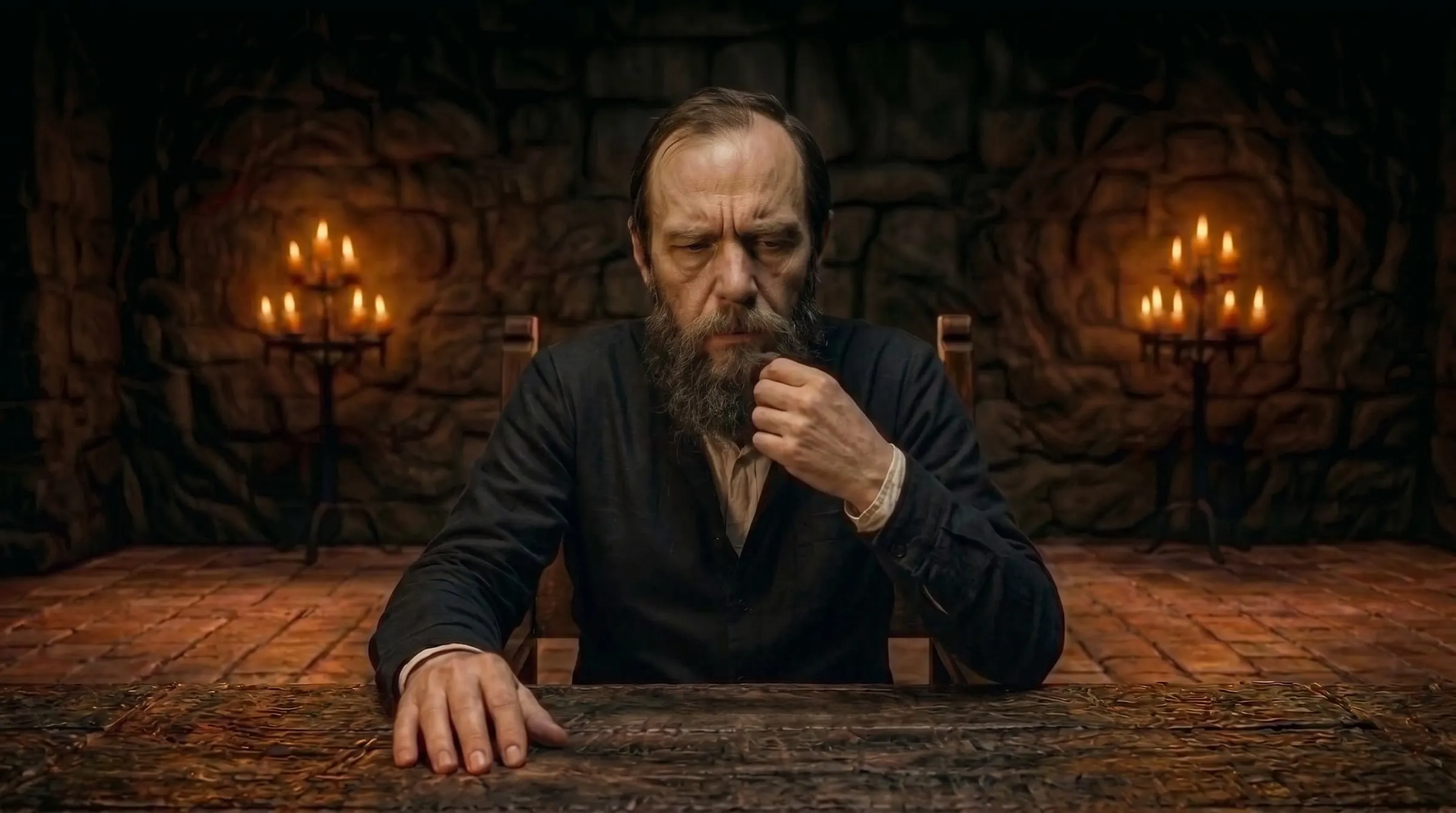
Seat three, between Nietzsche and Marcus Aurelius, and the placement does most of the work.
His function is to be the counsellor who will not accept a solution that requires ignoring a specific person. Every other seat here reasons in general terms - about states, natures, virtues, species, orders. Dostoevsky’s method is to grant the general argument, and then produce the child in the freezing outhouse and ask where she goes in it. It is the one move at this table that cannot be answered by a better system, because it is an objection to systems.
He is also the table’s authority on self-deception. Machiavelli watches what men do; Dostoevsky watches what they tell themselves while doing it, and he is unmatched at the gap between the two. When a counsellor gives a clean account of his own motives, Dostoevsky is the one listening for the second motive underneath the first.
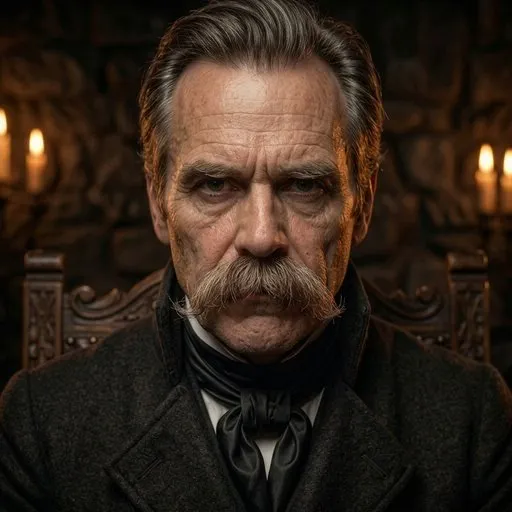
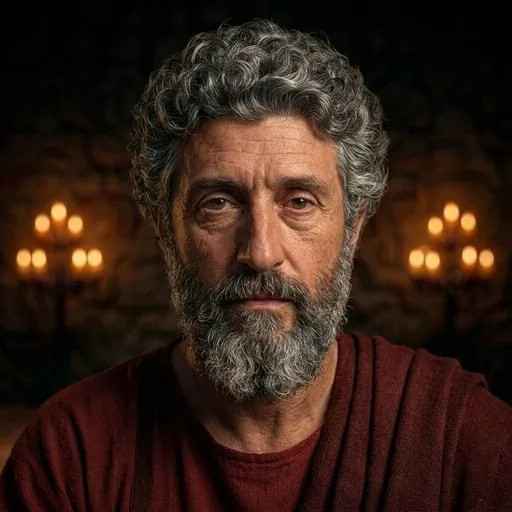
To his left, Nietzsche, who read him hungrily and called him the only psychologist he had anything to learn from. They agree entirely on the diagnosis and completely on nothing else. To his right, Marcus Aurelius, whose serenity depends on a rational order that Ivan has just handed back. Across the empty chair, Jesus - whose silence in the Inquisitor chapter Dostoevsky wrote himself, unable to give him a line that would not diminish him.
And the charge put to Dostoevsky, episode after episode, is that he cheated. He gave the atheist all the best material, made the case unanswerable, and then answered it with a kiss, a monk and a boy’s funeral - which is not an argument, and which he knew was not an argument.
His reply is that nothing that could be put in the form of an argument would have been worth having.
The works
1846
Poor FolkБедные люди
A correspondence between a copying clerk and a young woman across a courtyard. Grigorovich and Nekrasov read it aloud through the night and woke the author at four; Nekrasov carried it to Belinsky the same day with the line about a new Gogol; the acclaim lasted about a year and the reaction to it lasted the rest of his life.
1862
Notes from the House of the DeadЗаписки из Мёртвого дома
The four years at Omsk, put behind a thin fictional narrator so the censor would pass it. Not a book about suffering so much as a report on a population the educated class had legislated for and never met.
1864
Notes from UndergroundЗаписки из подполья
A hundred pages of a nameless civil servant arguing with an imaginary audience. The opening line - "I am a sick man… I am a spiteful man" - begins modern literature’s interior monologue, and the argument against rational self-interest inside it has never been fully answered.
1866
Crime and PunishmentПреступление и наказание
A student murders a pawnbroker to test whether he is one of the extraordinary men permitted to step over. The novel spends five hundred pages on what the theory does to him afterwards.
1866
The GamblerИгрок
Dictated in twenty-six days to beat a contract that would otherwise have handed a publisher nine years of everything he wrote. The stenographer he hired to do it became his wife and the reason the late novels exist.
1869
The IdiotИдиот
What happens when a genuinely good man - epileptic, guileless, incapable of calculation - is put into Petersburg society. The answer is not redemptive, which is the point.
1872
DemonsБесы
Also translated as The Possessed or Devils. Written after the Nechayev affair, in which a revolutionary cell murdered one of its own. The most savage political novel of the century, and uncomfortably prophetic.
1880
The Brothers KaramazovБратья Карамазовы
His last novel, finished less than three months before his death. A parricide, three brothers, and the two chapters - Rebellion and The Grand Inquisitor - that constitute the strongest case against God ever written by a believer.
1873–1881
A Writer’s DiaryДневник писателя
A one-man periodical of reportage, polemic and fiction. Indispensable, and the place where his nationalism and antisemitism are least defensible and most visible.
Where the answers part
The same question, read differently by the seats nearby.
Friedrich Nietzsche
What follows when God goes
They diagnose the same illness and prescribe opposite cures. Both see that European belief has collapsed and that the morality resting on it cannot stand alone. Dostoevsky writes Raskolnikov and Ivan to show where the collapse leads and offers Christ as the only exit; Nietzsche regards Christ as the origin of the sickness. Nietzsche read him with delight and called him a great teacher, which makes the disagreement sharper rather than softer.
Marcus Aurelius
Whether the order is really there
Stoic consolation requires the universe to be rationally ordered, so that a private catastrophe is a part of a whole that makes sense. Ivan Karamazov collects newspaper accounts of tortured children and returns his ticket: he does not deny that the harmony may come, he refuses to accept a harmony bought at that price. It is the one argument at this table that cannot be met by adjusting one’s judgement.
Plato
Whether the wise may lie to the many for their good
The Republic hands its guardians a noble lie and a censored poetry on the ground that most people cannot carry the truth and will live better without it. The Grand Inquisitor makes the identical case, in identical terms, out of identical pity, and Dostoevsky wrote it as the strongest speech the devil has. Neither man thinks the many are wicked. The question between them is whether protecting people from a burden they did not choose is government or contempt.
Contents
What is the Grand Inquisitor about?
Ivan Karamazov’s invented poem, told to his monk brother. Christ returns to Seville during the Inquisition and is arrested by the Cardinal, who explains that the Church has spent fifteen centuries correcting his one mistake: he gave humanity freedom, and humanity cannot bear it. People want miracle, mystery and authority, and will hand over their freedom for bread. Christ says nothing throughout, and at the end kisses him. It is the most powerful attack on Christianity in literature and it was written by a Christian.
Did Dostoevsky write "if God does not exist, everything is permitted"?
Not in those words, and never in his own voice. The idea is attributed to Ivan by other characters in The Brothers Karamazov and functions as a report of his position rather than a quotation. The exact famous phrasing owes more to Sartre, who quoted it as if it were verbatim, than to the novel.
What actually happened at his mock execution?
On 22 December 1849 he and other members of the Petrashevsky Circle were taken to Semyonovsky Square, given last rites, and tied to posts in groups of three. The first three were bound and the firing squad took aim. Dostoevsky was in the second group, some minutes from death, when a rider arrived with a commutation - which had been decided in advance and staged deliberately by Nicholas I. One of the prisoners went permanently insane.
Was Dostoevsky an epileptic, and does it matter?
Yes, from at least his late twenties, with major seizures throughout his life. It matters because he wrote it into the work with clinical precision - Prince Myshkin and Smerdyakov are both epileptic - and because he described the aura before a seizure as a few seconds of absolute harmony for which he said he would give his whole life. The relation between that experience and his religious writing is unresolved and probably unresolvable.
Why is he considered a psychologist?
Because he wrote characters who lie to themselves in real time and whose stated motives are visibly not their real ones - decades before there was a vocabulary for it. Freud called The Brothers Karamazov the most magnificent novel ever written; Nietzsche called him the only psychologist from whom he had anything to learn. Dostoevsky himself rejected the label, saying he was a realist in a higher sense: he depicted the depths of the human soul.
What is Ivan Karamazov’s returned ticket?
In Rebellion, book five of The Brothers Karamazov, Ivan tells Alyosha he accepts God but refuses the world God made. He recites cases of tortured children taken from newspapers and court reports, then argues that no final harmony can be worth them, because the price has already been paid by someone who was never asked. He does not deny the harmony. He declines to attend, and says he respectfully returns the entrance ticket.
What does Notes from Underground argue against?
Nikolai Chernyshevsky’s What Is to Be Done, published in 1863, and the rational egoism behind it: the claim that once people understand their real interests they will act on them, and a society built on that understanding will make them happy. The Underground Man answers that a person will wreck the arrangement out of sheer ingratitude, in order to prove that he is a man and not a piano key.
Was Dostoevsky antisemitic?
Yes, in his own voice and in print. The March 1877 chapter of A Writer’s Diary argues that Jews form a state within a state, hostile to the peoples they live among, and that Russian peasants were being handed over to their exploitation. The same chapter calls for full civil equality for Jews in Russia. Both are on the same pages, and the second does not cancel the first.
What did Nietzsche say about Dostoevsky?
He found a French volume of Dostoevsky in a Nice bookshop in the winter of 1886 to 1887, and wrote to Peter Gast in March 1887 that instinct told him at once he had met a kinsman. In Twilight of the Idols he called Dostoevsky the only psychologist from whom he had anything to learn, and one of the happiest windfalls of his life. There is no evidence he ever read The Brothers Karamazov.
Which Dostoevsky book should be read first?
Notes from Underground, which is short, is where the later arguments begin, and makes clear within twenty pages whether a reader wants the rest. Then Crime and Punishment, which is the most propulsive of the novels. The Brothers Karamazov is last, not first: it answers arguments the earlier books set up, and reading it cold means meeting the reply without having heard the case.
How did Dostoevsky die?
Of a pulmonary haemorrhage, on 28 January 1881 by the Russian calendar and 9 February by the Western one, in his flat on Kuznechny Lane in St Petersburg. He was fifty-nine, and had been diagnosed with emphysema. The funeral procession to the Alexander Nevsky Monastery drew a crowd whose size is disputed and was in every estimate enormous. He is buried in the Tikhvin Cemetery.
Was Dostoevsky’s father murdered by his serfs?
Probably not. The story circulated in the family and was believed by most biographers for a century, and Freud built an essay on it. Joseph Frank re-examined the evidence in the first volume of his biography and concluded that the local record of an apoplectic stroke is the likelier account and the murder story unsupported. What is certain is that Dostoevsky knew the rumour and wrote a novel about a murdered father.
Sources and further reading
- The Brothers Karamazov1880Quoted here from the Constance Garnett translation (1912), which is in the public domain. Also Richard Pevear and Larissa Volokhonsky (1990), David McDuff (Penguin) and Ignat Avsey (Oxford).
- Crime and Punishment1866Quoted from the Constance Garnett translation (1914). Cited by part and chapter, since editions differ.
- Notes from the Underground1864Quoted from the Constance Garnett translation. Chapter ten of part one survives only in the form the censor of 1864 left it.
- The Possessed (Demons)1872Quoted from the Constance Garnett translation.
- The Idiot1869Quoted from the Eva Martin translation (1915), which is in the public domain.
- Stavrogin’s Confession, and The Plan of the Life of a Great Sinner1922The chapter At Tikhon’s, cut from Demons by its editor and printed only after the revolution. Translated for the Hogarth Press by S. S. Koteliansky and Virginia Woolf.
- Letters of Fyodor Michailovitch Dostoevsky to His Family and Friends1914Trans. Ethel Colburn Mayne. The source for the letter of 22 December 1849 and the letter to Natalya Fonvizina quoted here.
- A Writer’s Diary1873–1881The complete English text is Kenneth Lantz’s two-volume translation (Northwestern University Press, 1993–94), with an introductory study by Gary Saul Morson.
- Dostoevsky (5 vols., 1976–2002)The definitive biography in any language: the life read through the intellectual history of nineteenth-century Russia. The one-volume abridgement, A Writer in His Time (2009), is the best starting point.
- Problems of Dostoevsky’s Poetics1929, rev. 1963The source of the "polyphonic novel" - the argument that Dostoevsky’s characters are genuinely independent voices rather than mouthpieces, which is why the case against God in his books is stronger than the case for it.
- Dostoevsky1923
- Dostoevsky the Thinker2002Takes the philosophical positions seriously as philosophy rather than as literary effects.
- Reminiscences1925By his second wife and stenographer, who married him at twenty and rescued him from his debts and his gambling.
- Existentialism and Humanism1946The lecture given at the Club Maintenant in Paris on 29 October 1945. The English quoted here is Philip Mairet’s translation. This is where the compressed version of Ivan Karamazov’s position entered general circulation as though it were a quotation.
- The Twilight of the Idols; The Antichrist1889, 1895Trans. Anthony M. Ludovici. Dostoevsky appears in Skirmishes in a War with the Age, section 45, and again in The Antichrist, section 31.
- Nietzsche's 'Discovery' of Dostoevsky1973Establishes exactly which books Nietzsche had, in which French translations, and when.
- Dostoevsky and Parricide1928Written as an introduction to a scholarly collection on The Brothers Karamazov. Rests on two claims now regarded as unsound: that the father was murdered, and that the seizures began at his death.
- Dostoyevsky and the Jews1981The standard treatment, with a foreword by Joseph Frank. Documents the antisemitic writing across the journalism, the letters and the notebooks.
- Redemption and the Merchant God: Dostoevsky’s Economy of Salvation and Antisemitism2008
- What Is to Be Done?1863Written in the Peter and Paul Fortress and read by an entire generation. The target of Notes from Underground.
- Dostoiewski’s epilepsy1963The first neurological account in a medical journal, and the origin of the temporal-lobe reading of the ecstatic aura.
- Fyodor Mikhailovitch Dostoevsky’s involuntary contribution to the symptomatology and prognosis of epilepsy1978Disputes Alajouanine and proposes generalised epilepsy. Later work has largely returned to Alajouanine.
- The Dostoevsky Encyclopedia2004
Last reviewed: