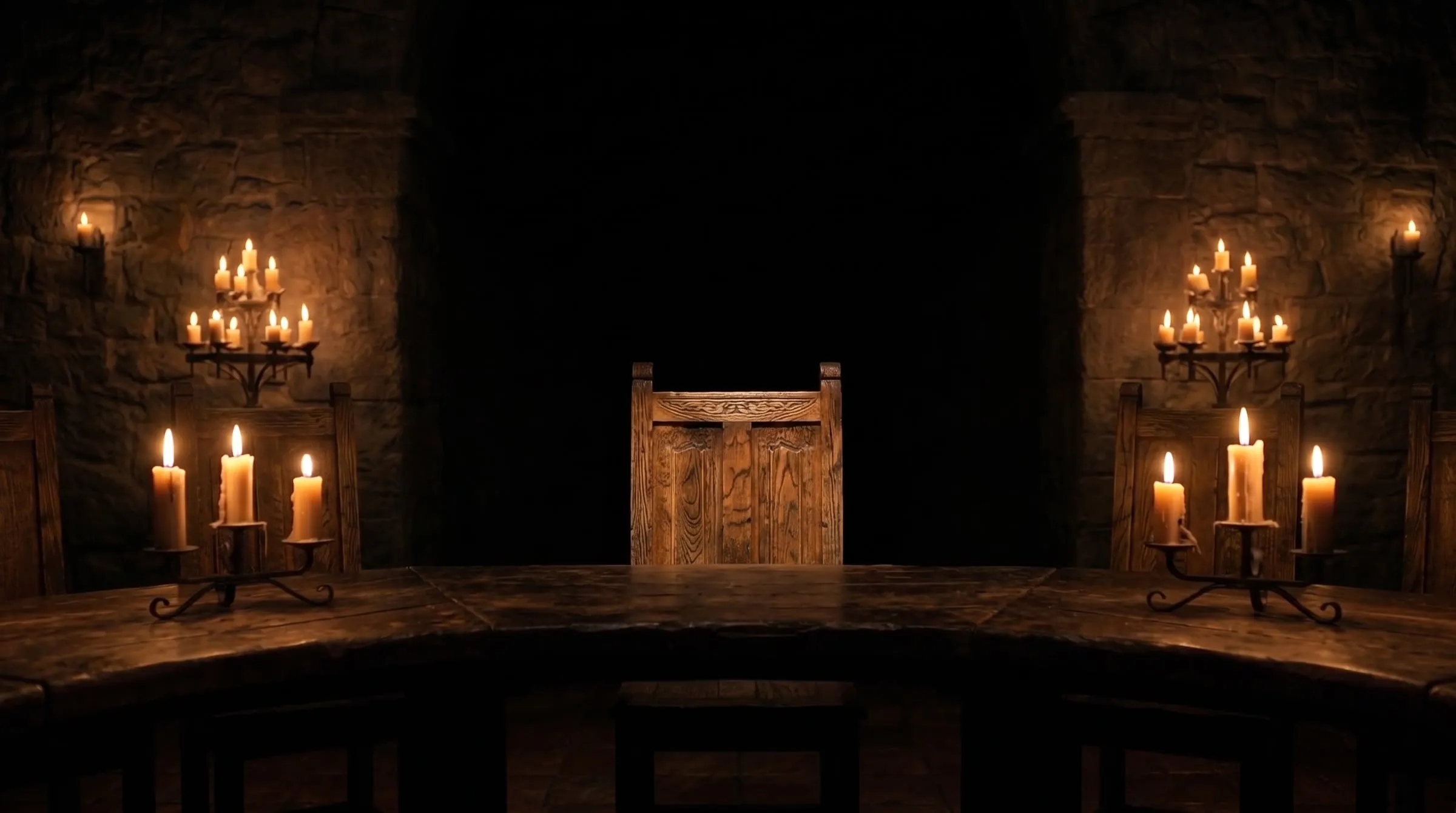
Ten of the eleven seats are permanent. Diogenes will be at this table in the last episode as he was in the first, and so will the other nine.
The eleventh is not like them. Seat five, at the head between the two wings, belongs to nobody. It is drawn to the same dimensions as the others, lit the same way, and it stands set and waiting.
It is a guest chair.
What it is for
Ten minds are a great deal and they are not everything. A question about grief reaches places this table can go; a question about, say, the mathematics of chance, or the law, or what a specific tradition holds about a specific duty, may reach past all ten at once.
When that happens the seat is used. An extraordinary counsellor is called - a figure chosen for that question, seated at the head for that episode, and gone by the next one. The chair does not become theirs. Nobody joins the council.
How a guest is chosen
By the question, and only by the question.
A theme is examined first for what the standing ten can actually reach. Most themes are covered: between an ascetic, a strategist, a destroyer of values, a novelist of guilt, an emperor, an engineer, a teacher, a renunciant, a metaphysician and a naturalist, very little about being alive falls outside the table entirely.
Where something does fall outside, the seat is offered to whoever closes it - someone with a life spent on precisely the thing the ten only pass near.
And where nothing falls outside, the chair stays empty. A guest invited to say what Marcus Aurelius is about to say anyway is not a guest; they are a repetition wearing a different face, and the episode is worse for the crowding.
Why it stays at the head
An eleventh chair could have been added at the end of a wing, which is where an extra place usually goes.
It is at the head instead, between the two wings, for a practical reason: whoever sits there is addressing the whole table at once rather than leaning into a neighbour. A guest arrives with the thing the room was missing, and the room should be facing them when they say it.
It also means the chair is visible in almost every shot when it is empty - which is most of the time, and is the point. The ten are not the whole of what can be thought about a question, and the furniture says so without anyone having to.
Why it is not a mystery
The chair is not a puzzle with a reveal, and there is no name being withheld.
An absence that turns out to have been an announcement is a device, and a device spends its value the moment it is used. This one is simply a working arrangement: a seat, kept free, so that a question that runs past ten minds has somewhere to go.
Why it is at this table
It is the only seat with no opinion, because it has no permanent occupant to hold one.
Its function is structural rather than argumentative. When an episode opens, the ten begin from lives they have already lived and positions they have already taken. Seat five begins from the question - it exists to be filled by whatever that particular question turns out to need, and by nothing else.
Which makes it the one place at the table where the question is in charge.
Contents
Who sits in seat five?
Nobody permanently. It is filled for a single episode at a time by an extraordinary counsellor - a figure brought in because a particular question calls for a mind the standing ten do not have between them. When that episode ends, the chair goes back to standing empty.
How is a guest chosen?
By the question, not by the calendar. A theme is examined for what the ten can and cannot reach, and where there is a genuine gap, the seat is offered to whoever fills it. A guest who would only restate what a permanent seat already says is not a guest; the chair stays empty instead.
Why keep the chair visible when it is usually empty?
Because it is the table saying, in the furniture, that the ten are not the whole of what can be thought about a question. An empty chair that occasionally fills is a standing admission that the roster has limits - and a promise about what happens when a question runs past them.
Why is the chair at the head of the table?
So it is in the eyeline of every seat and every shot. A guest placed out at the end would be an addendum; at the head, whoever takes it is addressing the whole table at once.
Last reviewed: